
 Worksheets
Unit 10 Thermochemistry Final Exam Review
Total questions: 58
Worksheet time: 5hrs 50mins

The potential energy diagram of a reaction is shown. Which statement below is correct relating to this reaction?
#1 represents the enthalpy change for this exothermic reaction.
#2 represents the enthalpy change for this endothermic reaction.
#3 represents the enthalpy change for this endothermic reaction.
#4 represents the enthalpy change for this exothermic reaction.
During an exothermic reaction, heat content in the surroundings increases because
heat energy is destroyed during reactions
the reaction absorbs heat energy
the energy contained in the reactants is lower then the products
the energy contained in the products is lower than the reactants

The diagram represents two solids and the temperature of each. What occurs when the two solids are placed in contact with each other?
Heat energy flows from solid A to solid B. Solid A decreases in temperature
Heat energy flows from solid A to solid B. Solid A increases in temperature
Heat energy flows from solid B to solid A. Solid B decreases in temperature.
Heat energy flows from solid B to solid A. Solid B increases in temperature.
The amount of heat energy required to change the temperature of 12 g of gold from 45°C to 15°C is -47 J. What is the specific heat capacity of gold?
0.13 J/(g°C)
17,000 J/(g°C)
1600 J/(g°C)
0.065 J/(g°C)

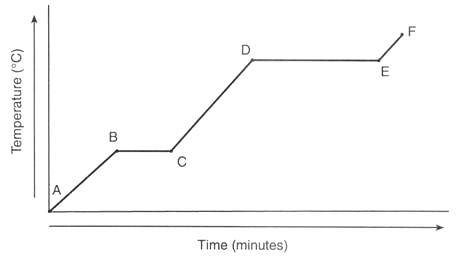
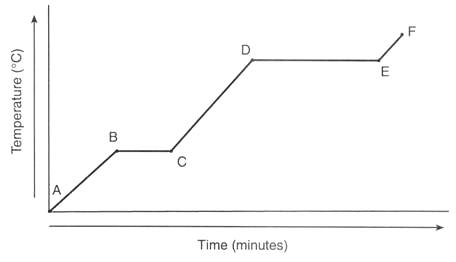
The graph represents the uniform heating of a substance, starting with the substance as a solid below its melting point. Which line segment listed below represents an increase in potential energy and no change in average kinetic energy?
Line segment AB
Line segment BC
Line segment CD
Line segment EF
The equation for cellular respiration is shown:
C6H12O6 + 6O2 --> 6CO2 + 6H2O + heat
What can be concluded about the heat energy in the reaction?
The reaction absorbs heat and is, therefore, endothermic.
The reaction absorbs heat and is, therefore, exothermic.
The reaction releases heat and is, therefore, exothermic.
The reaction releases heat and is, therefore, endothermic.
The specific heat of platinum is 0.133 J/g°C. How much heat(Q) is absorbed when a 10 g piece of platinum warms from 100°C to 150°C?
66.5 J
0.0266 J
665 J
0.665 J
Calculate ΔH for the process
Zn (s) + S (s) + 2O2 (g) → ZnSO4 (s)
from the following information:
Zn (s) + S (s) → ZnS (s) ΔH = – 206.0 kJ
ZnS (s) + 2 O2 (g) → ZnSO4 (s) ΔH= – 776.8 kJ
570.8 kJ
-570.8 kJ
-982.8 kJ
982.8 kJ
Students are trying to calculate the heat of reaction for the following overall reaction.
4A + 5B → C + 3D
They find the heat of reactions for the two reactions as shown.
2A + 2B → C + 2D ΔH= -100 kJ
2A +3B → D ΔH= 65 kJ
-35 kJ
-165 kJ
35 kJ
165 kJ
If two objects have different temperatures when they come in contact, heat will flow from the warmer object to the cooler one UNTIL ____________
one reaches a temperature of zero
one runs out of energy
they both have equal temperature
Select all which are endothermic...
H2O(L)-->H2O(g)
H2O(s)-->H2O(L)
H2O(g)-->H2O(L)
H2O(L)-->H2O(s)

Use the graphs to help answer:
In an exothermic reaction, which has more potential energy?
neither
products
reactants
both are equal

Which graph represents a reaction that is endothermic and why?
Graph 2, because the reactants have lower potential energy than the products
Graph 1, because the products have lower potential energy than the reactants
Graph 1, because the reactants have lower potential energy than the products
Graph 2, because the products have lower potential energy than the reactants
If the specific heat of water is 4.18 J/g∙°C, how much heat is required to increase the temperature of 1200 g of water from 23 °C to 39 °C?
-80,256 J
80.256 J
-80.256 J
80,256 J

Diagram shows reaction between sodium and water. The reaction is
(a)

Is this reaction endothermic or exothermic?

What is the specific heat of water?
4.184 J/gC
2.00 cal/g
All of the above
4.184 cal/g
1 food calorie = _______ chemistry calories
1000
1
500
4.184
What is the formula for calculating heat?
q = mcΔT
H = ΔH x moles
H = ΔH x grams
products - reactants

A 24.0 gram sample of copper was heated from 25.0oC to 500.0oC, 4378 J of heat were absorbed, what is the specific heat of copper?
0.384 J/g°C
49909200 J/g°C
2.60 J/g°C
8.77 J/g°C
A sample of iron receives 50 J of heat energy that raises the temperature of the iron 25.0°C. If iron has a specific heat of 0.10 J/g°C, what is the mass of the iron sample?
25g
30g
20g
50g

Ca(OH)2 -> CaO + H2O
ΔHf in kJ/mol:
Ca(OH)2 -983.2
CaO -634.9
H2O -285.5
When Julio dissolved Sodium Hydroxide in water, he noticed that the temperature of the water increased drastically. He could conclude that this dissolving process, shown below, was… NaOH(s) --> Na+ (aq) + OH-(aq)
Exothermic
Endothermic
Neither endothermic or exothermic
Both endothermic and exothermic
What happens when kinetic energy increases?
Temperature increases.
Temperature decreases.
Temperature is not affected by kinetic energy.
A liquid has _________ temperature than a solid.
Higher
Lower
A gas has ________ kinetic energy than a liquid.
more
less
A sample of a compound has a mass of 30 g and a specific heat of 0.258 J/g*K. If its temperature drops 40 K, how much heat was released? ( q=mcΔT )
309.6 J
-309.6 J
465 J
-465 J
When water evaporates, the process is...
endothermic
exothermic
When wood is burned in a campfire, the process is...
endothermic
exothermic
For an exothermic reaction, ΔH is...
negative
positive
For an endothermic reaction, ΔH is...
negative
positive
In an exothermic reaction, heat is a...
product
reactant
In an endothermic reaction, heat is a...
product
reactant

The graph is showing an ____________ reaction.
exothermic
endothermic

The graph is showing an _________ reaction
endothermic
exothermic
In our coffee cup calorimetry experiment, we dropped a piece of hot metal into cool water. The heat lost by the metal was ___________ the heat gained by the water.
equal to
greater than
less than
Thermal energy always moves:
From a high temperature object to a lower temperature object.
From a lower temperature object to a higher temperature object.
From an object with lower kinetic energy to an object with higher kinetic energy.
From an object of higher mass to an object of lower mass.

Given the heating curve of a solid being heated at a constant rate, what is the boiling point of this substance?
20°C
50°C
110°C
170°C

The melting point of the sample is
-60 ºC
-100 ºC
60 ºC
100 ºC

NaCl(s) was heated up starting at an initial temperature of 0°C. The heating curve is shown in the picture. What is the melting point of this substance?
0°C
801°C
1000°C
1465°C

Given the heating curve of water, what is happening to potential and kinetic energy during segment CD?
the potential energy and kinetic energy both increase
the potential energy increases while the kinetic energy decreases
the potential energy is constant while the kinetic energy increases
the potential energy increases while the kinetic energy is constant

This curve indicates what about the heat energy?
Heat energy is being added or absorbed
Heat energy is being released

In which region(s) of the graph would the substance be melting?
No melting occurs on this graph
Region C-E
Region E-G
Region G-I
Region I-K
What is the freezing point of the substance?
0oC
60oC
120oC
180oC
From point A to point F, the sample is going through an __________ process by __________.
exothermic, releasing heat to the surroundings
exothermic, absorbing heat from the surroundings
endothermic, releasing heat to the surroundings
endothermic, absorbing heat from the surroundings

