Wayground logo

Free Printable Worksheets

Font size

S
M
L
XL
Worksheets

2nd Sem. Science Exam Review

Total questions: 48

Worksheet time: 43mins

Name
Class
Date
1.

When looking at two birds of the same species, you notice that one has darker feathers than the other one. You also notice that one has a beak that is just a little longer. These slight differences within members of the same species are called.....

a)

Fossils

b)

Extinction

c)

Meiosis

d)

Variations

2.
The diagram shows fossils in different rock layers. Which of these statements about the age of these fossils is most likely correct?
a)
Fossil A and C are the same age
b)
Fossil B is older than fossil C
c)
Fossils A is older than fossil B
d)
Fossil D is older than fossil C
3.
Why are advantageous traits more likely to be passed onto offspring?
a)
Because they are more likely to survive and reproduce.
b)
Because they come from dominant alleles.
c)
Because they come from recessive alleles.
d)
Because the trait is an acquired phenotype.
4.
Farmers breed cows to produce high amounts of milk. This is an example of...
a)
Natural Selection 
b)
Variations in a species 
c)
Selective Breeding 
d)
inbreeding
5.
Which of the following is a factor in natural selection?
a)
Individuals of species compete with one another to survive.
b)
All species are genetically diverse.
c)
Individuals better able to adapt to changes leave more offspring.
d)
All are correct 
6.
Starting in 1954, commercial fishers in the northwest Pacific were paid by weight, rather than by the individual fish, for pink salmon. The fishers increased the use of a type of net that selectively catches larger fish.  Which of the following effects did this change in fishing technique most likely have on the salmon population over the next 20 years?
a)
The average body size of the salmon population decreased significantly.
b)
The average body size of the salmon population increased significantly.
c)
The average body size of the males in the salmon population increased, and the females stayed the same.
7.
European rabbits were introduced to Australia in 1859. The rabbits reproduced rapidly in their new habitat, displaced other animals, and overgrazed vegetation. In an attempt to reduce the rabbit population, a virus was introduced in 1951. This virus is usually deadly to European rabbits. When the virus was first introduced, the rabbits died in large numbers, but the death rate decreased over time. Which of the following best explains the decrease in the rabbit death rate? 
a)
Young rabbits learned to avoid being infected with the virus.
b)
The lifespan of the virus was too short to affect rabbits over a long period of time.
c)
Natural selection favored rabbits that were resistant to the virus. 
d)
No correct choices.
8.
Which of the following is NOT an example of natural selection? 
a)
People selectively breeding hamsters.
b)
Insect populations developing resistance to certain pesticides.
c)
Bacteria becoming resistant to antibiotics.
d)
Male birds of certain species developing colorful feathers to attract female mates.
9.
The environment around Manchester, England, changed during the Industrial Revolution.  How did this change affect peppered moths living in the area?
a)
Natural selection favored moths with dark wings because predators could not see them on the soot-colored trees.
b)
Natural selection favored moths with white wings that were easy for predators to see.
c)
Natural selection favored moths with white wings because predators could not see them on the soot-colored trees.
d)
Natural selection caused moths with white wings to become extinct.
10.

Adaptations are:

a)

physical or behavioral tendencies.

b)

physical or behavioral characteristics that help an organisms survive and reproduce.

c)

physical or behavioral characteristics that do not help the organism in any way.

d)

genetic mutations that have gone wrong.
11.
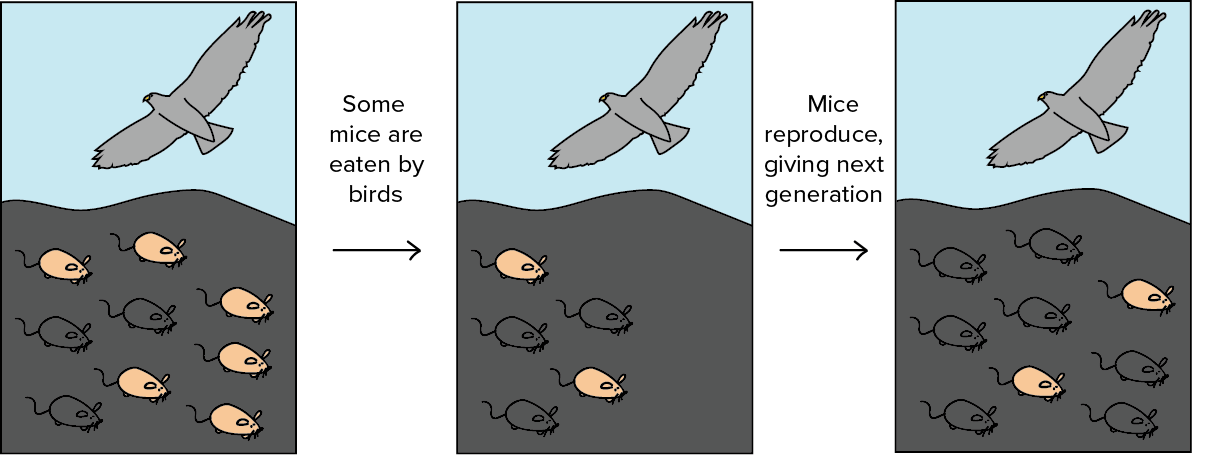
Why is the mouse population changing over time?
a)
The light mice can reproduce more successfully than the dark mice
b)
The hawks eat more dark mice than light mice because the dark mice taste better
c)
The hawks eat more light mice than dark mice because they can see the light mice more easily
d)
The hawks eat more dark mice than light mice because they can see the dark mice more easily
12.
Which layer is the oldest?
a)
1
b)
2
c)
3
d)
4
13.
The cause of artificial selection is…
a)
The environment
b)
Humans
c)
Mutation
d)
Gene Flow
14.
The scientific name for water bear is Hypsibius dujardini.  What is its genus?
a)
Hypsibius 
b)
dujardini
c)
water 
d)
tardigrade
15.
Panthera leo, the scientific name for a lion, is a member of which species?
a)
leo
b)
Animalia
c)
Panthera
d)
mammalia
16.
Which characteristics best describes the Plant Kingdom?
a)
unicellular; eukaryote; autotroph
b)
multicellular, prokaryote, autotroph
c)
multicellular, eukaryote, autotroph
d)
unicellular, prokaryote, heterotroph
17.
Which characteristics best describes the Animal Kingdom?
a)
unicellular, eukaryote, autotroph
b)
multicellular, prokaryote, heterotroph
c)
multicellular, eukaryote, autotroph
d)
multicellular, eukaryote, heterotroph
18.

Which statement is NOT true about both archaebacteria and eubacteria?

a)

they are unicellular

b)

they are prokaryotes

c)

they live in harsh environments

d)

they reproduce asexually

19.

Why are fungi not considered plants?

a)

their cell wall is made of chitin instead of cellulose

b)

they are heterotrophs

c)

they reproduce asexually whereas most plants reproduce sexually

d)

all of the above

20.
The 8 levels of classification, most broad to most specific.
a)
Domain, Genus, Family, Order, Class, Phylum, Kingdom, Species
b)
Domain, Species, Kingdom, Genus, Phylum, Family, Class, Order
c)
Domain, Kingdom, Phylum, Class, Order, Family, Genus, Species
d)
Domain, Kingdom, Species, Phylum, Family, Order, Class, Genus
21.
What do plants and fungi have in common?
a)
They are both autotrophic
b)
They are both unicellular
c)
They both have cell walls
d)
They both are prokaryotes 
22.
An illustration and a dichotomous key are given. What is the correct classification for this organism?
a)
Class Insecta
b)
Order Amblygygi
c)
Order Araneae
d)
Order Scorpiones
23.
What is the name of bird Z?
a)
Certhidea
b)
Geospiza
c)
Camarhynchus
d)
Platyspiza
24.
Kingdom with the following characteristics: eukaryotic cells, unicellular or multicellular, autotrophic or heterotrophic 
a)
Fungi
b)

Bacteria

c)

Protista

d)
Plant
25.

Plant-like protists, such as algae, are not considered plants because...

a)

they're heterotrophs.

b)

they're prokaryotic.

c)

they're unicellular.

26.
The rabbit in this food web would be considered a:
a)
Decomposer
b)
Producer
c)
Secondary Consumer
d)
Primary Consumer
27.

The amount of energy that usually transfers from one trophic level to the next...

a)

10%

b)

90%

c)

80%

d)

50%

28.
Two or more members of a particular species living and interacting in the same area
a)
Community
b)
Population
c)
Organisms
d)
Biosphere
29.
Different populations living and interacting with each other in the same area
a)
Biome
b)
Ecosystem
c)
Community
d)
Niche
30.
If the population of a certain predator increases, there is often _______ its prey
a)
a decrease the population of
b)
an increase of the population of 
c)
great news for its prey of
d)
no  impact found on
31.

What would happen to the bird if the green fish died out?

a)

the bird population would grow

b)

the bird population would die out

c)

the smaller fish will die out

32.

What is the bottom layer of the an energy pyramid?

a)

producer

b)

tertiary consumer

c)

Secondary consumer

d)

primary consumer

33.
Which organism recieves the least amount of energy from the producer?
a)
Owl
b)
Grasshopper
c)
Lilypad
d)
Mouse
34.
What would most likely happen if the rabbit population was removed from the food chain grass —› rabbit —› fox?
a)
their would be more grass
b)
there would be less rabbits
c)
there would be more fox
35.
An oxpecker bird eats ticks off of a zebra.  The bird gets food from eating the ticks and the zebra has harmful parasites removed.  Which type of symbiosis is this?
a)
mutualism
b)
parasitism
c)
commensalism
36.

Remoras attach themselves to a shark's body. They then travel with the shak and feed on the left over scraps from the shark's meals.

a)

Commensalism

b)

Predation

c)

Mutalism

d)

Competition

37.

The flea feeds on a mouse's blood to the mouse's detriment (or harm).

a)

Predation

b)

Commensalism

c)

Parasitism

d)

Mutualism

38.

Two male elephants are fighting over a cute little elephant at the watering hole.

a)

Commensalism

b)

Predation

c)

Competition

d)

Mutualism

39.

The main difference between the Taiga and Tundra is (choose all that apply):

a)

One is dry, one is humid

b)

One is hot, one is cold

c)

One has trees, one doesn't

d)

All of these

40.

What abiotic factor does the tundra and desert have in common?

a)

Temperature

b)

Low rainfall

c)

Soil content

d)

Air quality

41.

looking at the graph which biome does D represent?

a)

tropical rain forest

b)

desert

c)

tundra

d)

deciduous forest

42.

looking at the graph which biome does C represent?

a)

tropical rain forest

b)

desert

c)

tundra

d)

deciduous forest

43.

looking at the graph which biome does B represent?

a)

tropical rain forest

b)

desert

c)

tundra

d)

deciduous forest

44.

Where a river or streams runs into an ocean...

a)

Salt water marsh

b)

Intertidal Area

c)

Coral reef

d)

Pond/lake

e)

Estuary

45.

In an estuary the amount of _________ is always changing.

a)

oxygen

b)

sunlight

c)

salt

d)

water depth

46.
Has clumps of trees and seasonal rains
a)
temperate deciduous forest
b)
coniferous forest
c)
savanna
d)
temperate grassland
47.
Has many trees that do not change much seasonally
a)
desert
b)
coniferous forest
c)
temperate deciduous forest
d)
savanna
48.
Has organisms with special adaptations to a hot, dry climate
a)
desert
b)
savanna
c)
tundra
d)
taiga