Worksheets
Year End Review 2
Total questions: 98
Worksheet time: 57mins

What do all waves transfer? (a)

What is the number of complete waves passing a fixed point in a given amount of time? (a)

What is the frequency of this wave? You must count the number of complete waves. (a)

What is frequency measured in? (a)

Which type of waves have the longest wavelength? (a)

What is the distance between the calm sea and the highest wave called? (a)

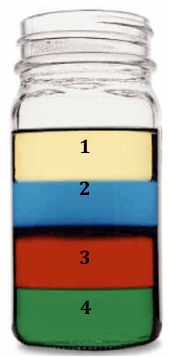
What does #1 represent? (a)

What does #2 represent? (a)

The graph shows the observed water levels, in feet (ft), for a tide gauge located at Montauk, New
York, on the easternmost end of Long Island, from January 24, 2008 to noon on January 25, 2008.
What causes the water-level variation pattern shown by the graph?
Earth's rotation and the gravitational pull of the Moon
changes in wind velocity produced by coastal storms
changes in magnetic orientation of the North American Plate
Earth's revolution and the distance from the equator
A large collection of stars, dust, and gas held together by gravity is a.........
solar systerm
galaxy
constellation
astronomy
What happens in the core of a star?
hydrogen and helium atoms are created
nuclear fusion
hydrogen atoms cool helium atoms down
other stars born
What can we use to measure the distance of objects in our solar system?
Astronomical unit
Cosmic mile
Astrological kilometre
Light- year

The formula for Speed is...
Speed = distance/ time
Speed = time/ distance

If Harry drives 4 miles in 2 minutes, what was his speed?
0.5 miles/min
2 miles/min
2 min/m
0.5 min/m
What is Energy?
The ability to do anything
The ability to cause change
The investigation of nature
A fact of life
What is an example of kinetic energy?
A bird sitting in a tree
A bouncy ball on the table
A car driving on the highway
A book on shelf
What is an example of potential energy?
A bowling ball rolling down a lane
A car parked in a lot
An apple falling from a tree
Sunlight heating up the atmosphere
How could you find the kinetic energy of an object?
Multiply the mass and speed of the object
Subtract the mass and speed of the object
Estimate the speed of the object
You cannot find the speed of moving objects
Which has more potential energy?
A 1,500 kg car traveling 20m/s
A 200 kg bus traveling 100m/s
A 300,000 kg plane traveling 0m/s
A 20 kg ball rolling 40 m/s
Energy cannot be created or destroyed.
True
False
Energy can't be .....
transformed.
made or destroyed.
converted.
harnessed or produced.
The sun provides ____________ and ____________ energy that can be harnessed and used for solar power.
chemical, sound
mechanical, light
sound, light
light, thermal
What does the number 3 represent in 4NH3?
Subscript
Superscript
Coefficient
What does the number 4 represent in 4NH3?
Subscript
Superscript
Coefficient

How many Nitrogen (N) atoms are in 4NH3?
4
1
3
12

How many Hydrogen (H) atoms are in 4NH3?
4
1
3
12

How many total atoms make up 4NH3?
4
16
3
12
How many total molecules is 4NH3?
4
1
3
12

In the equation shown, what are the reactant(s)?
N2 + H2
NH3
In the equation shown, what are the product(s)?
N2 + H2
NH3

Is this equation balanced?
Yes
No

Is this equation balanced?
Yes
No

To balance an equation you should:
ONLY change subscripts.
ONLY change coefficients.
Change BOTH subscripts and coefficients.
What is the left part of a chemical equation called?
2H2 + O2 ---> 2H2O
Reactants
Yields
Products
Chemical equation
What is the right part of a chemical equation called?
2H2 + O2 ---> 2H2O
Reactants
Yields
Products
Chemical Equation
Is the following equation balanced?
Al + O2 ---> 2Al2O3
YES
NO
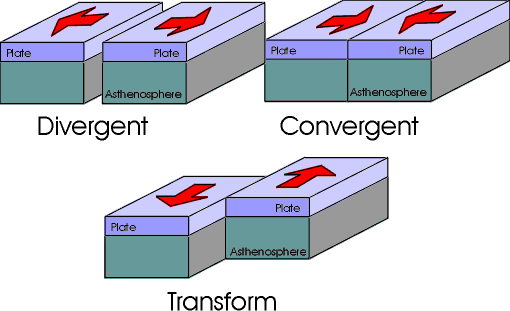


The same side of the moon always faces Earth.
True
False


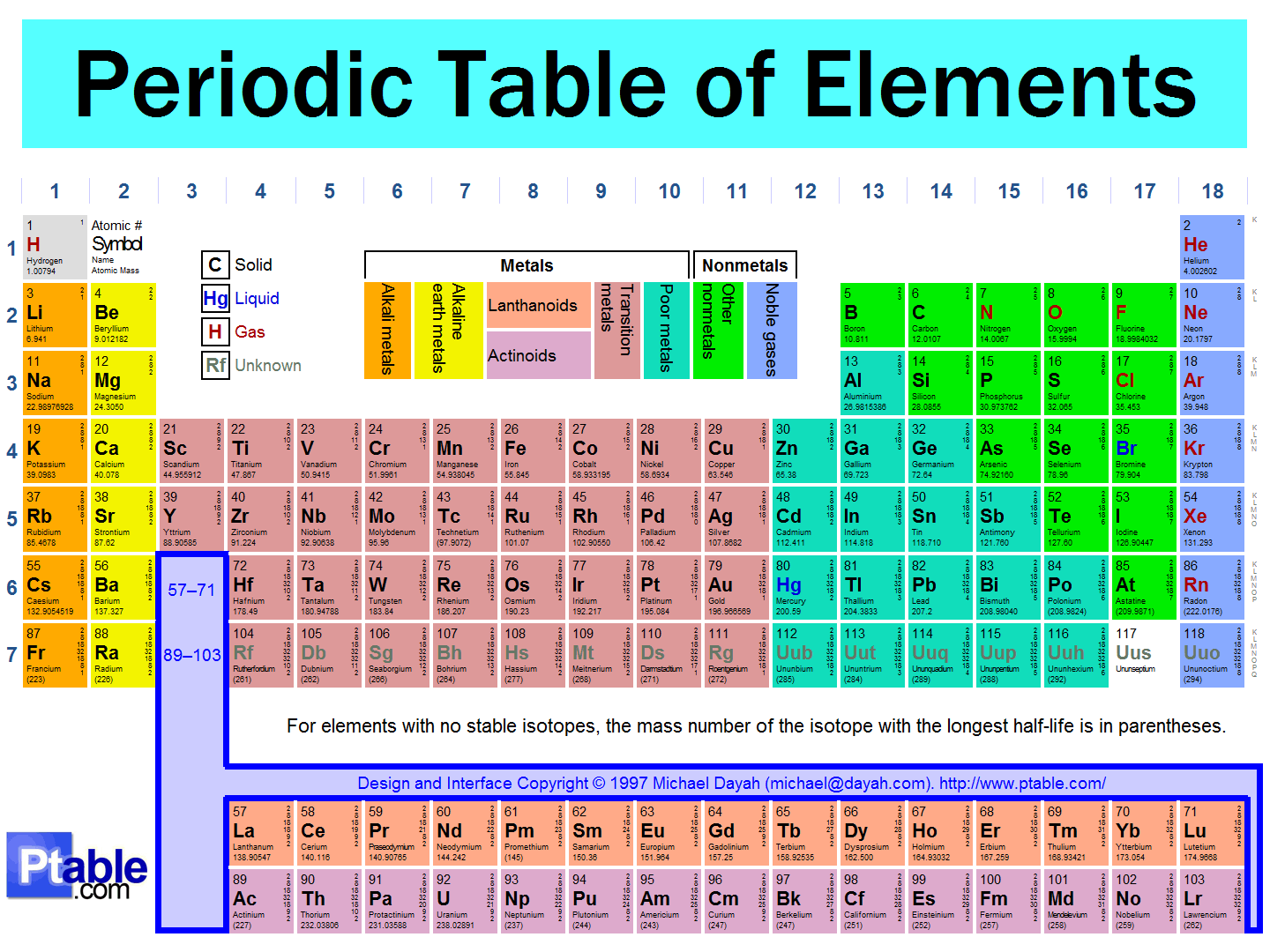
The vertical (up and down) columns in the Periodic Table are called
groups
towers
periods
atomic numbers
Which of the following are physical properties of metal?
Luster
Conductivity
Malleability
Ductility
Name this group: These metals are the most reactive.


I am a metal
I am in group 2
I am in period 6
I am…
Mo
Re
S
Ba
I am a nonmetal
I am in period 2
I am in group 16/6A
Ba
Si
Ba
O
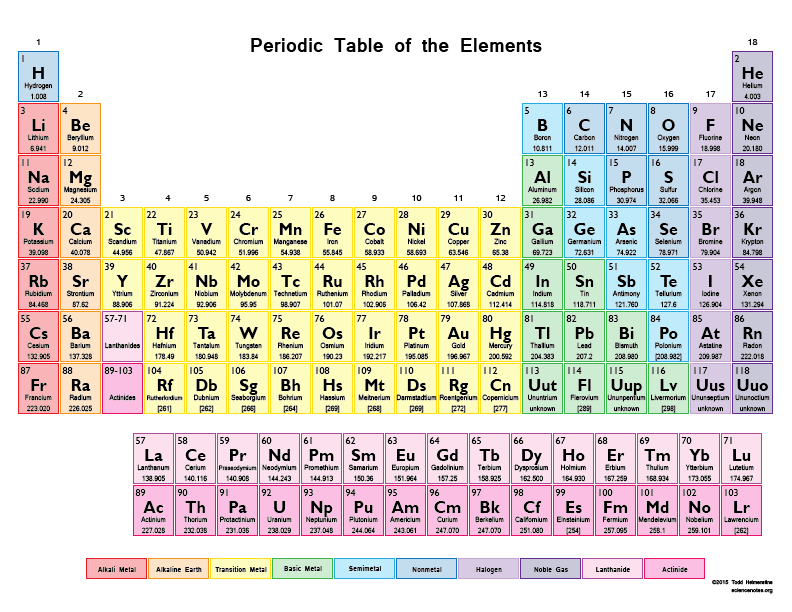
What is the atomic number of Barium, Ba? (enlarge the periodic table)
20
38
56
88
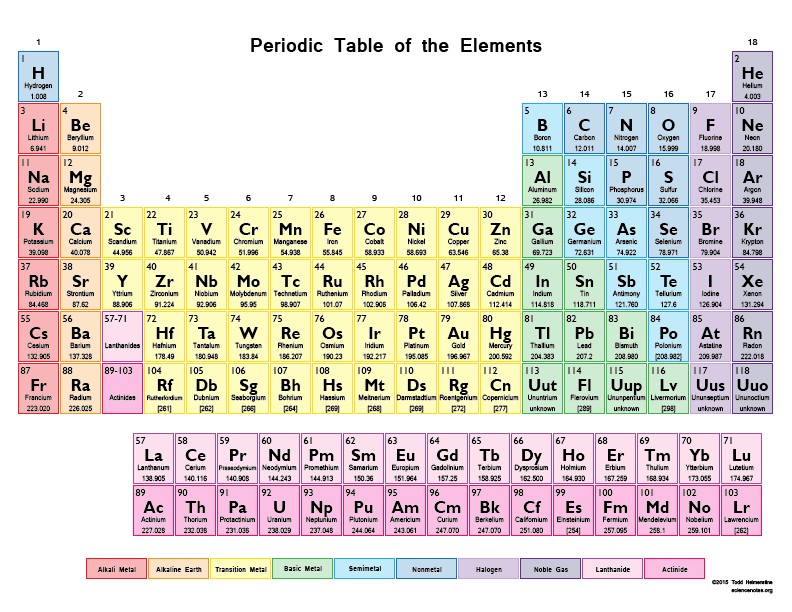
How many protons are in a sodium atom, Na? (tap to enlarge the periodic table)
Sodium has 1 proton.
Sodium has 3 protons.
Sodium has 11 protons
How many valence electrons does Beryllium have?
1
2
3
4
5
How many valence electrons does Nitrogen have?
1
2
3
4
5
How many valence electrons does Oxygen have?
4
5
6
7
8
How many valence electrons does Fluorine have?
4
5
6
7
8
How many valence electrons does Neon have?
4
5
6
7
8
How would you draw a Lewis dot diagram for Magnesium?


What are valence electrons?
The innermost electrons
The outermost electrons
What is the octet rule?
Elements can only have 8 electrons in its outermost shell
The elements must form an octopus like structure

Choose the correct Lewis dot structure for Carbon.
A
B
C
D

Choose the correct Lewis dot structure for Hydrogen.
A
B
C
D

Choose the correct Lewis dot structure for Neon.
E
F
G
H
Choose the correct Lewis dot structure for Fluorine.


A crayon has a mass of 10.0 g and volume of 5.0 mL. What is the density?
30 g/mL
15 g/mL
1.0 g/mL
2.o g/mL

A block of aluminum occupies a volume of 15 mL and has a mass of 40.5 g. What is its density?
.37 g/mL
605.5 g/mL
2.7 g/mL
25.5 g/mL
Jack has a rock. The rock has a mass of 14g and a volume of 2cm3. What is the density of the rock?
7 mL
7 g/cm3
28 g/cm3
1/7 g/cm3

A piece of copper has a mass of 89g and a volume of 10.0 cm3. What would be the density of the copper?
0.89 g/cm3
89 g/cm3
8.9 g/cm3
890 g/cm3

Use the density chart to identify the substance. If the substance has a volume of 5 cm3 and a mass of 52.5.
lead
aluminum
silver
water

In the picture, a can of Pepsi sunk and a can of Diet Pepsi are put into water. The Pepsi must be
more dense than water
less dense than water
it has no density
it has a density of 1 g/mL
Why does ice float
Liquid water is less dense than solid water.
Solid water is less dense than liquid water.
Gaseous water is less dense than solid water.
Liquid water is less dense than gaseous water.

In this picture, what is true?
Box A has a lower volume
Box B has a greater volume
The boxes have the same mass
The boxes have the same volume