wayground logo

Free Printable Worksheets

Font size

S
M
L
XL
Worksheets

Space Review 24

Total questions: 101

Worksheet time: 2hrs 44mins

Name
Class
Date
1.

What causes DAY and NIGHT?

a)

Revolution

b)

Tilt

c)

Rotation

d)

Tilt and Revolution

2.

What causes SEASONS?

a)

Revolution

b)

Tilt

c)

Rotation

d)

Tilt and Revolution

3.

When the Moon is directly between the Sun and the Earth, what phase would the Moon be in?

a)

Full Moon

b)

New Moon

c)

Half Moon

d)

Waxing Crescent

4.

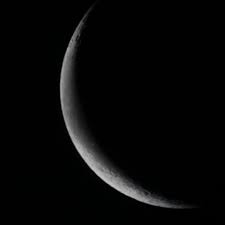
What phase of the moon is this?

a)

Waxing Gibbous

b)

Waning Gibbous

c)

Waxing crescent

d)

Waning crescent

5.
Name the phase of the moon that comes BEFORE this moon phase.
a)
waxing gibbous
b)
waning gibbous
c)
waning crescent
d)
waxing crescent
6.

What is the phase of the Moon at position #5?

a)

New Moon

b)

Third Quarter Moon

c)

First Quarter Moon

d)

Full Moon

7.
The moon cycle (lunar cycle) takes approximately _______________ to complete.
a)
14 days
b)
28 days/approximately one month
c)
58 days
d)
1 week
8.
Name the moon phase
a)
waning crescent
b)
waxing crescent
c)
waning gibbous
d)
waxing gibbous
9.
When the Earth is between the Moon and the Sun, it is most likeky a:
a)
Full Moon
b)
Half Moon
c)
3rd Quarter Moon
10.

The Moon gets its light from the

a)

It reflects the Earth's light

b)

It reflects the other stars' light

c)

It reflects the Sun's light

d)

It makes its own light

11.
Name the phase of the moon for letter f
a)
Waning Gibbous
b)
Waxing Gibbous
c)
Waning Crescent
d)
Waxing Crescent
12.

The Moon orbits Earth in a ________________ direction

a)

clockwise

b)

counterclockwise

c)

upwards

d)

downwards

13.

What is the name of the moon phase in the diagram?

a)

New Moon

b)

Full Moon

14.

What is the name of the moon phase in the diagram?

a)

1st Quarter Moon

b)

3rd Quarter Moon

15.

What is the name of the moon phase in the diagram?

a)

New Moon

b)

Full Moon

16.
What causes the moon's phases
a)
Where you are standing on Earth
b)

the angle we view the moon's lighted surface at from Earth

c)
The tilt of Earth
d)
how fast the moon is moving
17.
What moon phase occurs during a solar eclipse?
a)
Full moon
b)
new moon
c)
1st quarter
d)
waxing gibbous
18.

In order to have an eclipse, the Moon, Sun and Earth have to be?

a)

Below each other

b)

Above each other

c)

In alignment

19.
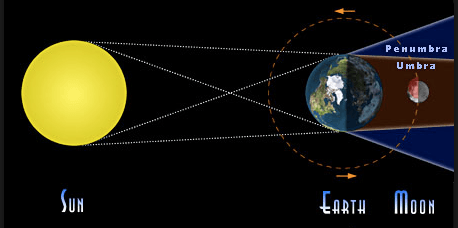
What type of eclipse is this?
a)
Solar eclipse
b)
Lunar eclipse
20.

We do NOT have a lunar eclipse each month because...

a)

The tilt of the moon's orbit is at 5 degrees

b)

The moon is too small

c)

The moon's orbital distance changes

d)

All choices

21.
Which type of eclipse is shown in the diagram?
a)
Solar Eclipse
b)
Lunar Eclipse
c)
Total Eclipse
d)
Partial Eclipse
22.
Tides are the cycle of rising and falling ocean water that repeats automatically every
a)
24 hours
b)
12.5 hours
c)
25 hours
d)
6.25 hours
23.
Differences in the moon's and sun's pull on different sides of the Earth cause _________.
a)
gravity
b)
lunar phases
c)
tides
d)
dabbing
24.

Which body has the greater effect on Earth's tides?

a)

Sun

b)

Saturn

c)

Moon

d)

Venus

25.

Which of the following is true of spring tides?

a)

Spring tides occur when the earth and sun are IN LINE with the new or full moon.

b)

Spring tides occur when moon in 3rd or 1st quarter phases

c)

Spring tides are LOWER than neap tides

d)

Spring tides occur in Spring and neap tides can occur in any season

26.
What type of tides would this arrangement of earth-moon-sun create?
a)
neap tide
b)
spring tide
c)
new moon tide
d)
full moon tide
27.

The diagram below shows the alignment of the sun, the moon, and Earth. In which locations are neap tides taking place?

a)

1 and 2

b)

1 and 3

c)

2 and 4

d)

3 and 4

28.
What word best describes our sun?
a)
Average
b)
Supergiant
c)
Dwarf
d)
Red Giant
29.
What color of star is the hottest?
a)
Blue
b)
Red
c)
Yellow
d)
Orange
30.
What color of star is the coolest?
a)
Red
b)
Yellow
c)
Blue
d)
White
31.
What is the name of the largest stars?
a)
Protostars
b)
Supergiants
c)
Red Giants
d)
Dwarf Stars
32.
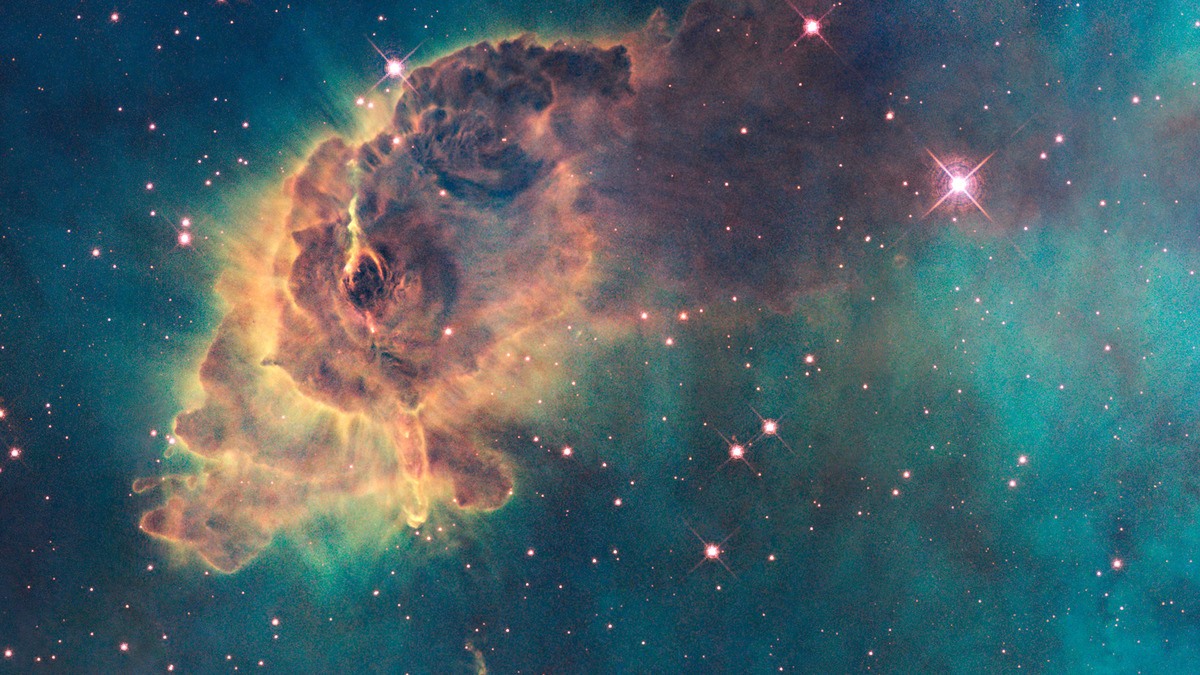
What is the name of the gas/dust clouds that form stars?
a)
Nebulas
b)
Protostars 
c)
Supernova
d)
Neutron Star
33.
Most stars are made of which elements?
a)
Hydrogen only
b)
Hydrogen and Lithium
c)
Hydrogen and Sodium
d)
Hydrogen and Helium
34.

What is a Star?

a)

a large celestial body that is made of plasma and held together by gravity.

b)

a large ball of fire held together by gravity.

35.
A small, hot star near the end of its life is a star called a
a)
white dwarf
b)
red dwarf
c)
supergiant
d)
protostar
36.

Our sun is currently in what star stage?

a)

Protostar

b)

Nebula

c)

Main Sequence

d)

Red Giant

37.
After the main sequence, a low mass star becomes a
a)
black dwarf
b)
protostar
c)
red giant
d)
supergiant
38.

Felix examined several photos of stars. To compare their temperatures, he looked at the colors of the stars. He organized the photos in order from coolest to hottest. Which of these answers shows the correct order?

a)

red, yellow, white, blue

b)

white, blue, yellow, red

c)

yellow, white, blue, red

d)

blue, yellow, white, red

39.
Which of the following is NOT a characteristic used to classify stars?
a)
Color
b)
Temperature
c)
Size
d)
Shape
40.

Which of the following is a name used to classify stars:

a)
Neutron
b)
Supergiant
c)
White dwarf
d)
All of the above
41.
True or False
The Sun is the biggest star in the sky.
a)
True
b)
False
42.

Different parts of the Sun rotate at different rates because

a)

The sun is solid and heavy

b)

The sun is made of water and is unstable

c)

The sun is made of gas

43.

The Sun core....

a)

The region of the sun where energy is produced.

b)

The region of the sun where solar flare happen.

c)

The sun spots are generated at core

d)

The carry particles of ligh

44.

Solar Prominence

a)

Quick burst of gas into the solar system

b)

Loop of gas that connects sun spots

c)

Hot gas moving into Earth's atmosphere

d)

Breaks power lines

45.

Solar Flare

a)

The crown of the sun

b)

Cooler spots on the sun

c)

A loop of energy

d)

Brief eruption of intense high energy of gas

46.

Rippled sheets of light in the sky because of electrical charged particles.

a)

Denver

b)

Stars

c)

Galaxies

d)

Auroras

47.

The layer of the sun that makes light

a)

Photosphere

b)

Solar flare

c)

Core

d)

Chromosphere

48.

Chromosphere

a)

The layer of sun that creates the suns color

b)

The layer that makes light

c)

The layer that creates energy

49.

Joining of hydrogen atoms to form helium

a)

Nuclear Fusion

b)

Nuclear Fission

c)

Sun spots moving together

50.

Sun Spots

a)

Throw particles into Earth's Atmosphere

b)

Create donuts

c)

Help the space probes send information

d)

The cooler darker parts of the Sun

51.

Which star stage is generally the HOTTEST?

a)

Supergiant

b)

Giant

c)

Main Sequence

d)

White Dwarf

52.

Which star stage is generally the COOLEST?

a)

Supergiant

b)

Giant

c)

Main Sequence

d)

White Dwarf

53.

What are hr diagrams?

a)

something for math

b)

a graph about stars

c)

a way to classify stars

d)

i dont know

54.

what are the three main characteristics used to plot stars on hr diagrams?

a)

color,brightness,and temperature

b)

brightness,color, and size

c)

color,temperature,and size

55.
The distance that light travels in one year...
a)
Light year
b)
Quantumyear
c)
Stellar-year
d)
1 million kilometers
56.
A large cloud of gas and dust in interstellar space; the predecessor to stars...
a)
Constellation
b)
Black hole
c)
Nebula
d)
Galaxy
57.
Which star is the coldest?
a)
Yellow Star
b)
Red Star
c)
Orange Star
d)
Blue Star
58.
In the diagram given, what happens as we move to the left?
a)
Stars Get Larger
b)
Stars get Colder
c)
Stars get hotter
59.
Compared to the rest of the stars, our sun is considered...
a)
Extremely Large and Cold
b)
Small with a medium temperature
c)
Medium size with medium temperature
60.
Blue stars are the _____________.
a)
hottest
b)
coolest
c)
smallest
61.
What determines the color of a star? 
a)
It's size
b)
It's temperature
c)
It's composition
d)
They are all the same color 
62.
As you move from the bottom to the top of the H R diagram the __________ changes.
a)
Temperature
b)
Luminosity or Brightness
63.

What shape is the Milky Way galaxy?

a)

Spiral

b)

Elliptical

c)

Irregular

64.

Describe where our sun and solar system are located in the Milky Way galaxy

a)

Directly in the center

b)

We are outside the galaxy

c)

We are at the end of one of the spiral arms

65.

Galaxies are classified by their....

a)

Size

b)

Density

c)

Brightness

d)

Shape

66.

What galaxy do we live in?

a)

Snickers

b)

3 Muskateers

c)

Mars

d)

Milky Way

67.

What type of galaxy is this?

a)

Spiral

b)

Elliptical

c)

Irregular

68.

What type of galaxy is this?

a)

Spiral

b)

Elliptical

c)

Irregular

69.

What type of galaxy is this?

a)

Spiral

b)

Elliptical

c)

Irregular

70.
What type of galaxy has no defined pattern or shape?
a)
Spiral 
b)
Elliptical
c)
Irregular
d)
Constellation
71.
What are galaxies held together by?
a)
Gravitational Attraction
b)
Stars
c)
Other galaxies
d)
Dust and Gas
72.
Place these objects in order from smallest to largest.
a)
Planets, solar system, universe, galaxy
b)
Solar system, planets, galaxy, universe
c)
Planets, solar system, galaxy, universe
d)
Galaxy, solar system, planets, universe
73.
What is 1 Astronomical Unit?
a)
The distance from the center of the earth to the center of the sun.
b)
The distance from the center of Earth to the center of the Moon.
c)
The distance of one entire revolution around the Sun by the Earth.
d)
The distance Light travels in a year.
74.
When we look at images of astronomical bodies are we looking at them in the present? 
a)
Looking at current images of distant astronomical bodies is like looking back in time; the light that we see does not show what the object looks like now but how it looked when the light was emitted. 
b)
Looking at current images of distant astronomical bodies is like looking forward in time; the light that we see does not show what the object looks like now but how it will look when our galaxies align. 
c)
Looking at current images of distant astronomical bodies is like looking at a our current point in time; the light that we see shows what the object looks like now.
75.
Earth is __________ astronomical units from the Sun…
a)
A. 0.5
b)
B. 0.8
c)
C. 1.0
d)
D. 1.5
76.
What are in galaxies?
a)
ice and rock
b)
dust, gas, and stars
c)
stars and ice
d)
water and dust
77.

Why do we always see the same side of the moon?

a)

because the moon rotates at the same speed earth does

b)

because the moon orbits earth clockwise

c)

because the moon rotates on its axis at the same rate that it orbits the earth

d)

because the moon's orbit is tilted at a slight angle around earth

78.
Which planet doesn't have a moon?
a)
Earth
b)
Mars
c)
Mercury
d)
Jupiter
79.
Which of the following is not true?
Planets closer to the sun...
a)
are hotter
b)
revolve slower
c)
have less moons
d)
are smaller
80.
The inner and outer planets are divided by...
a)
The asteroid belt
b)
The oort cloud
c)
The kuiper belt
d)
a fraction
81.
What is the correct order of planets from the sun?
a)
Mercury, Venus, Earth, Mars, Jupiter, Saturn, Uranus, Neptune
b)
Mars, Venus, Earth, Mercury, Jupiter, Saturn, Uranus, Neptune
c)
Mercury, Venus, Earth, Mars, Jupiter, Saturn, Neptune, Uranus
d)
Jupiter, Saturn, Venus, Earth, Pluto, Mars, Mercury, Neptune
82.
What does the word terrestrial mean?
a)
Warm planets
b)
planets with moons
c)
planets with ailens
d)
Rocky planets
83.
Compared to the inner planets, the outer planets are...
a)
larger
b)
warmer
c)
denser
d)
better
84.
Which of the following is NOT true of all the inner planets?
a)
They are made of solid rock.
b)
They are called gas giants.
c)
They do not have rings.
d)
They have impact craters.
85.
Impact craters are caused by
a)
solar bursts.
b)
atmospheric changes.
c)
exploding volcanoes.
d)
collisions with objects in space.
86.
Pluto is a dwarf planet that is part of the...
a)
Oort cloud
b)
Kuiper Belt
c)
Moon system of Neptune
87.

Planet W is

a)

Jupiter

b)

Saturn

c)

Uranus

d)

Neptune

88.

What planet takes the longest to orbit the sun?

a)

Uranus

b)

Jupiter

c)

Neptune

d)

Saturn

89.

What makes the Outer Planets different than the Inner Planets?

a)

They're made of rock and move slow

b)

They don't exsist

c)

They're made of gas and move fast

d)

They're made of gas and rock and move fast

90.

Early historical models of the solar system were geocentric. Which of these phrases describes a geocentric solar system?

a)

the sun as a reference point

b)

existing in a star system

c)

Earth as a reference point

d)

circular, orbital path of travel

91.

How does Ptolemy’s model of the universe compare with Aristotle’s model?

a)

Both are heliocentric

b)

Both are based on parallax

c)

Both show that celestial objects have circular paths

d)

Both show that celestrial objects have elliptical paths

92.

Based on the belief that the sun is the center of the universe

a)

heliocentric

b)

geocentric

c)

aphelion

d)

parallax

93.

An apparent shift in the position of an object when viewed from different locations

a)

heliocentric

b)

geocentric

c)

parallax

d)

aphelion

94.

Who came up with this model?

a)

Copernicus

b)

Kepler

c)

Galileo Galilee

d)

Ptolemy

95.

Who discovered the shape of a planet's orbit is actually an ellipse?

a)

Ptolemy

b)

Copernicus

c)

Kepler

d)

Galileo

96.

Who used a telescope to prove that the Earth could not be the center of the universe?

a)

Ptolemy

b)

Copernicus

c)

Kepler

d)

Galileo

97.

Object spinning on its axis.

a)

revolution

b)

rotation

98.

The motion of one object around another object

a)

rotation

b)

revolution

99.
What effect does the tilt of the earth have?
a)
It changes the angle that the sun strikes the earth in different land areas
b)
It causes the earth to be farther away from the sun at different times of the year
c)
When the earth is tilted away from the sun we have night
d)
When the earth is tilted away from the sun we have day
100.
Which of the following best describes the tilt of the earth when it is summer in the southern hemisphere?
a)
The northern hemisphere is tilted toward the sun
b)
The northern hemisphere is tilted away from the sun
c)
The norther hemisphere is tilted neither toward or away from the sun
d)
Why are you talking about the northern hemisphere when you asked about the southern hemisphere?
101.

If its ____ in the Northern hemisphere, then its fall in the Southern hemisphere.

a)

spring

b)

summer

c)

fall

d)

winter