
 Worksheets
Billings Quarter 4 Practice Test
Total questions: 176
Worksheet time: 4hrs 40mins
Which of the following is the best example of work being done.
doing homework
lifting a box
pushing a stationary box
holding a box
You push against the back of your friends car that is stuck. You push and be become very tired, but the car does not move. Did you do work?
Yes, work was done
No, work wasn't done
What would 54N be an example of?
work
power
distance
force
what would 1m be an example of?
work
power
time
distance
what would 14J be an example of?
work
distance
time
force
What is an example of a force?
Energy
Power
Pressure
Weight
If you increase your work and decrease your time, you will have
more power
less power
same amount of power
power rating can not be determined
What would you solve for if given time and work?
power
force
distance
work
what would you solve for if given distance and force?
work
power
time
motion
What would you solve for if you were given work and distance
power
time
force
motion
If you have the same work as someone, but in less time
You are more powerful
You are less powerful
You have the same power
Person A and Person B are both using the same amount of work to lift something. Person A takes half as much time to do it. Who has greater power.
Person A
Person B


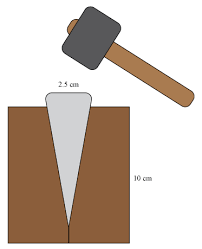


Which type of waves have vibrations that run perpendicular to the direction the wave travels?
transverse
longitudinal
Which type of waves have vibrations that run parallel to the direction the wave travels?
transverse
longitudinal
Examples of this type of waves include water waves, waves on a string/jump rope, and light waves.
transverse
longitudinal
An example of this type of wave is a sound wave.
transverse
longitudinal
Waves transfer _______.
energy
matter
particles
_______ is the length of a full cycle of a wave, from one crest to the next crest.
Wavelength
Frequency
Amplitude
The _______ is the highest point on a transverse wave.
Crest
Trough
Wavelength
Amplitude
The _______ is the lowest point on a transverse wave.
Wavelength
Amplitude
Trough
Crest
The _______ is the size or height of a wave, measured from the equilibrium to the crest or trough.
Amplitude
Wavelength
Frequency

The _______ of a wave is how many waves pass a given point every second.
Frequency
Wavelength
Amplitude
Frequency is measured in _______.
Hertz (Hz)
Meters per second
Meters
Newtons
Frequency is how many waves pass a point in 1 second. If 100 waves pass a given point in 4 seconds, what is the wave's frequency?
25 Hz
100 Hz
4 Hz
400 Hz

In a longitudinal wave, a ________ is an area where the particles are spread apart.
rarefaction
compression
crest
trough

In a longitudinal wave, a ________ is an area where the particles are close together.
rarefaction
compression
crest
trough

Examples of ________ waves include visible light, xrays, ultraviolet, and radio waves.
transverse
longitudinal
The formula for _________ is λ = v/f.
wavelength
frequency
period
The formula for frequency is ____________.
λ = v/f
f=1/p
p=1/f
f=p/1
The formula for period is __________.
p=1/f
p=f/1
f=1/p
λ = v/f
ex. police car siren sounding lower pitch after the car passes


Vibrations that travel through the air or other medium that can be heard when they reach the ear.
Sound
Pitch
Frequency
Sound Wave

Which sound wave shows the sound with the highest pitch?
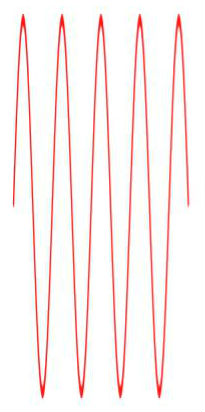
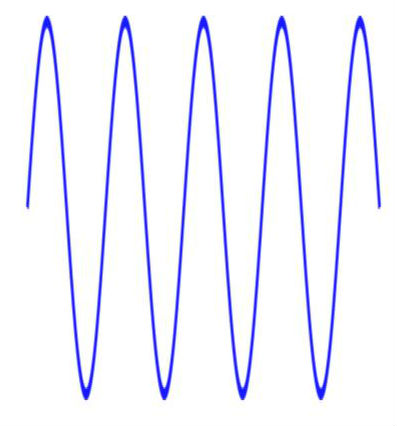
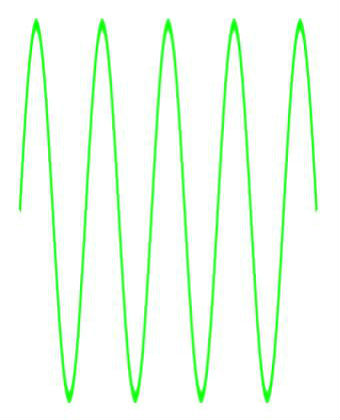

Which sound wave shows the loudest sound?
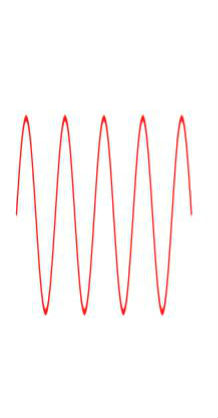
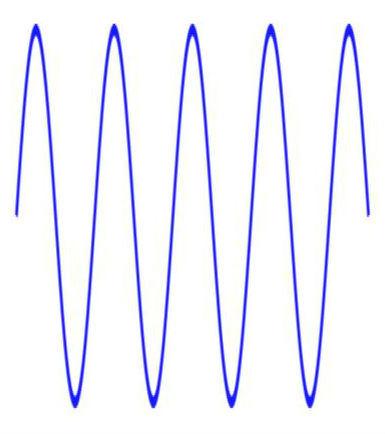
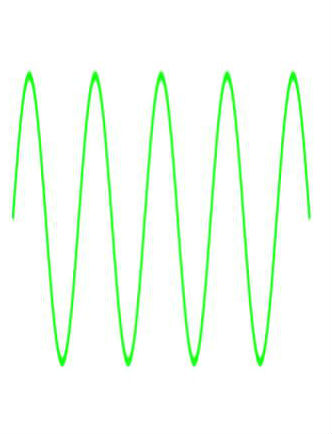

If someone is standing to the left of this wave, they would hear a ______ pitch than someone standing to the right of it.
uglier
prettier
higher
lower
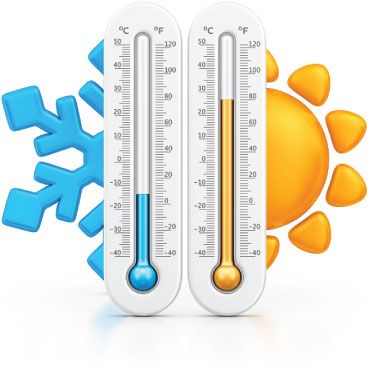
Sound Waves Move faster in what temperature
Hot
Cold
Doesn't Matter
Both
Sound with frequencies between 20 Hz and 20 000 Hz are known as:
ultrasonic
infrasonic
audible range
visible range

The speed of sound in air is 340 m/s. The frequency of the sound waves generated by my voice is 720 Hz. Calculate the wavelength of sound of my voice.
380 m
0.472 m
2.11 m
244,800
none of these are correct
The speed of sound depends on these two things:
The type of medium and the temperature of the medium
Speed of the medium and temperature of the medium
Temperature of the medium and sound of the medium
None of the above

Sonar and echolocation use ----- to detect objects under water.
Refraction
Reflection
Which part of the ear is a thin membrane that is made to vibrate by sound waves?
ear drum
cochlea
auditory nerve
ear canal
What type of waves are sound waves?
transverse
longitudinal
In the ear, what amplifies the vibrations from the ear drum?
cochlea
ossicles (tiny bones)
auditory nerve
ear canal
What are the common names of the ossicles (tiny bones) in your ear?
hammer, anvil and stirrup
hammer, nail and screws
iron, stirrup and leather
block, mallet and nail
Where are the tiny hairs found, which detect vibrations and create electrical signals?
ear drum
cochlea
auditory nerve
ossicles
What are the electrical signals that travel along neurones to the brain called?
impulses
signals
messages
nerves
What carries electrical signals from the ear to the brain?
ear canal
cochlea
auditory nerve
olfactory nerve
What is the frequency range of human hearing?
20 - 20 000 Hz
200 - 200 000 Hz
200 - 20 000 Hz
20 - 200 000 Hz
Inside the cochlea, what causes the membrane to detect different frequencies of sound?
The membrane is thicker at one end than the other
There are different number of hairs in different parts of the membrane
The hairs are of different lengths along the membrane
There is more fluid at one end than the other
How can you calculate the speed of a wave? (2 answers)
distance ÷ time
frequency x wavelength
frequency ÷ wavelength
wavelength ÷ frequency


Why does light refract?
speeds up
gets hot
slows down
gains energy
Light travels through an object during
absorption
reflection
transmission
diffraction

What is the earth's primary source of light energy?
moon
sun
waves
fire
The height of the sound waves
Frequency
Amplitude
Wavelength


What does the picture below illustrate?
Visible Light Spectrum
Electromagnetic Spectrum
Frequency Indicator
Color Line
What is the saying that can help you remember the order of the visible spectrum?
ROYGBIV
RYOBIVG
ROYBVIG
RIBYOVG
How are we able to see the color white?
All colors except red are absorbed
All colors are absorbed
All colors are reflected
All colors except red are reflected
What does reflection mean?
Bending Light
Bouncing Light
Of the visible spectrum, what color has the longest wavelength?
Blue
Green
Yellow
Red
Violet
What type of wave does a light wave resemble?
Transverse wave
Compressional wave
Light is a type of energy that travels as an ______________ ____________.
Longitudinal Wave
Electric Current
Electromagnetic Wave
Magnetic Wave
A prism can be used to...
separate visible light into colors
make a beam of light brighter
measure the speed of light
make UV light visible
What happens when light transitions into a new medium?
Reflection
Absorbing
Refraction
Mirror
A blue dish appears blue because it
absorbs blue light
absorbs white light
reflects white light
reflects blue light

What is this a picture of?
Reflection
Refraction
___________ is a form of energy that we can see with our eyes.
Radio Waves
Visible Light
Ultraviolet
Reflection
What is visible light used in?
Light Bulbs, TVs, Lasers
Nothing, Visible light cannot be used
Sound
When we Breathe
Is Visible Light Dangerous?
No, Visible light cannot harm you
Yes, visible light is highly radioactive and should be handled carefully. Visible light when in contact with human skin can cause aerial skin cancer.
No, this is because visible light isn't real
Yes, Visible light at high concentrations can cause burns, blindness, and indirect DNA damage but at low levels is harmless
What is the Corona? (BONUS)
The temperature of the sun
The outer most layer of the Sun's atmosphere
Another name for the Electromagnetic Spectrum
The measurement of the crests and troughs on a transverse wave




Near point of an healthy human eye
25 m
2.5 cm
2.5 m
25 cm
Change in focal length of an eye lens is caused by the action of the
Pupil
Retina
Ciliary muscles
Iris
The human eye can focus objects at different distances by adjusting the focal length of the eye lens . This is due to
Presbyopia
Accommodation
Near-sightedness
Far-sightedness
A person with a myopic eye cannot see objects beyond 1.2 metres distinctly . What should be the type of corrective lens used to restore proper vision
Concave lens
Convex lens
Bifocal lens
Concave mirror
What is the far point of human eye with normal vision
Infinity
25cm
2.5 m
25 m
Name the corrective lens used for hypermetropia
Concave lens
convex lens
Bifocal lens
Diverging lens
Function of the optic nerve is is
Transfer the signals to brain
Image formation
sensation of vision
Controls the light entering the human eye
A person gets out in the sunlight from a dark room. How does his pupil regulates and controls the light entering in the eye?
The size of pupil will decrease and less light will enter the eye
The size of pupil will decrease and more light will enter the eye
The size of pupil will increase and less light will enter the eye
The size of pupil will increase and more light will enter the eye
Near point of an healthy human eye
25 m
2.5 cm
2.5 m
25 cm
Change in focal length of an eye lens is caused by the action of the
Pupil
Retina
Ciliary muscles
Iris
The human eye can focus objects at different distances by adjusting the focal length of the eye lens . This is due to
Presbyopia
Accommodation
Near-sightedness
Far-sightedness
A person with a myopic eye cannot see objects beyond 1.2 metres distinctly . What should be the type of corrective lens used to restore proper vision
Concave lens
Convex lens
Bifocal lens
Concave mirror
What is the far point of human eye with normal vision
Infinity
25cm
2.5 m
25 m
Name the corrective lens used for hypermetropia
Concave lens
convex lens
Bifocal lens
Diverging lens
Function of the optic nerve is is
Transfer the signals to brain
Image formation
sensation of vision
Controls the light entering the human eye
A person gets out in the sunlight from a dark room. How does his pupil regulates and controls the light entering in the eye?
The size of pupil will decrease and less light will enter the eye
The size of pupil will decrease and more light will enter the eye
The size of pupil will increase and less light will enter the eye
The size of pupil will increase and more light will enter the eye

