
 Worksheets
Beyond Our World 6th Grade Q4
Total questions: 100
Worksheet time: 3hrs 11mins
To describe the vast distances between stars, astronomers use ______________________, or the distance light travels in one year.
kilometers
astronomical units (AU)
light-years
miles
Astronomers also use the distance between Earth and the Sun as a base unit of measuring distances - usually within star/solar systems. These are known as ________________________.
light-years
miles
astronomical units (AU)
kilometers

The Andromeda Galaxy is the nearest spiral galaxy to the Milky Way Galaxy. Which unit would best be used to represent the distance between the Milky Way Galaxy and the Andromeda Galaxy?
astronomical unit
kilometer
light year
mile
How has our ability to send remote-controlled devices to planets such as Mars enhanced our understanding of the universe?
It has allowed us to visually explore distant planets without endangering anyone.
It has limited our exploration to planets with atmospheres similar to ours.
It has made it possible for astronauts to visit distant planets in person.
It has enabled us to collect soil samples from distant planets and bring them back to Earth.

The chart below shows the average distance in astronomical units between each planet and the Sun.
Based on the table, which planet orbits the Sun closest to Earth?
Mars
Mercury
Jupiter
Venus
Scientists use the light-year to describe the relationships between objects in space. What does a light-year measure?
the distance that light can travel in one year
the brightness of light that travels through space
the number of years it takes light to travel to Earth
the time it takes light to travel 1 million km
Astronomers use the light-year to describe the relationship between objects in space. For example, the Andromeda galaxy is 2.5 million ly from Earth. Which of the following units is most similar to the light-year?
gram
second
kilometer
degrees Celsius
The sun is much larger than the moon. However, as viewed from Earth, the sun and moon appear to be the same size. Why do the sun and moon appear to be the same size when viewed from Earth?
The moon is much hotter than the sun.
The moon is much denser than the sun.
The moon is much brighter than the sun.
The moon is much closer to Earth than the sun.
Which two objects in space are located farthest apart?
Earth and Mars
Earth and the sun
Earth and the moon
the Milky Way galaxy and the Andromeda galaxy
A ___ is observed and describes in the natural world what appears to always be true.
hypothesis
theory
law
All the measurements and data scientists gather in support of a scientific explanation.
empirical evidence
explains
evidence
Happens under very specific conditions in nature.
hypothesis
theory
law

Which piece of evidence could be used to BEST support this claim:
High school students should be required to wear uniforms.
When adding everything up, a school uniform could end up costing more than $200.
A student reported, "Allowing us to wear our own clothes gives us a chance to show our unique style and independence."
At one school that recently required students to wear uniforms, attendence rates went up, and behavior incidents went down.
School uniforms can be ordered online .
What is a moon?
A celestial body that has no atmosphere
A small celestial body that has no gravity
A celestial body that orbits around another world, and also the Sun
None of the above
The moon produces its own light
True
False
We can see all sides of the Moon
True
False
Titan is a moon that belongs to...
Mars
Jupiter
Uranus
None of the above

Mrs. Mac drew this model of the Solar System. What is wrong with this model?
Earth is shown to be moving in the wrong direction.
There are too many planets in the Solar System.
It shows the Sun moving in the wrong direction.
The Sun is not in the right location.
Mrs. Mac studied different historical models of the Solar System. According to the geocentric model, what is at the center of the Solar System?
the Earth
the Sun
the Moon
the galaxy
Methane is a compound found on Earth. Scientists have discovered methane on Titan, one of Saturn's moons. What must be true about Titan's methane?
Because it's in space, it will have completely different properties.
Because it's near Saturn, it will be much hotter.
Because it's a compound, it's properties will be the same.
Because it's on a moon, it will be made of different elements.
The Moon has many more impact craters than Earth. Which of the following gives the best explanation for the Moon having more craters than Earth?
The Moon has no atmosphere.
The Moon orbits between Earth and the Sun.
The Moon rotates much slower than Earth does.
The Moon has one side facing away from Earth at all times.
All of the planets in our Solar System orbit around the Sun. Which of the following is true of all orbits?
They are all the same shape.
The planets are all the same distance from the Sun.
The planets take the same amount of time to orbit.
They are all the same speed.
Most planets have some type of atmosphere, but Mercury has almost none. Which of the following is the most likely explaination for why Mercury does not have an atmosphere?
It is too new to have formed an atmosphere.
It is not large enough to hold on to much of an atmosphere.
It is too cold for any gases to remain in its gravitational field.
It is not close enough to the Sun to have an atmosphere.
Although Venus is almost twice as far from the Sun as Mercury, its surface temperature is much higher. Which of the following is the best explanation for Venus' high temperature?
Venus revolves in the opposite direction as Mercury.
Venus rotates very slowly compared to Mercury.
Venus has a solid surface and Mercury does not.
Venus has a thick atmosphere and Mercury has a very thin atmosphere.

Generally, a planets surface temperature varies with its distance from the Sun. The table shows distances of several planets from the Sun. Which of the following planets should have the lowest surface temperature?
Earth
Jupiter
Mars
Saturn

The graph shows the distribution of compounds throughout the Solar System as it relates to temperature and distance from the Sun. What can be concluded from this graph?
Ammonia ice is found only in warm temperatures.
Uranus is the warmest planet on the graph.
Silicates and rocky materials are not present on Saturn.
Temperature if not related to distance from the Sun.
Scientists are continually making new discoveries. Which statement about scientific knowledge is true?
Scientific knowledge rarely changes.
Scientific knowledge is never questioned.
Scientific knowledge is mostly wrong, but can be useful.
Scientific knowledge changes as new evidence is collected.

Many years ago, people thought that the Sun revolved around Earth. Copernicus proposed that the Earth revolved around the Sun. What does this change in understanding show about scientific knowledge?
Science allows for adjustments to be made as new evidence is found.
People have always believed that scientists can find the right answers.
Before Copernicus, science was not based on observations.
People trust in science and always accept new ideas.

Mrs. Mac used the following model of the Solar System in science class. What cannot be observed using this model?
the path that the planets orbit the Sun
the composition of the planets
the relative size of each planet
the order of the planets from the Sun
Models can help answer some, but not all, scientific questions. Which of the following is the best example of a scientific model?
a computer simulation of the surface of the Sun
a graph comparing the temperature of stars
a data table showing the number of stars visible over three nights
a painting of the nighttime sky

The graph shows the number of sunspots observed from 1900-2000. What does the information in the graph tell you?
The number of sunspots was highest between 1940 and 1950.
The number of sunspots does not change over time.
The number of sunspots decreased throughout the 20th century.
The number of sunspots changes in a pattern that repeats every ten years.

The diagram illustrates the effect of the Moon's gravity on Earth as it relates to the changing ocean tides. What type of tide is shown in the diagram?
red tide
noon tide
neap tide
spring tide
The planets and their moons are in constant motion in the Solar System. Each movement has an impact on the other bodies in the system. What occurs when the shadow of an astronomical body blocks our view of the Sun from Earth?
night time
an eclipse
summer
a high tide

Mrs. Mac's class is studying the Sun-Moon-Earth system. They study the diagram of the Sun, Moon, and Earth shown above. What daytime event is shown in the diagram?
solar eclipse
lunar eclipse
new moon
neap tide
Mrs. Mac is at the beach and witnesses high tides and low tides. Which of the following causes tides?
the pull of mountains close to beaches
the pull of the ocean's gravity
the pull of the Moon's gravity
the pull of waves caused by storms
The Kuiper Belt is an area beyond Neptune where small objects made from mostly rock and ice are orbiting the Sun. Which of the following best explains why the objects in the Kuiper Belt orbit the Sun?
The objects are held in place by Neptune's magnetic force.
The objects are held in place by the Sun's gravity.
The objects have too much mass to overcome Neptune's pull.
The objects have too much gravity to move on their own.
One of the important criteria in classifying an object as a planet is that the object is spherical. What makes an astronomical object become spherical?
gravity
electromagnetic force
convection
magnetism
Isaac Newton's Law of Universal Gravitation states that every object in the universe is attracted to every other object. Scientists have used this law to explain the formation of planets. Because universal gravitation is a scientific law, which of the following best describes this law?
The law only applies to objects in space.
The law could be easily disproved.
The law was only true during Newton's lifetime.
The law describes a measurable relationship between object.
Many moons orbit around the planet Jupiter. What determines the motion of the moons around Jupiter?
The Theory of Plate Tectonics
The Heliocentric Theory
The Law of Superposition
The Law of Universal Gravitation

The arrows in the diagram represent the strength of the gravitational attraction between two objects. Under which of the following conditions would the thickness of the arrows between the two objects decrease?
if the mass of the objects increased
if the objects moved closer together
if the objects moved farther apart
if the size of the objects increased
The table lists the masses of four planets relative to the mass of Earth. Imagine an object that is moved to each of the planets in the table. What would change about the object if it was taken to another planet?
its weight and its mass
its weight, but not its mass
its mass, but not its weight
neither its weight nor its mass

The width of the arrows in the diagram represents the strength of the gravitational attraction between two objects. Using the Law of Universal Gravitation, select the answer that best explains why the arrows are thicker in the top figure than in the bottom figure?
The distance between the objects is shorter in the bottom figure.
The gravitational force is weaker in the bottom figure.
The masses of the objects are different from those in the bottom figure.
The smaller objects have more gravitational force than the larger objects.
The Sun has about 300,000 times more mass than Earth. What can you infer from this fact?
The Sun has less energy than Earth.
The Sun travels through the galaxy faster than Earth.
The Sun's gravitational force is much weaker than Earth's.
The Sun's gravitational force is much stronger than Earth's.
Earth's gravity keeps the objects and people on Earth's surface from floating off into space. What else does gravity have an effect on?
The mass of objects on Earth's surface.
The weight of objects on Earth's surface.
The temperature of objects on Earth's surface.
The chemical composition of objects on Earth's surface.
Imagine that astronauts on the Moon used a scale to measure the mass of moon rocks. They then return to Earth where they again use the same scale to measure the the rocks. What will they find happens to the mass of each rock?
The mass increases.
The mass remains the same.
The mass decreases.
The mass cannot be measured on the Moon.
Astronomers also use the distance between Earth and the Sun as a base unit of measuring distances - usually within star/solar systems. These are known as ________________________.
light-years
miles
astronomical units (AU)
kilometers
What model is Earth at the center of revolving planets and stars?
geometric model
geocentric model
heliocentric model
hectocentric model
A heliocentric model is...
A model where the sun is at the center of the universe.
A model where the Earth is at the center of the star system.
A model where the Earth revolves around the sun.
A model where the sun revolves around the Earth.
What happens during a solar eclipse?
The sun blocks out the moon.
The moon blocks out the sun.
When a star explodes.
When the earth finishes revolving around the sun.
What is a dwarf planet?
A medium sized planet.
A big planet.
A small planet.
An enormous planet.
A lunar eclipse is...
when the sun explodes!
when the moon moves into Earth's shadow.
when the sun blocks out the stars.
when the moon blocks out the sun.

what makes a meteoroid, meteor, and a meteorite different? (best answer)
color
size
location
texture
choose the best description for a meteoroid...
-burns up while entering earths atmosphere
-hits earth surface
-still in space
choose the best description for a meteor
-still in space
-burns up in earths atmosphere
-hits earth surface
choose the best description for a meteorite
-still in space
-burns up in earth's atmosphere
-hits earth surface
which planet is the asteroid belt close to?
neptune
jupiter
earth
choose the best description for a comet
icy small body with a tail
chunky rock
rock moving body

We often see these objects appear as "shooting stars" or streak of light in the sky. They are "smaller" pieces of rock that are burning in our atmosphere.
Asteroids
Meteors
Meteroids
Comets


A meteorite is DIFFERENT from a comet mainly because
has a tail of ice and gas
is found in orbit between Jupiter and Mars
enters the Earth's atmoshere
has a nucleus made of rock and snow.
These are composed mainly of rock and metal.
comets and stars
stars and meteors
asteroid and meteors
comets and asteroid
The types of planets are
Rock, liquid and solid
Gas, terrestrial and solid.
Gas, terrestrial and dwarf.
Gas, terrestrial and rock.
Earth is colder than Mars.
True
False
One of the main differences between the outer and inner planets is __________.
the inner planets all have water
the inner planets are much bigger than the outer planets
the outer planets are gas planets
the outer planets have do not have rings and the inner planets do
What planet has a very hot surface and is most like Earth in size?
Venus
Mercury
Mars
Uranus
Which property makes Earth unique compared to other planets in the solar system?
It orbits the Sun.
It is a rocky planet
It has liquid water
It rotates on its axis.
Which contributes to Earth’s ability to sustain life?
The atmosphere allows all of the sun’s radiation to enter due to Earth’s distance from the sun.
The atmosphere prevents all space debris from reaching the surface due to the ozone layer.
The atmosphere is extremely thin due to the temperatures of the sun.
The atmosphere is breathable due to the unique mixture of gases.
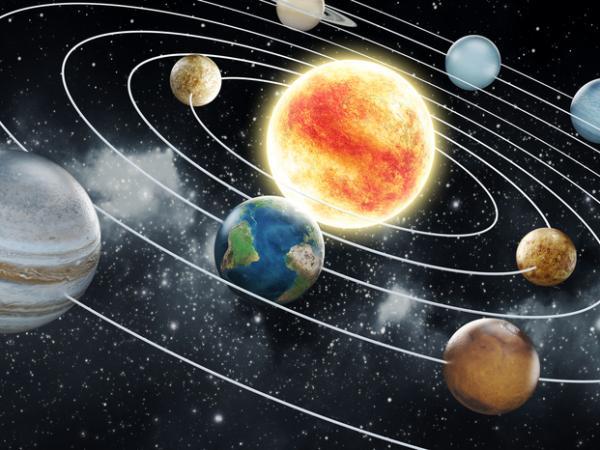
What is the correct order of the planets in the Solar System, starting closest to the Sun?
Mars, Mercury, Earth, Venus, Jupiter, Saturn, Uranus, Neptune,
Mercury, Venus, Earth, Mars, Jupiter, Saturn, Uranus, Neptune
Mercury, Mars, Venus, Earth, Jupiter, Saturn, Uranus, Neptune,
Mercury, Venus, Earth, Mars, Jupiter, Neptune, Uranus, Saturn
Which planet has extreme temperatures because it has no atmosphere?
Earth
Jupiter
Saturn
Mercury
Which planet has the most extensive ring structure, the second largest in solar system, has at least 31 moons (the largest being Titan), and has thick outer rings of hydrogen, helium, ammonia, methane, and water vapor?
Jupiter
Neptune
Saturn
Pluto
What do Mercury, Venus, Earth, and Mars all have in common?
They are all very cold planets.
They are considered terrestrial planets, that is rocky or have metals with hard surface.
They are about the same size.
They are considered gas giants
The four inner planets are rocky and small. Which description best fits the next four outer planets?
They are also rocky and small.
They are very large and has no moons
They are small and made of ice.
They are very large, made of gases with no solid surface
Which planet is the largest planet in the solar system and is the fifth planet?
the sun
Uranus
Jupiter
Earth
Which is the eighth planet from the Sun and orbits the Sun once every 164.8 years and is blue in color?
Neptune
Jupiter
Saturn
Mars
Which of the following is ordered from largest to smallest?
Universe -> Galaxy -> Solar System -> Planet
Planet -> Galaxy -> Solar System -> Universe
Planet -> Solar System -> Galaxy -> Universe D.) Universe
Universe -> Solar System -> Galaxy -> Planet
Which planet is home to the tallest mountain , has the largest dust storms in the solar system and is also known as the 'Red Planet' because of the presence of iron oxide in it's rock.
Earth
Venus
Jupiter
Mars
The inner planets are also called a
Gas giants
Terrestrial planets
Large planets
Asteroid
Name for region containing all 8 planets, the sun, asteroids, and other celestial objects?
The Solar System
The Degoba System
Asteroid Belt
Kuiper Belt system
What is the object that all planets in our solar system orbit?
The moon
The sun
The Milky Way
Mercury
Which of the these planets would have the greatest gravitational pull on a nearby object?
Mars
Mercury
Jupiter
Neptune


Who came up with this model?
Copernicus
Kepler
Galileo Galilee
Ptolemy
What does "helios" mean?
Helium
Earth
Sun
Medicine
Who discovered the shape of a planet's orbit is actually an ellipse?
Ptolemy
Copernicus
Kepler
Galileo
Who used a telescope to prove that the Earth could not be the center of the universe?
Ptolemy
Copernicus
Kepler
Galileo

