wayground logo

Free Printable Worksheets

Font size

S
M
L
XL
Worksheets

Characteristic Of Living Organism

Total questions: 72

Worksheet time: 39mins

Name
Class
Date
1.
What is an organism that consists of one cell?
a)
unicellular
b)
multicellular
c)
nucleus
d)
organelle
2.
This picture is a good example of
a)
Growth
b)
Development
c)
Organelle
d)
Cell
3.
This picture is a good example of
a)
Growth
b)
Development
c)
Organelle
d)
Cell
4.

Responding to change helps an organism to survive. Which are a response to change in an environment? There are two correct choices.

a)

A cell reproduces asexually.

b)

You get hot and sweat.

c)

A cell only grows in a certain environment.

d)

Hummingbirds migrate to the south for the winter.

5.
Which one of these is NOT one of the characteristics of living things?
a)
All living things drink water.
b)
All living things are composed of one or more cells.
c)
All living things grow develop and have life spans.
d)
All living things reproduce.
6.

Identify all of the following that are living.

a)

Volcano

b)

Tree

c)

Sun

d)

Fungus

7.

Identify the characteristic: A cactus grows toward the sunlight coming through the window.

a)

Responds to stimuli

b)

Grow and develop

c)

Evolution

d)

Take in and use energy

8.

Identify the characteristic: When a dog is too hot, he will sweat through his paws and pant to cool himself down.

a)

Reproduce

b)

Made of cells

c)

Share similar chemicals

d)

Homeostasis

9.
All living organisms are made up of ____.
a)
Cells
b)
Bacteria
c)
Organs
d)
Tissue
10.
Rocks, water, air, sun, and soil are...
a)
living
b)
nonliving
11.
This stores our genetic information:
a)
DNA
b)
lipids
c)
ATP
d)
flash drives
12.

Air

a)

Biotic factor

b)

Abiotic factor

13.

A pinecone

a)

Biotic factor

b)

Abiotic factor

14.

Bacteria

a)

Biotic factor

b)

Abiotic factor

15.

A cactus

a)

Biotic factor

b)

Abiotic factor

16.

Virus

a)

Biotic factor

b)

Abiotic factor

17.

Grizzly Bear

a)

Biotic factor

b)

Abiotic factor

18.
A giraffe has a long neck in order to better reach leaves to eat.  This is an example of _____. 
a)
an adaptation
b)
environment
c)
response
d)
stimulus
19.
A/An ____________is the smallest unit of life.
a)
atom
b)
stimulus
c)
cell
d)
DNA
20.

What do you use to see cells?

a)

microphone

b)

microscope

c)

telescope

d)

binoculars

21.
The characteristic of life that involves using oxygen to release energy from food is
a)
respire
b)
excrete
c)
assimilate
d)
respond
22.
The characteristic of life that removes wastes from your body is
a)
respire
b)
excrete
c)
assimilate
d)
respond
23.
The characteristic of life that makes a copy of an organism to continue a species is
a)
reproduce
b)
excrete
c)
assimilate
d)
respond
24.
The characteristic of life that collects information from around you and react to it is
a)
reproduce
b)
excrete
c)
assimilate
d)
respond
25.
The characteristic of life that takes in nutrients, change them and make them part of your body is
a)
reproduce
b)
excrete
c)
assimilate
d)
respond
26.
The characteristic of life that lets an organisms get larger, older or change form during a life cycle is
a)
reproduce
b)
excrete
c)
grow
d)
respond
27.

What is an organism?

a)

An organism is a non-living thing like air, water, and the sun.

b)

An organism is a living thing that can live on its own.

c)

An organisms is a living thing such as rocks and plants.

d)

An organism is a non-living thing like people, plants, and animals.

28.

What non living things do plants interact with for survival?

a)

insects, water, carbon dioxide

b)

insects, water, sunlight

c)

other plants, water, carbon dioxide

d)

water, sunlight, carbon dioxide

29.

A Potato

a)

Living

b)

Non- living

c)

1 potato 2 potato 3 potato 4

d)

Baked

30.

Air

a)

Crisp and refreshing

b)

Windy

c)

Living

d)

Non-Living

31.

An Amoeba

a)

Living

b)

Non-Living

c)

Has a sister

d)

Looks like a creature from space

32.

A Battery

a)

Living

b)

Non-Living

c)

Just keep going

d)

I'm dead

33.

Fire

a)

Hot

b)

Non-Living

c)

Living

d)

Chemical change

34.

Mold

a)

Is gross

b)

Living

c)

Non-living

d)

Smells bad

35.

Sunlight

a)

Living

b)

Bright

c)

Sunny

d)

Non-living

36.

Tree bark

a)

Is rough

b)

Non-living

c)

Living

d)

Rhymes with Free Shark

37.

A rock

a)

Listens to rock music

b)

Living

c)

Non-living

d)

Rock Paper Scissors Lizard Spock

38.

A metal saucepan

a)

Listens to heavy metal music

b)

Living

c)

Non-living

d)

Dead as a doornail

39.

A cotton t-shirt

a)

Listens to soft music

b)

Living

c)

Non-living

d)

Dead as a doornail

40.

A pair of leather shoes

a)

Listens to soft music

b)

Living

c)

Non-living

d)

Dead as a doornail

41.
Enzymes will make a reaction go _______ and use ______ energy.
a)
faster, less
b)
faster, more
c)
slower, less
d)
slower, more
42.

What type of cell is an animal cell?

a)

Prokaryotic

b)

Eukaryotic

43.

What type of cell is a plant cell?

a)

Prokaryotic

b)

Eukaryotic

44.

What type of cell is a bacterial cell?

a)

Prokaryotic

b)

Eukaryotic

45.

How to prokaryotes reproduce?

a)

Sexually

b)

Asexually

c)

Both

46.

How do eukaryotes reproduce?

a)

Sexually

b)

Asexually

c)

Both

47.

Which scientist coined the term "cell"?

a)

Schleiden

b)

Schwann

c)

Hooke

d)

Van Leuwenhoek

48.

Which scientist invented the first compound microscope?

a)

Jansen

b)

Hooke

c)

Van Leuwenhoek

d)

Newton

49.

Which scientist discovered bacteria?

a)

Jansen

b)

Hooke

c)

Van Leuwenhoek

d)

Newton

50.

What is the smallest unit of an organism that can perform life functions?

a)

Organ system

b)

Organ

c)

Tissue

d)

Cell

51.

All organisms are made of

a)

organs

b)

tissues

c)

cells

52.

The idea that cells are crystallized into existence

a)

Free cell formation

b)

cell crystallization

c)

mitosis

d)

meiosis

53.

The idea that all living things are composed of cells, the cell is the basic unit of structure and function, and all cells come from cells is known as the

a)

Theory of relativity

b)

Agenda Theory

c)

Cell Theory

d)

Theory of naturalization

54.

Control center of the cell

a)

Cell Membrane

b)

Endoplasmic reticulum

c)

Ribosome

d)

Nucleus

55.

A cell without a true nucleus

a)

Prokaryotic

b)

Eukaryotic

56.

A cell that has a true nucleus

a)

Prokaryotic

b)

Eukaryotic

57.

Variable that is manipulated

a)

Independent

b)

Dependent

58.

The variable that responds

a)

Independent

b)

Dependent

59.

All cells have DNA,cytoplasm, ribosomes, and

a)

Nucleus

b)

Cell membrane

c)

Golgi body

d)

Endoplasmic Reticulum

60.
Osmosis is the movement of _____ across a membrane.
a)
food
b)
energy
c)
oxygen
d)
water
61.
_______ regulates what enters and leaves a cell.  
a)
Cell Membrane
b)
Nucleus
c)
Mitochondria
d)
Cytoplasm
62.
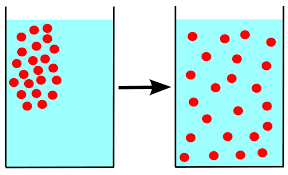
The picture below is an example of _________________.
a)
osmosis
b)
isotonic
c)
diffusion
d)
active transport
63.

What is the definition of Osmosis?

a)

the passive movement of WATER molecules from a high to low concentration across the cell membrane.

b)

the state where molecules are equally concentrated (balanced) on both sides of the cell membrane.

c)

the process that brings LARGE particles INTO the cell through the cell membrane

d)

the movement of molecules across the cell membrane that REQUIRES ENERGY output from the cell

64.
Active transport requires
a)
energy
b)
the nucleus
c)
chloroplasts
d)
lysosomes
65.
The movement of molecules from higher concentration to lower concentration is
a)
diffusion
b)
cell division
active transport
c)
active transport
d)
tonicity
66.
The diffusion of WATER across a semi-permeable membrane is
a)
osmosis
b)
diffusion
c)
endocytosis
d)
exocytosis
67.
Active transport requires ______, moves materials from __________________, and goes _______ the concentration gradient.
a)
No energy, low to high, against
b)
ATP, high to low, with
c)
ATP, low to high, with
d)
ATP, low to high, against
68.
Which diagram best shows the end result of diffusion?
a)
F
b)
G
c)
H
d)
J
69.
Osmosis is a form of ______________. 
a)
Passive Transport
b)
Active Transport
70.
The movement of molecules against a concentration gradient
a)
simple diffusion
b)
facilitated diffusion
c)
active transport
d)
osmosis
71.

If a cell is placed in an environment with MORE oxygen OUTSIDE the cell than inside, the cell will...

a)

gain oxygen

b)

lose oxygen

c)

gain water

d)

lose water

72.
Cells use energy to move materials across a membrane (low to high concentration).
a)
Active transport
b)
Passive transport
c)
Diffusion
d)
Osmosis