
 Worksheets
Heat and Heat Transfer Review
Total questions: 39
Worksheet time: 50mins
What heat transfer method is this an example of?
Convection
Conduction
Radiation

What method of heat transfer is this an example of?
Convection
Conduction
Radiation

What method of heat transfer is this an example of?
Conduction
Convection
Radiation
Near the ceiling of a room the air is warmer; the warm air rises because of __________.
conduction
convection
radiation
Carole owns a two story house with a heating and cooling unit on each floor. In the winter she mostly uses the downstairs unit to heat the house because the volume of warm air __________ and __________, warming the whole house through __________.
expands and rises, convection
expands and sinks, conduction
contracts and rises, conversion
contracts and sinks, conduction
In heat transfer, heat always flows from the _______________ substance to the _______________ substance.
warmer, cooler
cooler, warmer
If two objects have different temperatures, heat will flow from the warmer object to the cooler one UNTIL ____________.
one reaches a temperature of zero
they both have an equal temperature
one runs out of energy
Which of the following is the best example of radiation?
The ocean breeze
The sun heating your body on the beach
Eating ice cream
A wave knocking over a sandcastle
As water in a freezer turns into ice, ___________.
the water absorbs energy from the air in the freezer.
the water absorbs the coldness from the air in the freezer.
the freezer air absorbs heat from the water.
the water neither absorbs nor releases energy
If you put a metal spoon and a wooden spoon into a pot of boiling water, one will become too hot to touch. Why?
Metals conduct heat better than wood.
Wood conducts heat better than metals.
Metals pull in heat because heat is attracted to metals.
Wood isn’t as strong as metals.
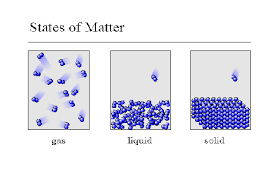
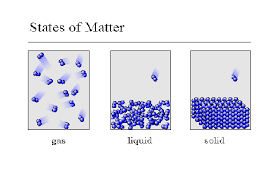

Freezing
Solid to gas
Liquid to solid
Gas to solid

Boiling
liquid to gas
gas to solid
gas to liquid
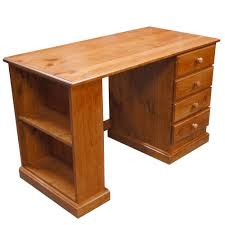

What is happening when my ice cream changes from a solid to a liquid?
freezing
melting
burning

The state of matter that has no definite size or shape is
Solid
Liquid
Gas

Particles in a ______________________ move quickly and are far apart.
gas
solid
liquid

Particles of a liquid
are tightly packed together and stay in a fixed position.
are free to move around one another but still touch.
What is condensation?
gas to solid
gas to liquid
liquid to solid
The slower the particles in a substance move,
the colder it is.
the warmer it is.
the more energy it has.

Definite shape and definite volume
Solid
Liquid
Gas

Has a definite volume but not a definite shape
Solid
Liquid
Gas
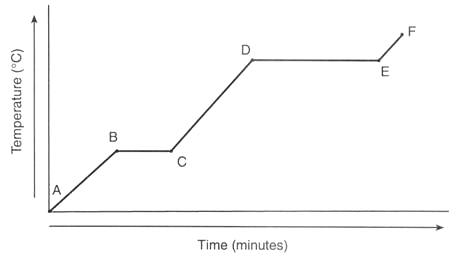
Are the particles moving faster or slower as time goes on? (Diagram F)
Faster
Slower

Is the substance gaining or losing energy? (Diagram D)
Gaining
Losing

What will occur when the substance transitions from B to A? (Diagram A)
condensation
evaporation
melting
freezing

**An ice cube feels cold when we hold it. Which of the following best explains why?
Heat moves from our hands into the ice cube.
Cold moves from our hands into the ice cube.
Heat moves from the ice cube into our hands.
Cold moves from the ice cube into our hands.

