

wayground logo

Free Printable Worksheets

Font size

S
M
L
XL
Worksheets

Chapter 9 - Reactions

Total questions: 40

Worksheet time: 1hrs 15mins
Name
Class
Date
1.
4Si + S8 --> 2Si2S4
a)
Synthesis
b)
Decomposition
c)
Single displacement
d)
Double displacement
2.
3Ca + 2AlCl3 --> 3CaCl2 + 2Al
a)
Synthesis
b)
Decomposition
c)
Single diplacement
d)
Double displacement
3.
3KOH + H3PO4 --> K3PO4 + 3H2O
a)
Synthesis 
b)
Decomposition
c)
Single displacement
d)
Double displacement
4.
2Pb(NO3)2 --> 2PbO + 4NO2 + O2
a)
Synthesis 
b)
Decomposition
c)
Single displacement
d)
Combustion
5.
3Mg + N2 --> Mg3N2
a)
Synthesis 
b)
Decomposition
c)
Single displacement
d)
Combustion
6.
2NO2 --> N2 + 2O2
a)
Synthesis
b)
Decomposition
c)
Single displacement
d)
Combustion
7.
2Fe + 3H2SO4 --> Fe2(SO4)3 + 2H2
a)
Synthesis 
b)
Decomposition
c)
Single displacement
d)
Combustion
8.
P4 + 3O--> 2P2O3
a)
Synthesis 
b)
Decomposition
c)
Single displacement
d)
Combustion
9.
Which chemical reaction breaks down into 2 substances?
a)
Double Replacement
b)
Single Replacement
c)
Synthesis
d)
Decomposition
10.
Which chemical reaction switches 2 elements?
a)
Double Replacement
b)
Single Replacement
c)
Combustion
d)
Decomposition
11.
A + B = AB
a)
Double Replacement
b)
Synthesis
c)
Combustion
d)
Decomposition
12.
AB + CD = AD + CB
a)
Double Replacement
b)
Single Replacement
c)
Combustion
d)
Decomposition
13.
A + BC = B + AC
a)
Single Replacement
b)
Combustion
c)
Double Replacement
d)
Synthesis
14.
Which chemical reaction takes place when 2 substances react to form a single product?
a)
Decomposition
b)
Double Replacement
c)
Single Replacement
d)
Synthesis
15.
AB = A + B
a)
Decomposition
b)
Single Replacement
c)
Combustion
d)
Synthesis
16.
Fe + H2SO4 --> Fe2(SO4)3 + H2
a)
Synthesis (combination)
b)
Decomposition
c)
Single replacement
d)
Combustion
17.
In a chemical equation, is it true that -
a)
the reactant side and product side can have different numbers of atoms for each element
b)
there can be different elements on the reactant side and the product side
c)
an element or compound must be accompanied by a phase change
d)
the coefficients indicate the number of molecules of each reactant used and the number of molecules of each product made
18.
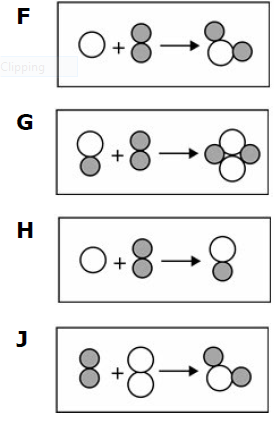
Which of the following models best demonstrates a balanced chemical equation?
a)
F
b)
G
c)
H
d)
J
19.
For an investigation a student poured a blue solution of CuSO4 into a beaker. The student placed a shiny, silver-colored strip of zinc metal in the solution and observed the changes.
The student inferred that a chemical reaction occurred. What evidence supports this inference?
a)
A dark solid formed on the zinc metal.
b)

The zinc metal remained silver-colored and shiny
c)
The CuSO4 solution turned blue when the zinc metal was added.
d)
None of these
20.
The reactants are on the left side of the chemical equation.
a)
True
b)
False
21.
Two clear colorless solutions were combined.
The student observed that the temperature changed from 25 •C to 23 •C when the solutions were combined and that a white substance rapidly formed and settled to the bottom of the container. What most likely happened to produce these results?
a)
One of the original compounds came out of solution
b)
The solutions reacted chemically
c)
Some of the water froze into ice crystals
d)
Rapid evaporation of water occurred, leaving a solid
22.
Coal contains carbon and other elements. Carbon dioxide forms when coal burns in the presence of oxygen. Which of these is the best evidence that a chemical reaction occurs when coal burns?
a)
The shape of the coal changes
b)
Oxygen is present
c)
A new substance is produced
d)
Coal is made up of more than one element
23.
All of the following reactions are correctly balanced except-
a)
A
b)
B
c)
C
d)
D
24.
A scientist performed four investigations using eight different liquids. In each investigation, the scientist combined two of the liquids under a fume hood and recorded observations in the table below.In which investigation is it least likely that the liquids reacted chemically?
a)
1
b)
2
c)
3
d)
4
25.

In a ___________change, a substance changes into a different substance.

a)

Physical

b)

Chemical

26.

Which of these is NOT a sign that a chemical change has occurred?

a)

A loss of transparency

b)

An unexpected color change

c)

A temperature change

d)

The formation of a precipitate

27.

The Law of Conservation of Mass states

a)

that matter exists in all states and reacts the same

b)

that matter can only be changed into new substances by introducing a catalyst

c)

that matter exists in the same state throughout any chemical change

d)

that matter cannot be created or destroyed and that the mass of the products must equal the mass of the reactants

28.

a copper penny turning greenish after a few years.

a)

Physical change

b)

Chemical change

29.

An gel ice pack getting cold after you put it in the freezer for an hour.

a)

Chemical change

b)

Physical change

30.

Which of the following IS a physical change?

a)

Getting a haircut

b)

Rusty metal

c)

sour milk

d)

A compound

31.
_P4+_O  _P2O3
a)
3 P4+1 O→ 2 P2O3
b)
1 P4+1 O→ 2 P2O3
c)
1 P4+ 3 O→ 2 P2O3
d)
1 P4+ 2 O→ 3 P2O3
32.
_AgNO3 + _Cu _Cu(NO3)2 + _Ag
a)
2 AgNO3 + 2 Cu → 3 Cu(NO3)2 + 1 Ag
b)
2 AgNO3 + 1 Cu → 1 Cu(NO3)2 + 2 Ag
c)
1 AgNO3 + 2 Cu → 2 Cu(NO3)2 + 1 Ag
d)
3 AgNO3 + 2 Cu → 3 Cu(NO3)2 + 2 Ag
33.
_BaS + _PtF2  _BaF2 + _PtS
a)
1 BaS + 1 PtF2 → 1 BaF2 + 1 PtS
b)
4 BaS + 2 PtF2 → 1 BaF2 +  1 PtS
c)
1 BaS + 2 PtF2→ 2 BaF2 +  2 PtS
d)
1 BaS + 3 PtF2 →1 BaF2 +  2 PtS
34.
_HCN + _ CuSO _H2SO4 + _Cu(CN)2
a)
2 HCN + 1 CuSO4 → 1 H2SO4 +1Cu(CN)2
b)
1 HCN + 7 CuSO4 → 3 H2SO4 + 8 Cu(CN)2
c)
1 HCN + 2 CuSO4 → 1 H2SO4 + 2 Cu(CN)2
d)
1 HCN + 1 CuSO4 → 2 H2SO4 + 1 Cu(CN)2
35.
_AlBr3 + _K2SO _KBr + _Al2(SO4)3
a)
6 AlBr3 + 1 K2SO4 → 6 KBr + 1 Al2(SO4)3
b)
2 AlBr3 + 3 K2SO→ 6 KBr + 1 Al2(SO4)3
c)
1 AlBr3 + 1 K2SO→ 2 KBr + 3 Al2(SO4)3
d)
2 AlBr3 + 3 K2SO→ 1 KBr + 2 Al2(SO4)3
36.
_SO2 + _Li2Se _SSe2 + _Li2O
a)
1 SO2 + 2 Li2Se → 1 SSe2 + 2 Li2O
b)
1 SO2 + 1 Li2Se → 2 SSe2 + 2 Li2O
c)
2 SO2 + 2 Li2Se → 2 SSe2 +  2 Li2O
d)
2 SO2 + 2 Li2Se → 1 SSe2 + 1 Li2O
37.
_Al + _HCl →_H2 + _AlCl3
a)
2 Al + 2 HCl → 2 H2 + 6 AlCl3
b)
3 Al + 3 HCl → 6 H2 + 2 AlCl3
c)
1 Al + 1 HCl → 3 H2 + 1 AlCl3
d)
2 Al + 6 HCl → 3 H2 + 2 AlCl3
38.
_K + _Cl2 _KCl
a)
2 K + 16 Cl2 → 8 KCl
b)
2 K + 1 Cl2 → 2 KCl
c)
3 K + 4 Cl2 → 3 KCl
d)
1 K + 1 Cl2 →1 KCl
39.
_NaF + _Br2 _NaBr + _F2
a)
1NaF + 2 Br2 →1 NaBr + 2 F2
b)
2NaF + 2 Br2 → 2 NaBr + 2 F2
c)
2 NaF + 3 Br2 → 1 NaBr + 2 F2
d)
2 NaF + 1 Br2 → 2 NaBr + 1 F2
40.
_NH3 + _H2SO4  _(NH4)2SO4
a)
2 NH3 + 1 H2SO4 → 1 (NH4)2SO4
b)
2 NH3 + 1 H2SO4 → 2 (NH4)2SO4
c)
1 NH3 + 1 H2SO4 → 2 (NH4)2SO4
d)
2 NH3 + 2 H2SO→ 2 (NH4)2SO4
