wayground logo

Free Printable Worksheets

Font size

S
M
L
XL
Worksheets

Unit10: Simple Harmonic Motion/Geo. and Phys. Optics F exam rev.

Total questions: 60

Worksheet time: 15hrs 0mins
Name
Class
Date
1.

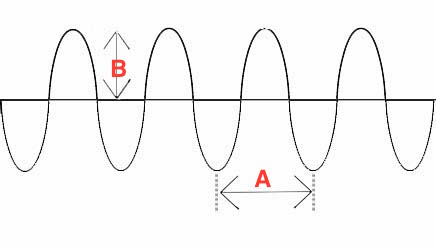
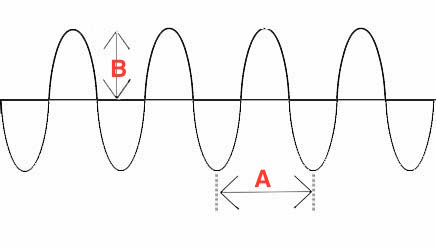
What property of this wave is represented by the letter "A"

a)

amplitude

b)

crest

c)

trough

d)

wavelength

2.
What property of the wave is represented by the letter "B"?
a)
amplitude
b)
crest
c)
trough
d)
wavelength
3.
The number of wavelengths that pass a point each per second is:
a)
frequency
b)
period
c)
longitudinal 
d)
transverse wave 
4.
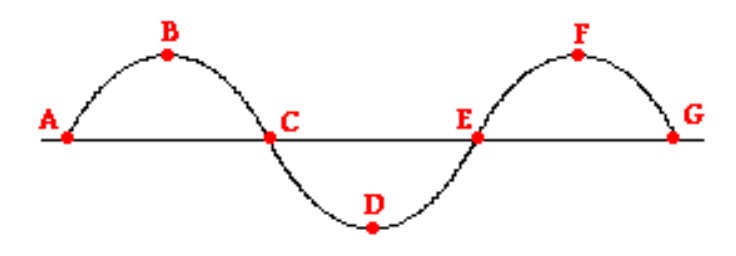
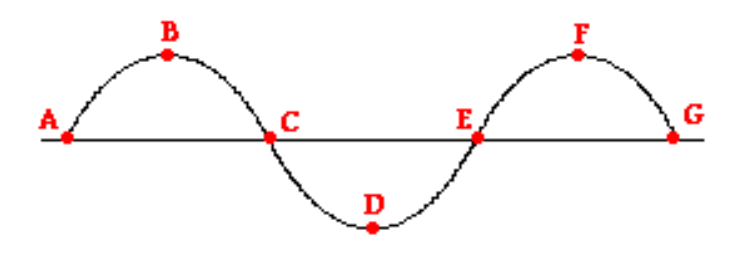
Which letter(s) represent the trough of the wave?
a)
A
b)
B & D
c)
D
d)
C & G
5.
Which letter(s) represent the crest of the wave?
a)
A
b)
B & D
c)
B & F
d)
F
6.
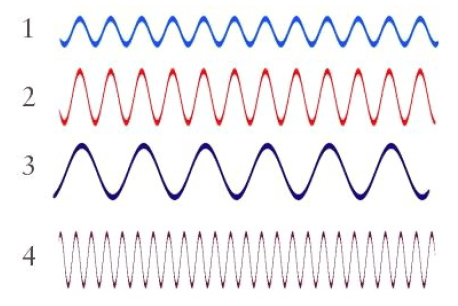
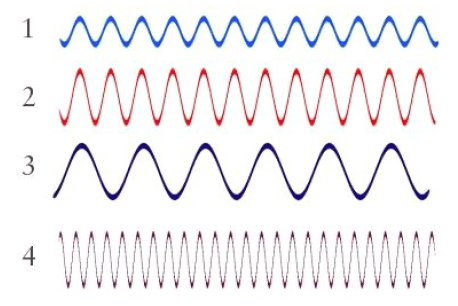
Which wave in the diagram has the greatest frequency?
a)
1
b)
2
c)
3
d)
4
7.
Which wave in the diagram has the greatest wavelength?
a)
1
b)
2
c)
3
d)
4
8.

In a transverse wave, particles move...?

a)

back and forth

b)

vertically

c)

up and down

d)

wherever the matter's going

9.
A wave carries...?
a)
energy only
b)
matter only
c)
the matter carries the energy
d)
neither
10.
Amplitude reflects the amount of ____________________ in a wave.
a)
energy
b)
compression
c)
rarefaction
d)
speed
11.
The units for frequency are measured in _____________.
a)
hertz
b)
seconds
c)
m/s
d)
grams
12.
Which statement best explains the difference between longitudinal and transverse waves?
a)
Longitudinal waves have troughs, while transverse waves have crests.
b)
Longitudinal waves produce energy, while transverse waves consume energy.
c)
Particles in longitudinal waves travel towards a force, while particles in transverse waves travel away from a force.
d)
Particles in longitudinal waves vibrate in the direction the wave is moving, while particles in transverse waves vibrate perpendicular to the direction the wave is moving.
13.

Light waves are ____________ waves.

a)

Transverse

b)

Compressional

c)

Longitudinal

d)

Electromagnetic

14.

What is the only type of EM waves the human eye can see?

a)

Radio waves

b)

Light waves

c)

Visible light

d)

Gamma ray waves

15.

A green laser has a wavelength of 532 nm in a vacuum. What is the frequency of green light?

a)

4.55 x 10¹⁴ Hz

b)

5.64 x 10¹⁴ Hz

c)

4.55 x 10¹¹ Hz

d)

5.64 x 10¹¹ Hz

16.
A sonar device bounces waves with a frequency of 16 Hz off of an object 2 km away and receives an echo in 0.2 s. What is the wavelength of the waves used?
a)
6.25 m
b)
625 m
c)
1000 m
d)
62500 m
17.
Two transverse waves overlap.  Crests overlap with crests.  Troughs overlap with troughs.  The waves are
a)
In-phase
b)
Out-of-phase
c)
In-synchronicity
d)
Out-of-synchronicity
18.
Two transverse waves overlap.  Crests overlap with troughs.  Troughs overlap with crests.  The waves are
a)
In-phase
b)
Out-of-phase
c)
In-synchronicity
d)
Out-of-synchronicity
19.
If two overlapping waves are in-phase, the resultant wave will have ______ compared to the two waves.
a)
Greater amplitude
b)
Greater frequency
c)
Greater wavelength
d)
Greater wave speed
20.
Constructive interference will result if parts of overlapping waves are _____.
a)
In phase
b)
Out of phase
c)
Moving in opposite directions
d)
Moving at the same wave speed.
21.
Destructive interference will result if parts of overlapping waves are _____.
a)
In phase
b)
Out of phase
c)
Moving in opposite directions
d)
Moving at the same wave speed.
22.
What is the superposition of waves?
a)
when a single wave splits into two different waves at a point
b)
when two waves combine at the same place at the same time
23.
What is interference of waves?
a)
A superposition of two waves to form a resultant wave with higher or lower frequency.
b)
A superposition of two waves to form a wave of larger or smaller amplitude.
c)
A superposition of two waves to form a resultant wave with higher or lower velocity.
d)
A superposition of two waves to form a resultant wave with longer or shorter wavelength.
24.
The following is an example of which type of interference? 
a)
constructive 
b)
destructive 
25.
Which wave behavior do noise cancelling headphones use?
a)
diffraction
b)
refraction
c)
constructive interference
d)
destructive interference
26.
The changing pitch of a police siren as the car moves past you
a)
sound interfernce
b)
doppler effect
c)
constructive interference
d)
destructive interference
27.

Storms in the South Pacific can create waves that travel all the way to the California coast, which are 12,000 km away. How long (in days) does it take them if they travel at 15.0 m/s? Round your answer to two decimal places

(a)  

28.

Scouts at a camp shake the rope bridge they have just crossed and observe the wave crests to be 8.00 m apart. If they shake it the bridge twice per second, what is the propagation speed of the waves (m/s)? round your answer to the nearest whole number

(a)  

29.

Wind gusts create ripples on the ocean that have a wavelength of 5.00 cm and propagate at 2.00 m/s. What is their frequency in Hz? round your answer to a whole number

(a)  

30.

Calculate the sound intensity for a sound wave traveling through air at 15° C and having a pressure amplitude of 0.80 Pa. (Hint—Speed of sound in air at 15° C is 340 m/s .) put your answer in scientific notation

(a)  

31.

Given that the sound intensity level of a particular wave is 82 dB, what will be the sound intensity for that wave? put your answer in scientific notation

(a)  

32.
Put the visible light colors in order from longest wavelength to shortest wavelength
a)
Violet, Indigo, Blue, Green, Orange, Yellow, Red
b)
Red, Yellow, Green, Orange, Violet, Blue, Indigo
c)
Red, Orange, Yellow, Green, Blue, Indigo, Violet
33.

What frequency is received by a mouse just before being dispatched by a hawk flying at it at 25.0 m/s and emitting a screech of frequency 3500 Hz? Take the speed of sound to be 331 m/s. Put your answer in scientific notation and round coefficient to two decimal places

(a)  

34.

A spectator at a parade receives an 888-Hz tone from an oncoming trumpeter who is playing an 880-Hz note. At what speed is the musician approaching if the speed of sound is 338 m/s? Round your answer to two decimal places

(a)  

35.
Which has the LONGEST wavelength and, therefore, the lowest frequency/energy
a)
Gamma Rays
b)
Radio Waves
c)
Visible Light
d)
Infrared rays
36.
Which has the SHORTEST wavelength and, therefore, the highest frequency/most energy
a)
Radio waves
b)
Ultraviolet Rays
c)
Gamma Rays
d)
X-rays
37.
Select the correct order of waves on the EMS from the longest wavelength to the shortest wavelength
a)
Radio, Micro, Infra, Visible, Ultra, X-ray, Gamma
b)
Gamma, X-ray, Ultra, Vis, Infra, Micro, Radio
c)
Vis, Micro, Infra, Ultra, X-ray, Gamma, Radio
d)
Micro, Radio, Vis, Infra, Ultra, X-ray, Gamma
38.
How are electromagnetic waves different from other waves? 
a)
They have very short wavelengths 
b)
They transmit energy instead of matter 
c)
They can travel through empty space
d)
They can change direction by reflection 
39.

which type of lens

a)

opaque

b)

convex

c)

concave

d)

plano

40.

which type of lens

a)

concave

b)

convex

c)

opaque

d)

plano

41.

which type of lens

a)

concave

b)

convex

c)

opaque

d)

plano

42.

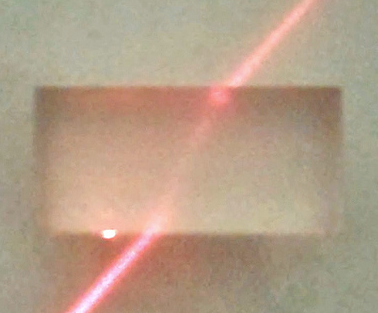
this is an example of

a)

refraction

b)

diffraction

c)

infraction

d)

reflection

43.

what type of mirror is this

a)

concave

b)

convex

c)

translucent

d)

plano

44.

what type of mirror is this

a)

concave

b)

convex

c)

translucent

d)

plano

45.

a convex lens does what to rays

a)

diverges

b)

converges

c)

implodes

d)

merges

46.

which mirror ALWAYS shows things right side up

a)

convex

b)

concave

c)

diverging

d)

converging

47.

We shine a laser light from air into a diamond at a 25o angle. What angle does it make in the diamond? (n1sinΘ1=n2sinΘ2)

a)

0.4132

b)

10.057

c)

.4226

d)

17.46

48.
A diverging lens is also known as a ____lens.
a)
refracted
b)
diffracted
c)
convex
d)
concave
49.
What type of image is formed when rays of light actually intersect?
a)
real
b)
virtual
c)
projected
d)
curved
50.

The critical angle of water when refracted angle is 90 ° and refractive index for water and air is 1.33 and 1 is

a)

48.8 °

b)

49.1 °

c)

50 °

d)

51 °

51.

SI unit of power of lens is

a)

meter

b)

sentimeter

c)

dioptre

d)

dipole

52.

Some telephoto cameras use a mirror rather than a lens. What radius of curvature is needed for a concave mirror to replace a 0.800-m focal-length telephoto lens? Round your answer to two decimal places

(a)  

53.

What is the focal length of a makeup mirror that produces a magnification of 2.00 when a person’s face is 8.00 cm away? round your answer to the nearest whole number

(a)  

54.

An image of a 2.0-cm object reflected from a mirror is 5.0 cm tall. What is the magnification of the mirror? Round your answer to one decimal place

(a)  

55.

Suppose an object, such as a book page, is held 6.50 cm from a concave lens with a focal length of –10.0 cm. Such a lens could be used in eyeglasses to correct pronounced nearsightedness. What magnification is produced? put your answer in decimal notation and round to three places

(a)  

56.
A converging lens produces an image twice the size of the original. If the object is placed 0.40 m from the lens, and the image produced is 0.80 m from the lens. What is the focal length of the lens? 
a)
0.351 m
b)
0.267 m
c)
0.416 m
d)
0.112 m
57.

A tree 20 m high is located 40 m from the converging lens of focal length 0.08 m.Calculate the distance from the lens to the image.

a)

0.08 m

b)

0.01 m

c)

0.10 m

d)

0.20 m

58.

An object is located 35.0 cm from a diverging lens. The lens forms an image at a distance of 15.0 cm. What is the focal length?

a)

26.25 cm

b)

10.5 cm

c)

-26.25 cm

d)

-10.5 cm

59.

An optical fiber uses flint glass (n=1.66) clad with crown glass (n=1.52). What is the critical angle? Round your answer to two decimal places

(a)  

60.

Calculate the index of refraction for a solid medium in which the speed of light is 2.012 × 10^8 m/s, and identify the most likely substance, based on the previous table of indicies of refraction (Table 16.2). Select the answer with the correct decimal notation and the substance name

a)

.149, Carbon Tetrachloride

b)

14.9 Polystyrene

c)

1.49 Polystyrene

d)

1.49 Carbon Tetra Chloride