
 Worksheets
BP Unit 2 Force and Newtons Laws Review
Total questions: 60
Worksheet time: 2hrs 50mins

Why does an 18-wheeler truck have more inertia than a bicycle?
it has more mass
it has more volume
it is not as aerodynamic
It has more space
The force that pulls things down to the surface of the Earth and keeps them from floating away into space.
force
gravity
net force
inertia
Any "push or pull" that change the shape or movement of an object.
force
inertia
gravitational force
gravity
Inertia is a force
True
False

The sketch shows a top view of a rock being whirled at the end of a string (clockwise). If the string breaks, the path of the rock is
A
B
C
D
Suppose you release the pencil while on a bus going 100 km/h. While it is dropping, and relative to the road, the pencil still has a horizontal velocity of …
less than 100 km/h
100 km/h
more than 100 km/h
Suppose you release the pencil while on a bus going 100 km/h. This means that the pencil will strike the floor at a place directly...
behind you
at your feet below your hand
in front of you
Suppose you release the pencil while on a bus going 100 km/h. Relative to you, the way the pencil drops...
is the same as if the bus were at rest
depends on the velocity of the bus
Suppose you are standing in the aisle of a bus that travels along a straight road at 100 km/h, and you hold a pencil still above your head. Then relative to the bus, the velocity of the pencil is 0 km/h, and relative to the road, the pencil It has a horizontal velocity of…
less than 100 km/h
100 km/h
more than 100 km/h

Green arrow up on force diagram
Gravitational force
Normal Force
Applied force
Frictional force
Purple arrow down on force diagram
Gravitational force
Normal Force
Applied force
Frictional force
Blue arrow right on force diagram
Gravitational force
Normal Force
Applied force
Frictional force

What is the net force
36N right
36N left
14N right
14N left
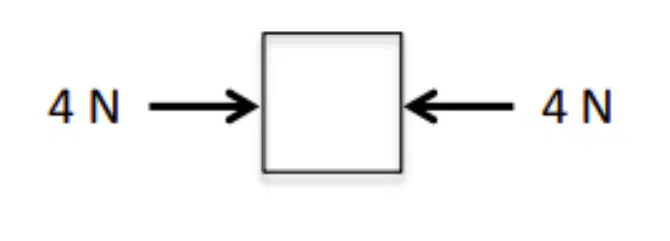
What is the net force
8N right
8N left
0N right
0N no accelereration
What does Statics mean?
Study of accelerating objects and the forces that acting upon those objects
Study of objects that are at rest or at constant velocity
Forces that are opposite in direction and equal in magnitude
Forces that are in the same direction or not equal magnitude
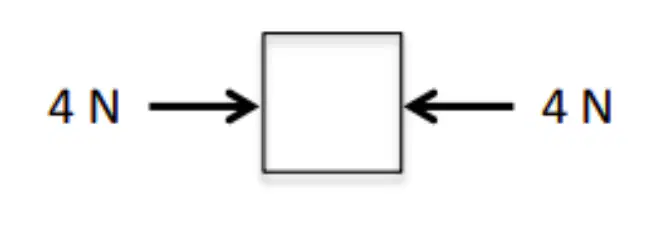
What is a balanced force
Study of accelerating objects and the forces that acting upon those objects
Study of objects that are at rest or at constant velocity
Forces that are opposite in direction and equal in magnitude
Forces that are in the same direction or not equal magnitude

What is a unbalanced force
Study of accelerating objects and the forces that acting upon those objects
Study of objects that are at rest or at constant velocity
Forces that are opposite in direction and equal in magnitude
Forces that are in the same direction or not equal magnitude
What is static equilibrium
Sum of all the forces acting on an object
Forces are all balanced, object is at rest
Forces that are opposite in direction and equal in magnitude
Forces that are in the same direction or not equal magnitude
Net force
Sum of all the forces acting on an object
Forces are all balanced, object is at rest
Forces that are opposite in direction and equal in magnitude
Forces that are in the same direction or not equal magnitude

The net force acting on the object is acting _____.
to the right
to the left
up
down
If the box is moving in the direction of the Blue arrow, the Red arrow represents what on this force diagram?
Gravitational force
Normal Force
Applied force
Frictional force
Force diagrams for all objects on earth (moving or still) always includes this force
Gravity
Inertia
Friction
Applied Force
The amount of 'matter' present?
Mass
Weight
Both
Neither
Units are Newtons
Mass
Weight
Is/Are a measure of FORCE?
Mass
Weight
Both Mass and Weight
Directly related to the value of gravity?
Mass
Weight
Both Mass and Weight
Changes depending on the planet you are on?
Mass
Weight
Both Mass and Weight
Just after someone jumps out of the plane (before the parachute opens). The relative forces will be
Balanced
Unbalanced
Just after someone jumps out of the plane (before the parachute opens). The relative forces will be
Weight force is equal to the friction force
Friction force is constant
Weight force is greater that the friction force
Friction force is greater than the weight force
Just after someone jumps out of the plane (before the parachute opens). The net force will be
zero
upward
downward
After the 60 seconds, the parachutist pulls the cord and opens her parachute.
Explain how the parachute reduces the speed of the parachutist when it is just opened.
The friction force decreases
The weight force decreases
The weight force increases
The friction force increases

The graph shows the vertical speed of a parachutist. At which point did they open the parachute?
A
B
C
D
If a skydiver changes from a vertical (aerodynamic) position to a horizontal (stretched out) position during freefall:
His terminal speed would increase
His terminal speed would decrease
His terminal speed would stay the same
When a parachute canopy is opened more drag is created because:
It has a large mass
It has a large surface area
It is travelling at terminal speed
The person is now vertical

If this graph were to show a parachutist jumping from a plane, how would you describe the forces acting at point B.
His weight is bigger than air resistance
Air resistance is bigger than his weight.
His weight and air resistance are balanced.
An object in equilibrium can still have forces acting on it.
True
False
An object travelling at terminal velocity moves at a steady speed.
True
False

Which diagram shows the forces acting on Peter when he is falling at Terminal Velocity?
1
2
3
When a skydiver is falling what happens to
a) her velocity
b) the air resistance?
a) Increases
b) increases
a) increases
b) decreases
a) increases
b) stays the same
a) stays the same
b) increases
Explain why the skydiver will eventually stop accelerating
The air resistance continues to increase as long as the velocity increases. When the air resistance reaches the same value as the weight there will be no resultant force, hence no acceleration (F=ma)
The air resistance continues to decrease as long as the velocity increases. When the air resistance is larger than the weight there will be no resultant force, hence no acceleration (F=ma)
The air resistance stays the same so the velocity increases. There will be no resultant force, hence no acceleration (F=ma)
The air resistance continues to increase as long as the velocity increases. When the air resistance reaches the same value as the weight there will be an increase in acceleration

A skydiver jumps from a plane. As she falls, air resistance upwards is
decreasing
increasing
constant
zero
A skydiver jumps from a plane. As she falls her acceleration is
decreasing
increasing
constant
zero
A skydiver jumps from a plane. The air resistance has increased so it is equal in size to her weight. The net force acting on her is
decreasing
increasing
constant
zero
When a falling skydiver opens their parachute …
(select all appropriate answers)
Friction is a force that __________ motion.
opposes
promotes
increases
starts
Friction depends on _____ surfaces in contact.
1
2
3
4
You can represent the direction of force using a __________.
signal
vector
diagram
Sliding friction increases with __________.
weight
mass
density

