
 Worksheets
Integrative Methods in Teaching Social Science in Basic Educatio
Total questions: 53
Worksheet time: 44mins
What does A stand in the ADDIE Model?
Analysis
Assessment
Activity
Answer
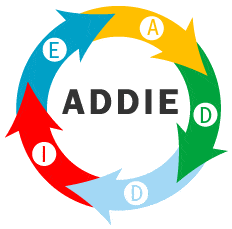
What does the acronym ADDIE stand for when discussing Learning Objectives ( Frankson, 2016)?
Analysis, Design, Develop, Implementation and Evaluation
Analysis, Design, Delivery, Imagine, Evaluate
Acquire, Design, Deliver, Implementation, Evaluation
Analyze, Deliver, Design, Imagine, Examine
Production of the the product
implement
How many steps are in the ADDIE process?
4
5
6
7
In which step of ADDIE model are learning objectives outlined?
Analysis
Design
Development
Implementation
In which step of ADDIE model is the problem identified?
Analysis
Design
Development
Implementation
In which step of ADDIE model are videos created?
Analysis
Design
Development
Implementation
He developed the Cone of Experience
Edgar Allan Dale
Edgar Deal
Edgar Dale
Edgar Gale
"Learning by doing" is also known as _____
Learning experience
Experiential learning
Cone experience
Learning action
In here, we make use of a representative model or mock-ups of reality
Direct experience
Dramatized experience
Exhibits
Contrived experience
These are displays to be seen by expectators
Mock-ups
Exhibits
Models
Motion pictures
These are first hand experiences which serve as the foundation of learning
Direct experience
Contrived experience
Dramatized experience
Field trips
Dale theorized that learners retain more information by what they do than what they only heard
True
False
These are visual and auditory devices which may be used by an individual or a group
Exhibits
Recordings, Radio, Still pictures
Visual symbols
Verbal symbols
Direct experience allows us to all senses.
True
False
Direct purposeful experiences represents reality or the closest things to real, everyday life
True
False
Indirect experience is the basis for the most effective and lasting learning
True
False
What is Robert Mager's approach to instructional design?
Criterion-Refenced Instruction
Nine Events of Instruction
Orgamizational Elements Model (OEM)
Includes written tests and quizzes, graded homework, portfolio, and performance assessments. It's developed prior to assessment.
test score
Formal assessments
Informal assessments
typical performance

This occurs before or more typically during instruction with focus on identifying impediments of learning, such as, prerequisite skills needed for mastery.
Diagnostic evaluation
Formal evaluation
Performance assessment
Maximum performance

Casual observations and oral questions during instruction and occur casually but yet systematically planned. Most classroom assessments are this type of assessment.
formal assessments
Diagnostic evaluation
Informal assessments
Summative evaluation
The process of determining a qualitative or quantitative attribute of an individual or group of individuals that is of academic relevance.
Typical performance
Measurement
Written test
Performance assessment

A direct, systematic observation of an individuals performance, with the process or product outcome of that performance scored using a pre-established criteria.
Test score
Written test
Performance assessment
Preliminary evaluation
What is a norm-referenced assessment?
assesses a student's strengths, weakness, knowledge, and skills prior to instruction
compares a student's performance against other students
assesses a student's performance during instruction, and usually occurs regularly throughout the instruction process
measures a student's achievement at the end of instruction
What assessment measures a student's performance against a goal, specific objective, or standard?
Formative Assessment
Summative Assessment
Criterion-referenced Assessment
Norm-referenced Assessment
This test assesses a very large number of students and develops on a national level.
Formative Test
Criterion-referenced Test
Norm-referenced Test
Summative Test
When interpreting performance, this involves comparing the learner's performance to a well-defined content domain.
Norm-referenced
Criterion-referenced
Norm group
Growth-referenced
When interpreting performance, this approach involves comparing the learner's present performance to a range of previously observed performances, usually the performance of other learners.
Norm-referenced
Criterion-referenced
Ability Grouping
Norm-grouping
For gaining efficiency in math concepts, we need _____.
Norm-referenced evaluation
Criterion-referenced evaluation
Norm-criteria evaluation
Student is exposed to knowledge
During class
After class
Alongside the class
Before class
What´s the main teacher´s role in a flipped classroom?
Guide or facilitator
Lecturer
Information provider
Role model
What do students do in a flipped classroom?
They work on learning contents by heart
They work on imitating all what the teachers do
They work on the application of contents
What is Blended Learning?
Blended learning is where students work in isolation.
Blended learning is where students learn at least in part through online learning, with some element of student control over time, place, path, and/or pace.
Blended learning is replacing actual teaching with digital content and strategies.
Blended learning is only for gifted students or credit recovery. Blended learning is not a successful strategies for students with IEPs and who are ELL.
What are the Blended Learning Models?
Flipped Classroom
Whole Group Rotation
Station Rotation
All of the Above
What of the following phrases best describes blended learning?
It involves two teachers instructing a class approach
It combines elements to face-to-face and online instruction
It combines students of different grade levels into one classroom
It involves older students teaching young students through a mentoring approach
Why do teachers utilize blended learning?
It allows teachers to personalize student instruction
It is easier for a teacher to manage his/her classroom
It involves less grading
It allows teachers time to use the bathroom
Which of the following is a desirable quality of a blended learning environment?
Content engagement
Offering something for every learning style
Flexibility
All of the Above
Students are expected to come to class and already have watched some videos or other kind of instruction. Which model does this fit under?
Whole Group Rotation
Flipped Classroom
Station Rotation
Allows students to physically move between teacher created stations to take ownership of their own learning. Which model does this fit under?
Whole Group Rotation
Station Rotation
Flipped Classroom
Allows teacher to rotate an entire class through a series of online and offline activities while remaining in a single classroom. Which model does this fit under?
Flipped Classroom
Station Rotation
Whole Group Rotation
Backward design begins with
Evidence Assessment
Plan Instruction
End in Mind
How many stages are there in Backward Design?
4
3
2
In Backward design, an enduring understanding is...
the lesson objective or standard
a sentence that generalize what today's lesson in class will be out.
a sentence that generalizes what the students will come to understand about the big idea.
an I can Statement for the student.
The correct order for the stages of the backward design is
Desired results, plan instruction and evidence assessment.
Evidence assessment, Desired results and plan instruction.
Desired Results, Evidence Assessment and Plan Instruction.

In Backward Designing, what is a "Big Idea"
the lesson objective for the day
the concept, theme, or process for a subject or topic
the teacher's standard for the day.
the product the student produces.

In Backward Design, the Essential Question is:
a question that is provocative and arguable
a question designed to guide inquiry to the Big Idea
a question that develops and deepens students understanding.
all of these

The purpose of a performance task is
provide the students a hands on task
demonstrate the Big Idea
provide student evidence of understanding and proficiency.
serve as a project

