wayground logo

Free Printable Worksheets

NEW

Font size

S
M
L
XL
Worksheets

DNA Structure and Replication

Total questions: 40

Worksheet time: 20mins
Name
Class
Date
1.
What is the function of nucleic acids?
a)
store genetic information
b)
store energy (long-term)
c)
store energy (short-term)
d)
build skin, hair, nails, muscles
2.

Which of the following describes the shape of a DNA molecule?

a)

double helix

b)

sphere

c)

pyramid

d)

rectangle

3.
What does DNA stand for?
a)
Deoxyribonucleic acid
b)
Denitrogenous acid
c)
Deribonucleic acid
d)
Diribonucleic acid
4.

Name this structure

a)

double helix

b)

nucelotide

c)

twisted ladder

d)

hydrogen bond

5.
Which organelle is DNA usually found in?
a)
cell membrane
b)
vacuole
c)
ribosome
d)
nucleus
6.

The letters of the DNA alphabet are:

a)

A, C, G and T

b)

A, O, G, and T

c)

C, G, P and T

d)

C, G, T and D

7.

Why is DNA important?

a)

It gives each cell instructions on how to do its job.

b)

It is what the cell membrane is made of.

c)

It helps the cell use water.

d)

It is food for the cell.

8.

A gene tells the cell how to make a __________.

a)

Sugar

b)

Phosphate

c)

Protein

d)

Ribosome

9.

The FULL NAME of the letter A from the DNA alphabet is:

a)

Adenine

b)

Albertine

c)

Augmentium

d)

Arginine

10.

The FULL NAME of the letter G from the DNA alphabet is:

a)

Guavine

b)

Grapine

c)

Glycine

d)

Guanine

11.

The FULL NAME of the letter T from the DNA alphabet is:

a)

Thymine

b)

Tyrosine

c)

Tryptophan

d)

Tellurium

12.

The FULL NAME of the letter C from the DNA alphabet is:

a)

Cytosine

b)

Cysteine

c)

Cryosine

d)

Calypsine

13.

If one strand of DNA says GCT, the other strand says:

a)

GCT

b)

CTA

c)

CGA

d)

TCG

14.

A nucleotide is the building block of:

a)

DNA

b)

Protein

c)

Cell membranes

d)

Mitochondria

15.

The sides of the DNA ladder are made of alternating:

a)

Letters from the DNA alphabet

b)

Sugar and phosphate

c)

Sugar and protein

d)

Phosphate and sulphur

16.

What are the components of a DNA nucleotide?

a)

Deoxyribose, a phosphate and one of the bases: adenine, cytosine, guanine or thymine

b)

Ribose, a phosphate and one of the bases: adenine, cytosine, guanine or uracil

c)

Deoxyribose, a nitrate and one of the bases: adenine, cytosine, guanine or thymine

d)

Ribose, a nitrate and one of the bases: adenine, cytosine, guanine or thymine

17.

The diagram below represents a DNA nucleotide.

What could the part labelled X represent?

a)

Adenosine

b)

Deoxryribose

c)

Phosphate

d)

Guanine

18.

The steps (rungs) of the DNA ladder are made up of __________.

a)

phosphate groups

b)

sugars

c)

nitrogen bases

d)

amino acids

19.
When Cells reproduce, they need to replicate their...
a)
sugar
b)
membrane
c)
DNA
d)
emotions
20.
DNA Replication is the process of turning 1 DNA molecule into...
a)
1 DNA molecule
b)
2 DNA molecules
c)
3 DNA molecules
d)
4 DNA molecule
21.
The enzyme that unwinds the double helix is called
a)
Helicase
b)
Primase
c)
Polymerase
d)
Replicase
22.
The enzyme that adds more nucleotides (monomers into a polymer) is called
a)
helicase
b)
primase
c)
polymerase
d)
 nuclease
23.
When new nucleotides are added, Adenine pairs with
a)
Guanine
b)
Cytosine
c)
Adenine
d)
Thymine
24.
When new nucleotides are added, Cytosine pairs with
a)
Guanine
b)
Cystosine
c)
Adenine
d)
Thymine
25.
When new nucleotides are added, Thymine pairs with
a)
Guanine
b)
Cytosine
c)
Adenine
d)
Thymine
26.
Which sequence of DNA bases would pair with this partial strand
CAT TCA CTG
a)
ATG TGA CAG
b)
TAC ACT GTC
c)
GTA AGT GAC
d)
CAT TCA CTG
27.
The process of DNA replication is called semi conservative because it results in
a)
none of these
b)
Two DNA molecules.  One original molecule and one with two new strands
c)
two exact copies with new strands
d)
two identical molecules, each with 1 original strand and one new.
28.

If a DNA molecule is 10% Guanine which of the following is correct

a)

10% cytosine, 40% adenine, 40% thymine

b)

40% cytosine, 10% adenine, 40% thymine

c)

10% cytosine, 80% adenine, 80% thymine

d)

10% cytosine, 10% adenine, 10% thymine

29.
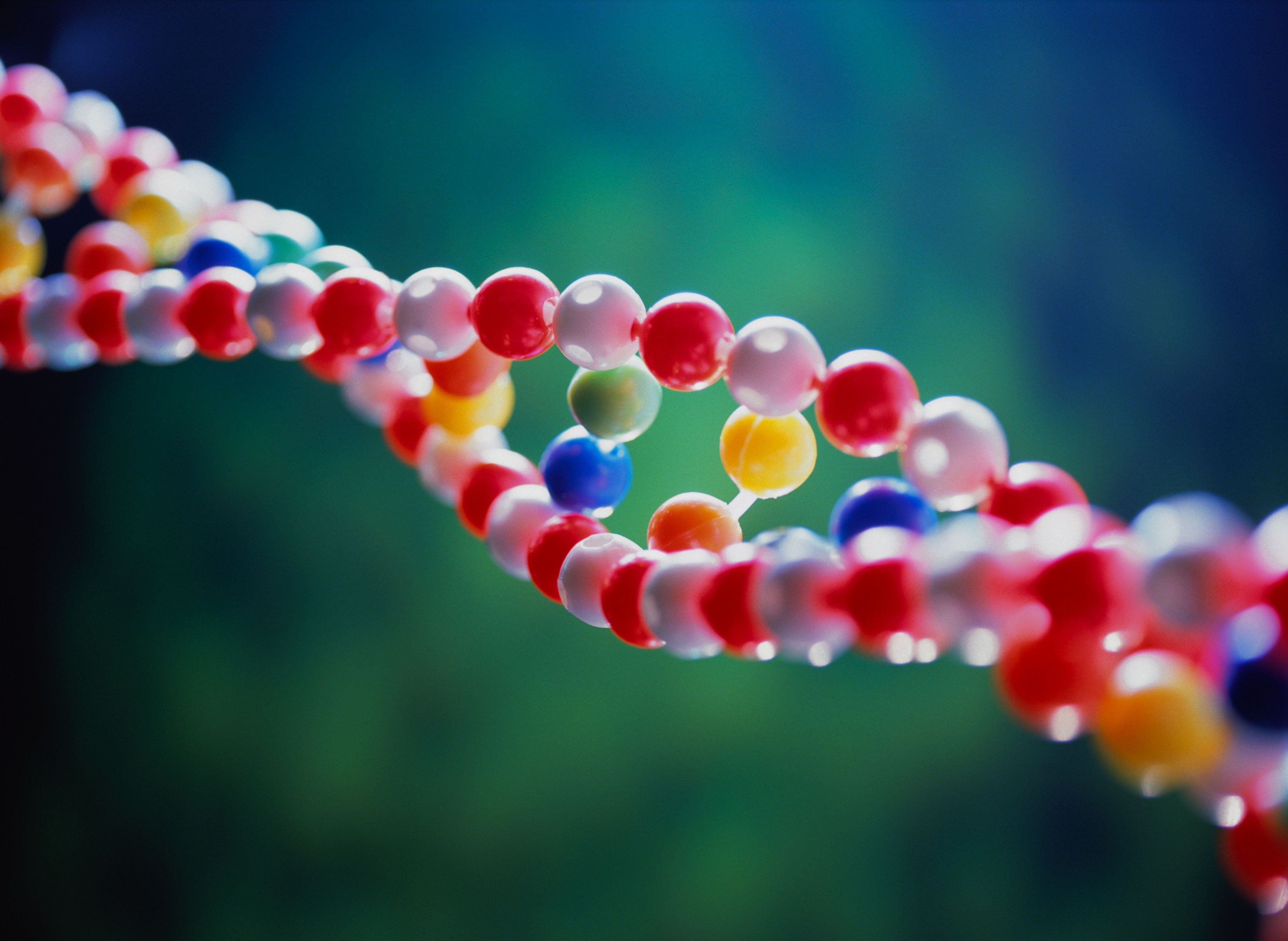
This picture is illustrating the ____ nature of DNA.
a)
anti-parallel
b)
deoxyribosic
c)
helical
d)
radioactive
30.
3' and 5' refer to...
a)
How effectively the helicase works
b)
What direction the nucleotides are pointing
c)
Where the RNA primer attaches
d)
Okazaki's famous experiment
31.
What is the shape of DNA?
a)
Double helix
b)
Triple helix
c)
Flat, bilayer
d)
Three-pronged rigid ladder
32.
Sometimes, DNA is called "semi-conservative." Why might this be?
a)
The old strand is "conserved" and used to make the new strands
b)
Uracil is "conserved" in that it is only used to make the new strands
c)
ATP is "conserved" via the usage of facilitated diffusion
d)
Ligase is "conserved" in that it is denatured by the process
33.
Why is DNA important?
a)
it is very small and very complicated
b)
it's in everything
c)
it serves as the blueprint for traits of all living things
d)
because we eat it every day for energy
34.
Why does DNA replicate?
a)
To create another copy for the new cell
b)
To create a duplicate copy in case the original gets damaged
c)
To create a new copy to replace the damaged original
35.
Place the following in sequential order
1. Recoil
2. Straightens the double helix
3. Breaks Hydrogen bonds
4. Adds Free nucleotides
a)
1, 2, 3, 4
b)
3, 4, 2, 1
c)
3, 2, 4, 1
d)
2, 3, 4, 1
36.

Enzyme that breaks hydrogen bonds (unzips)

a)

Ligase

b)

Polymerase

c)

Primase

d)

Helicase

37.

The new DNA strand formed after DNA replication is an exact copy of its parent strand

a)

True

b)

False

38.

The directionality of DNA is said to be ___________, because it is side by side by goes in opposite directions.

a)

Anti-directional

b)

Parallel

c)

Anti-parallel

d)

Anti-uniform

39.
In a molecule of double-stranded DNA, the amount of Adenine present is always equal to the amount of
a)
cytosine
b)
guanine
c)
thymine
d)
uracil
40.
If the percentage of DNA is made of 30% Thymine, what is the correct percentage of Guanine?
a)
30
b)
15
c)
20
d)
60