wayground logo

Free Printable Worksheets

Font size

S
M
L
XL
Worksheets

States of Matter Pre-test

Total questions: 60

Worksheet time: 39mins
Name
Class
Date
1.

What state of matter?

a)

Solid

b)

Liquid

c)

Gas

d)

Plasma!!!

2.

What state of matter?

a)

Solid

b)

Liquid

c)

Gas

3.

What state of matter?

a)

Solid

b)

Liquid

c)

Gas

4.

Which is not true about the liquid state of matter?

a)

The liquid state has a definite volume and a definite shape.

b)

The liquid state takes on the shape of its container.

c)

The liquid state has a definite volume and an indefinite shape.

d)

The particles in a liquid can easily move past each other.
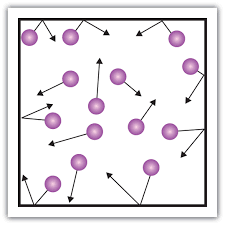
5.

A gas typically consists of:

a)

low energy particles that experience high attractive forces between them.

b)

low energy particles that experience no attractive forces between them.

c)

high energy particles that experience high attractive forces between them.

d)

high energy particles that experience little attractive force between them
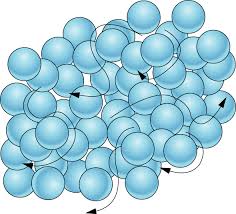
6.

Which of the following statements is true regarding the particle structure of liquids? Particles of a liquid are:

a)

very close together, so the liquid cannot easily change its shape.

b)

fast-moving, so they fill the volume of their container.

c)

relatively close together, so they cannot be easily compressed.

d)

very far apart, so they have plenty of room to move around.

7.

The state of matter in which a material has a definite volume and a definite shape is the:

a)

Solid

b)

Liquid

c)

Gas

d)

Plasma

8.

Which process could cause a material to change state from gas to liquid?

a)

Adding heat

b)

Adding energy

c)

Removing particles

d)

Removing energy

9.

If I add heat to a solid, how will the motion of the particles be affected?

a)

They will move slower

b)

They will stop moving

c)

They will move faster

d)

They will move to a different container

10.

How can you stop the movement of particles?

a)

Increase the temperature

b)

Decrease the temperature

c)

You can't.

d)

Hold them still with your hands.

11.
What are the states of matter?
a)
solid, liquid, and juice
b)
solid and liquid
c)
solid and gas
d)
solid, liquid, and gas
12.

Which form of matter has a definite shape and takes up space (has definite volume)?

a)

liquid

b)

solid

c)

gas

d)

clay

13.
Which form of matter take the shape of a container like this juice?
a)
liquid
b)
solid
c)
glass
d)
gas
14.
Which form of matter fills the space like it has in the balloon?
a)
liquid
b)
string
c)
solid
d)
gas
15.
The milk in the glass has volume and takes the shape of its container. Therefore, it is assumed that milk is a ______________.
a)
solid
b)
liquid
c)
gas
d)
plasma
16.
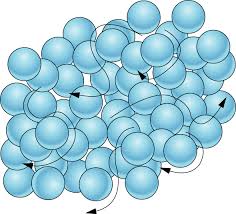
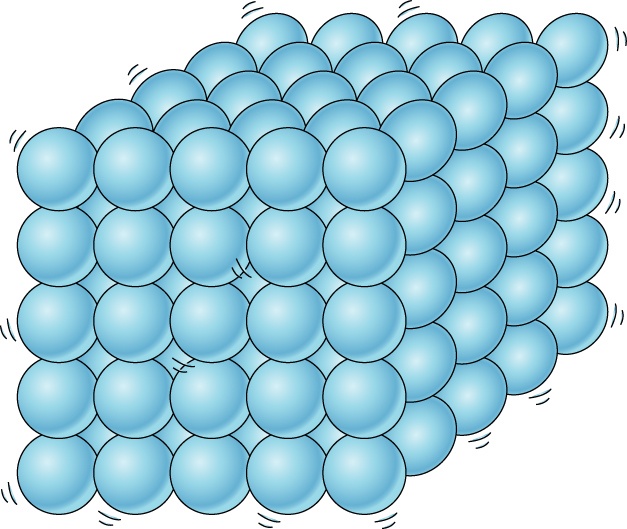
The molecules in the picture are tightly held together with little movement. They have shape and energy.  Therefore, the picture represents _________.
a)
solid
b)
liquid
c)
gas
d)
plasma
17.
Molecules move quickest in which state of matter
a)
solid
b)
liquid
c)
gas
d)
solid, liquid and gas
18.
When the temperature of matter decreases the particles ...
a)
speed up and move farther apart
b)
speed up and move closer together
c)
slow down and move farther apart
d)
slow down and move closer together
19.
When the temperature of matter increases the particles...
a)
speed up and move closer
b)
speed up and move farther apart
c)
slow down and move closer together
d)
slow down and move farther apart
20.
Water can be a solid, liquid, and a gas.
a)
True
b)
False
liquid
21.
Molecules are closest together in a 
a)
Solid
b)
Liquid
c)
Gas
d)
plasma
22.
If the tops were removed from the cylinders, the following would happen:
a)
The solid would fly out of the container
b)
The liquid would fly out of the container.
c)
The gas would fly out of the container.
d)
They ALL would fly out of the container.
23.
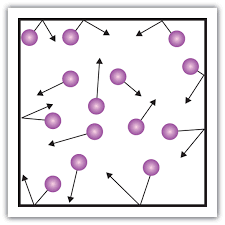
What does this picture represent? 
a)
solid
b)
liquid
c)
gas
d)
plasma
24.
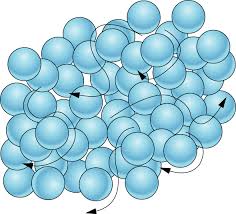
What does this picture represent? 
a)
solid
b)
liquid 
c)
gas
d)
plasma
25.
Which of the following statements is NOT true of all different types of matter?
a)
They are made of atoms and molecules
b)
The particles are always in motion
c)
The particles always move at the same speed
d)
They are made of particles that are too small to see
26.
Something that takes up space and has mass.
a)
volume
b)
matter
c)
mass
d)
density
27.
A state of matter that has a definite volume and shape.
a)
solid
b)
liquid
c)
gas
d)
matter
28.
A measure of how much mass is contained in a given unit of volume.
a)
mass
b)
density
c)
volume
d)
matter
29.
The amount of space something takes up
a)
density
b)
volume
c)
mass
d)
matter
30.
Shape is a ____ that helps identify an object.
a)
physical property
b)
chemical property
c)
mass
d)
matter
31.
A watermelon has more matter than a grape, so it has more
a)
mass
b)
eat
c)
solid
d)
greater
32.
You can measure ______ with grams.
a)
mass
b)
volume
c)
conductivity
d)
melting point
33.
The ability to move, work or cause a change in matter is...
a)
mass
b)
volume
c)
energy
d)
density
34.
One hot summer, you remember you left a cup of water outside. A few weeks later, you saw that the cup was empty and you remember the cup having water. What happened to the water?
a)
It evaporated
b)
It underwent deposition
c)
It melted
35.
Which statement about atoms is true?
a)
They are all the same
b)
All substances are made of just one kind
c)
You can see them with your eyes
d)
They are too small to be seen with an ordinary microscope
36.
Water in its solid form is _____________.
a)
a vapor
b)
ice
c)
a liquid
d)
boiling
37.
Which physical property is measured in liters?
a)
color
b)
length
c)
mass
d)
volume
38.

What units do we use to measure mass?

a)

meter

b)

Celsius

c)

kilogram/gram

d)

Newton

39.

Which of the following determines an object’s ability to float in water?

a)

volume

b)

mass

c)

weight

d)

density

40.

What do protons, electrons and neutrons make?

a)

element

b)

compound

c)

atom

41.

What is the smallest piece of matter that still has properties of that matter?

a)

element

b)

atom

c)

proton

42.

Negatively charged particle

a)

proton

b)

neutron

c)

electron

43.

Neutral charge particle

a)

proton

b)

neutron

c)

electron

44.

Positively charge particle

a)

proton

b)

neutron

c)

electron

45.
The central region of an atom where its neutrons and protons are is its 
a)
nucleus 
b)
electron cloud
c)
core 
d)
center 
46.
Most of the mass in an atom is concentrated in the...
a)
electrons
b)
nucleus
c)
protons
d)
empty space
47.
What does the nucleus consist of?
a)
Protons + Electrons
b)
Neutrons + Electrons
c)
Atoms
d)
Protons + Neutrons
48.
The part of the atom that is moving around the nucleus is called?
a)
electron
b)
neutron
c)
proton
49.
All matter is made of what 
a)
energy 
b)
atoms 
c)
electrons 
d)
compounds 
50.
In an atom, what is the number of protons equal to?
a)
the number of electrons
b)
the number of neutrons
c)
the number of molecules
d)
the number of nuclei
51.
True or False? Neutrons have a negative charge
a)
True
b)
False
52.
Where are electrons of an atom found?
a)
Nucleus
b)
Electron Cloud
c)
Some are in the nucleus and some in the electron cloud.
d)
They are moving everywhere.
53.
Most of the mass in an atom is concentrated in the...
a)
electrons
b)
nucleus
c)
protons
d)
empty space
54.
Which of the following determines the type of element that an atom makes?
a)
size of the nucleus
b)
number of protons
c)
how much the atom weighs
d)
number of neutrons
55.
Particles in an atom that are neutral and have no charge are 
a)
negatrons 
b)
electrons 
c)
neutrons 
d)
protons 
56.
The smallest part of an element is known as the 
a)
Periodic Table
b)
Atom
c)
Group
d)
Period
57.
What is the overall charge of this atom?
a)
+3
b)
-3
c)
0
d)
+1
58.
Can a mixture be separated? 
a)
No
b)
Yes
c)
Only sometimes
59.

Select the temperature in °C

a)

40°C

b)

100°C

c)

96°C

d)

36°C

60.
What tool do we use to measure temperature?
a)
Thermometer
b)
Ruler
c)
Balance
d)
Magnifying Glass