wayground logo

Free Printable Worksheets

NEW

Font size

S
M
L
XL
Worksheets

IPC Spring Final Exam 2023

Total questions: 80

Worksheet time: 55mins

Name
Class
Date
1.

How far will Barkus go in 9 seconds?

a)

9 meters

b)

1 meter

c)

6 meters

d)

10 meters

2.
The baseball park is 4200 m from Camden's house.  I took him 30 minutes to get there.  What was Camden's speed?
a)
.007 m/min
b)
12.60 m/min
c)
140 m/min
d)
126 m/min
3.
A jet airliner flies 4100 km from New York City to San Francisco in 4.25 hours.  What is its average speed?
a)
964.71 km/hr
b)
96.47 km/hr
c)
17,425 km/hr
d)
174.25 km/hr
4.
A bus carrying Ava's friends to a soccer game traveled 10 km in 30 minutes. To determine the average speed of the bus in km/hr, your first step would be to __________?
a)
convert speed to distance
b)
convert minutes to hours
c)
convert hours to seconds
d)
convert seconds to hours
5.
Kelsey ran 130 m in 15 seconds, then she ran 310 m in 25 seconds. What was Kelsey's average speed in m/s?
a)
12.4 m/s
b)
8.67 m/s
c)
11 m/s
d)
10 m/s
6.
Akela rode her bike 48 km for 3 hours, she rested for 1/2 an hour and then rode another 24 km for 1 hours. What was the total distance she rode on her bike?
a)
24 km
b)
72 km
c)
48 km
d)
76 km
7.
Using the graph provided, how long did it a ball to roll 30 cm?  What was the average speed of the ball?
a)
35 seconds, 1.17 cm/s
b)
30 seconds, 1 cm/s
c)
30 seconds, 1.17 cm/s
d)
35 seconds, 1 cm/s
8.

The formula for Speed is...

a)

Speed = distance/ time

b)

Speed = time/ distance

9.

Based on the UNITS given, which of the following would be a correct answer for finding the SPEED.

a)

S = 4 miles

b)

S = 4 minutes

c)

S = 4 min/miles

d)

S = 4 miles/min

10.

Speed -

a)

A measure that gives rate of change and position

b)

A measure that dissolves to one unit

c)

A measure of distance an object travels per unit of time.

d)

A measure of distance an object travels per unit of measurement.

11.
Why does a car accelerate as it round a corner at a constant speed?
a)
Its direction changes
b)
It doesn't
c)
It slows down
d)
Its speeds up  
12.

The SI unit for acceleration is

a)

mph

b)

ft/sec

c)

m/s2

d)

m/s

13.
A negative acceleration means that your object is _____. 
a)
not accelerating
b)
not moving
c)
speeding up 
d)
slowing down 
14.
A box sliding down an inclined plane attains a velocity of 27 m/s in 3 seconds from rest.  Find the acceleration.
a)
30 m/s
b)
24 m/s2
c)
9 m/s2
d)
81 km/hr
15.
A car starts from rest at a stop light and reaches 20 m/s in 3.5 s. Determine the acceleration of the car.
a)
2.2m/s2
b)
7.0m/s2
c)
5.7m/s2
d)
70m/s2
16.

What type of acceleration is shown in the graph?

a)

positive

b)

negative

c)

centripetal

d)

Zero

17.

Acceleration is defined as

a)

the change in velocity over time

b)

the change in position over time

c)

the change in time over velocity

d)

the change in time over distance

18.

What type of acceleration is shown in the graph?

a)

positive

b)

negative

c)

0 or no acceleration

d)

centripetal

19.

If you speed up then velocity and acceleration are in _____________, but if you slow down velocity and acceleration are in _______________.

a)

the same direction; the same direction

b)

opposite directions; opposite directions

c)

opposite directions; the same direction

d)

the same direction; opposite directions

20.
Describe the motion of the car.
a)
The car has acceleration because it is at rest 
b)
The car does not have acceleration because it is at rest 
c)
The car has velocity because it is at rest 
d)
The car has acceleration because it is at rest 
21.
Determine the motion of he car.
a)
speeding up
b)
slowing down
c)
at rest
d)
moving at constant speed
22.
Determine the motion of the car ?
a)
Speeding up
b)
slowing down
c)
at rest
d)
constant velocity
23.
Determine the motion of the car.
a)
at rest 
b)
moving at constant speed
c)
speeding up
d)
slowing down
24.

speed of an object in a particular direction

a)

motion

b)

velocity

c)

speed

d)

acceleration

25.

when an object changes its position compared to a reference point.

a)

acceleration

b)

speed

c)

motion

d)

reference point

26.

total distance traveled divided by total time taken to travel that distance

a)

velocity

b)

motion

c)

acceleration

d)

average speed

27.

the rate at which speed or velocity changes

a)

acceleration

b)

average speed

c)

motion

d)

reference point

28.

What is happening at segment E?

a)

acceleration

b)

deceleration

c)

constant speed

d)

no motion/object at rest

29.

What is happening at segment B?

a)

acceleration

b)

deceleration

c)

constant speed

d)

no motion/object at rest

30.

What is happening at segment B?

a)

no motion/object at rest

b)

constant speed

c)

acceleration

31.

What is happening at segment A?

a)

no motion/object at rest

b)

constant speed

c)

deceleration

32.

A runner crossed the 1 mile marker of a race running at a speed of 9 miles per hour. She crossed the finish line running at a speed of 9.8 miles per hour. Did the runner change her velocity?

a)

Yes

b)

No

33.

A snake slithered across the sidewalk in between two sign posts. At the first sign post his speed was 1.2 m/s. At the second sign post his speed was 1.2 m/s. This is an example of...

a)

positive acceleration

b)

negative acceleration

c)

no acceleration

34.

a=Δυta=\frac{\Delta\upsilon}{t}  

An object at rest begins to move to a final speed of 30 m/s in 5 seconds. Calculate the object's acceleration.

a)

6 m/s2

b)

-6 m/s2

c)

150 m/s2

d)

0.17 m/s2

35.

a=Δνta=\frac{\Delta\nu}{t}  

An object traveling at speed of 20 m/s increases to a speed of 80 m/s in 3 seconds. What is the object's acceleration?

a)

20 m/s2

b)

-20 m/s2

c)

33.3 m/s2

d)

4 m/s

36.

a=Δvta=\frac{\Delta v}{t}  

An objects traveling at 10 m/s comes to a complete stop in 2 seconds. What is the objects acceleration?

a)

-5 m/s2

b)

5 m/s2

c)

0.2 m/s2

d)

200 m/s2

37.

a=Δvta=\frac{\Delta v}{t}  

A car traveling at a speed of 25 m/s increases its speed to 30.0 m/s in 10 seconds. What is the magnitude of its acceleration?

a)

0.5 m/s2

b)

-0.5 m/s2

c)

-5.5 m/s2

d)

2 m/s2

38.
The speed boats speed increased from 0m/s to 24m/s in a time span of 12 seconds.
a)
4 m/s²
b)
2 m/s²
c)
8 m/s²
d)
6 m/s²
39.
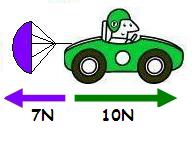
Calculate the net force of the object in the image shown.
a)
20N
b)
35N
c)
5N
d)
25N
40.

What is the net force?

a)

3 N

b)

3 N, right

c)

17 N, right

d)

3 N, left

41.
What is the net force?
a)
20 N 
b)
0 N 
c)
400 N 
d)
40 N 
42.

A ____________ is a push or a pull on an object.

a)

friction

b)

force

c)

magnet

d)

gravity

43.
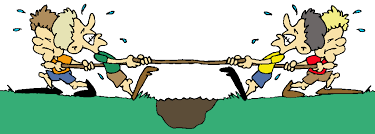
If these teams are pulling with the same amount of force what will happen?
a)
The boy in blue will win.
b)
They will not move at all.
c)
The boy in red will win.
d)
Both will fall down.
44.

Forces that have a net force of zero Newtons

a)

Balanced force

b)

Unbalanced force

45.
The sum of all forces acting on an object.
a)
Contact Force
b)
Balanced Force
c)
Unbalanced Force
d)
Net Force
46.
What will cause an object to move?
a)
Applied forces
b)
Balanced forces
c)
Unbalanced forces
47.
With unbalanced forces, the object will move in the direction of the _______ force.
a)
larger 
b)
smaller 
c)
equal 
48.

When the vectors (arrows) point away what function do you use?

a)

Dividing

b)

Multiplying

c)

Subtracting

d)

Adding

49.

When your position changes, you're in ____________.

a)

motion

b)

force

50.

What is speed?

a)

A measure of how fast something moves.

b)

A measure of how you move.

51.

Which requires more force to move it?

a)

A heavy object, like a bowling ball.

b)

A light object, like a tennis ball

52.
Which force is so low that it causes the man to slip and fall?
a)
Gravity
b)
Friction
c)
Air Resistance
d)
Motion
53.

When an object is moving, friction acts in the _______ direction as the motion.

a)

perpendicular

b)

same

c)

opposite

d)

precise

54.
This force holds us to earth’s surface.
a)
friction
b)
mass
c)
gravity
d)
tension
55.

What is the magnitude and direction of the force in the free body diagram shown?

a)

70 N right

b)

70 N left

c)

50 N right

d)

50 N left

56.
If there are two forces going in the same direction how would you find the net force?
a)
Subtract
b)
Add
c)
Neither
d)
Multiply
57.

Energy is

a)

the force to do work.

b)

the ability to do work.

c)

a push or pull upon an object.

d)

flow of electrical charges.

58.
Energy due to motion is ____________ energy. 
a)
Potential 
b)
Energy
c)
Kinetic
d)
Friction
59.
The faster an object moves, the ________ kinetic energy it has. 
a)
more
b)
less
c)
none of the above
d)
all of the above 
60.
The SI unit in which kinetic energy is measured is 
a)
Newton
b)
Kilogram
c)
Joules
d)
Metres per second
61.
Calculate the kinetic energy of a moving 4 kg object travelling at a velocity of 3 m/s.
a)
18 J
b)
36 J
c)
12 J
d)
6 J
62.
How much kinetic energy does a moving 6 kg object have if it moves with a velocity of 3 m/s?
a)
27 J
b)
18 J
c)
9 J
d)
2 J
63.

What is potential energy?

a)

The energy an object has due to its atomic structure.

b)

The energy an object has due to its chemical composition.

c)

The energy an object has due to its motion.

d)

The energy an object has due to its position or condition.

64.

Which object has the most potential energy?

a)

A ball resting on the ground.

b)

A ball being thrown at 100 miles per hour.

c)

A ball on top of a refrigerator.

d)

A ball resting on the edge of a cliff.

65.

When does a yo-yo have the most potential energy?

a)

When it's at its highest point.

b)

When it's at its lowest point.

c)

When it's moving between its highest and lowest points.

d)

When it's moving at its top speed.

66.

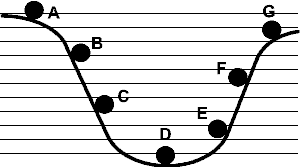
At which point does the ball has the greatest gravitational potential energy (GPE)?

a)

A

b)

G

c)

D

d)

C

e)

G

67.
Gravitational potential energy depends on the ________ and ________ of the object. 
a)
Height and mass
b)
Friction and movement
c)
Mass and Movement
d)
Height and Friction 
68.
As a pendulum swings from its highest to lowest position, what happens to its kinetic and potential energy? 
a)
Both the potential energy and kinetic energy decrease
b)
The potential energy decreases while the kinetic energy increases 
c)
The kinetic energy decreases while the potential energy increases 
d)
Bothe the potential energy and kinetic energy increase 
69.
How do you calculate power?
a)
P = W/t
b)
P = E/t
c)
P = w * t
d)
P = bbq/chicken
70.
The SI unit of work is?
a)
Joules
b)
Watts
c)
Newtons
d)
meters
71.

A current of 3.7 amps is running through a circuit with a resistance of 1.5 ohms. What is the voltage?

a)

5.55V

b)

2.47V

c)

0.41V

72.

If the current in a circuit is 10 amps and the resistance is 3 ohms, what is the voltage?

a)

30V

b)

3.33V

c)

0.3V

73.

If the battery in a circuit is 24 V and the resistance is 12 ohms, what is the current, I?

a)

2A

b)

0.5A

c)

288A

74.

Given a voltage of 120 volts and a current of 5 amps, what is the resistance?

a)

24Ω

b)

0.042Ω

c)

600Ω

75.

Given a resistance of 1500 ohms and a current on 0.03 amps, what’s the voltage?

a)

45V

b)

0.00002V

c)

50000V

76.

Resistance is 200 ohms and voltage is 24 V. Find I.

a)

0.12A

b)

8.33A

c)

4800A

77.

Battery potential is 12 volts and current is 2.7 amps. What’s the resistance?

a)

4.44Ω

b)

0.225Ω

c)

32.4Ω

78.

House voltage is 110 volts. If a light bulb runs a current of 0.5 amps, what’s the resistance of the bulb?

a)

220Ω

b)

0.0045Ω

c)

55Ω

79.

Your car battery is a 12 V DC source. Typically you might find a fuse that can handle a 5 amp surge. What resistance is that fuse protecting?

a)

2.4Ω

b)

60Ω

c)

0.42Ω

80.

You might have a flashlight that runs (2) D-cells of 1.5 volts each in series. The bulb is rated for 0.7 amps. What’s its resistance?

a)

4.29Ω

b)

2.14Ω

c)

1.05Ω