wayground logo

Free Printable Worksheets

NEW

Font size

S
M
L
XL
Worksheets

World History Final Exam Review

Total questions: 74

Worksheet time: 46mins

Name
Class
Date
1.
Millions of slaves were brought from Africa to North and South America to perform labor. Which of the following was one of the jobs that many slaves performed in the Americas? 
a)
They worked as merchants
b)
They worked on plantations
c)
They worked in colonial armies
d)
They worked as artists
2.
What was the significance of Gutenberg inventing the printing press? 
a)
It attached paper sheets together for books to be bound faster and more easily.
b)
It provided an opportunity for news to travel more quickly to a broader audience.
c)
It established English as the primary language spoken around the world.
d)
It provided a way to add other colors beside black to printed documents.
3.
The phrase "Renaissance Man" has been used to describe Leonardo da Vinci. Why is this phrase used to describe Leonardo da Vinci? 
a)
Leonardo da Vinci was an outspoken critic of the new ideas developed during the Renaissance.
b)
Leonardo da Vinci was the first person born during the Renaissance.
c)
Leonardo da Vinci had a wide knowledge of many subjects and had diverse talents.
d)
Leonardo da Vinci started a university and taught many famous artists.
4.
What was the MAIN reason for the decline of Native American populations after European contact?
a)
Exposure to European diseases
b)
Mass emigration to Europe and Africa
c)
Numerous natural disasters
d)
Widespread famine and starvation
5.
During the Renaissance, a new intellectual movement known as humanism evolved. What was the significance of the humanist movement? 
a)
Humanists were inspired by classical texts and emphasized the dignity and worth of the individual.
b)
Humanists spread the teachings of Eastern philosophers such as Confucius throughout Europe.
c)
Humanists were very interested in religious studies and sought to increase the influence of the Church.
d)
Humanists felt formal education was impractical and unnecessary; therefore, many schools were closed.
6.
Early in the Industrial Revolution, why did many employers want to hire women and children rather than men to work in factories? 
a)
Employers could pay women and children less.
b)
Women and children were skilled workers.
c)
Children were a burden at home and needed work.
d)
Men were farmers and did not need factory jobs.
7.
How did the Columbian Exchange impact people living in Europe and in the Western Hemisphere? 
a)
Millions of Native Americans moved to Europe and assimilated into European society.
b)
People across Europe began practicing Native American religions.
c)
Many Europeans were enslaved and taken to North and South America.
d)
People in both places were introduced to new crops and animals.
8.
Which aspect of the Haitian Revolution made it different from the any other revolutions? 
a)
The Haitian Revolution involved a slave rebellion.
b)
The Haitian Revolution did not involve European powers.
c)
The Haitian Revolution did not succeed in its goals.
d)
The Haitian Revolution overthrew an emperor.
9.
What term is used to describe the journey of African slaves across the Atlantic Ocean? 
a)
the Great Passage
b)
the Middle Passage
c)
the Long Passage
d)
the Northwest Passage
10.
The rise of fascist regimes in countries like Italy and Germany in the early 20th century came about in part because of which of the following? 
a)
fear of anti-semitism which spread through Europe
b)
imperialist aims of Eastern European countries
c)
economic and emotional burdens following World War I
d)
high employment rates during the inter-war years
11.
Why was the United Nations formed in 1945? 
a)
to form the Pacific and Atlantic Charters to help rebuild war-torn countries
b)
to provide economic rebuilding support for countries impaired by civil war
c)
to intervene in conflicts between governments in hopes of avoiding future wars
d)
to honor those who have died in the military for their countries in times of war
12.
What was responsible for the death of so many Native Americans?
a)
Advanced Weaponry
b)
Tribal Warfare
c)
Hernan Cortes
d)
Disease
13.

John Locke believed a government should not deprive citizens of their natural rights of...

a)

freedom of religion

b)

life, liberty, and property

c)

owning a weapon

d)

a fair and speedy trial

14.

2. Which of the following was the leading cause of WWI?

a)

a. Feminism

b)

b. Humanism

c)

c. Communism

d)

d. Imperialism

15.

6. Study the picture above and choose the best answer that represents the ideas revealed in the WWI event.

a)

a. WWI was fought by men who were fearful to face the enemy during the day

b)

b. the picture is a true example of a war that was fought on friendly terms


c)

c. WWI militaries used tanks to surprise the enemy

d)

d. WWI militaries used trenches as a cover from attacking enemies the condition was wet and many had diseases like trench foot.

16.
This is extreme feelings of patriotism
a)
Militarism
b)
Nationalism
c)
Isolationism
d)
Reparations
17.
The death of Franz Ferdinand Started WWI. Where was he from?
a)
Minnesota
b)
Germany
c)
Austria-Hungary
d)
Russia
18.
a belief in one God
a)
Gilgamesh
b)
monotheism
c)
polytheism
d)
scribe
19.
What invention helped to spread the information of the Reformation?
a)
The Globe
b)
The Mona Lisa
c)
The Paint Brush
d)
The Printing Press
20.
Feudalism
a)
political system of land agreements with lords and vassals
b)
increase in strong central government
c)
depended on support of emperors
d)
was instituted by the church
21.
What is a Tyrant?
a)
Leadership that was passed down from generation to generation
b)
A small group of rich and powerful people
c)
Leaders that took control of the government by force
d)
A place where people met
22.
What is a Democracy?
a)
A government where one man ruled
b)
A government by the people, where people voted on issues
c)
A government lead by a small group of rich people
d)
A place where people met to discuss the government
23.
What is an Oligarchy?
a)
An old church
b)
A system of government where one man rules all
c)
A government where the people rule and vote on laws
d)
A system of government where a small group of rich and powerful men rule
24.
What is a Monarchy?
a)
Leaders that took control by force
b)
A government where one man rules. It was passed father to son
c)
A government where people voted on laws and government issues
d)
A type of butterfly
25.
Aristocrats were.......
a)
All citizens living in Ancient Greece
b)
Government meaning ruled by the Best and Richest
c)
Government rules by one tough leader
26.
What is a citizen?
a)
The people that had right and responsibilities in a city-state
b)
A rich, land owner
c)
A place where people met and talked about the government
d)
Rule passed from father to son
27.

Which of these best describes the Scramble for Africa?

a)

Imperialist powers sliced Africa amongst themselves by drawing borders on a map

b)

Diplomats worked with tribal leaders to determine how to colonize countries in Africa

c)

European countries worked to finance capital expansion in African nations through loans.

d)

The United States used the Roosevelt Corollary to prevent nations from colonizing Africa.

28.

Define "colony."

a)

a country which is controlled by a more powerful country.

b)

the policy of extending the rule or authority of an empire or nation over foreign countries, or of acquiring and holding colonies.

c)

An area of land under the jurisdiction (rule) of a ruler or state.

d)

Having power and influence over others.
29.
the process of moving from an agricultural society, in which most goods are handmade, to a society that thrives on machine-manufactured goods
a)
textile
b)
economy
c)
industrialization
d)
technology
30.
the use of human knowledge to create tools and machines that allow us to navigate and control the environment; does NOT have to be electronic
a)
industrialization
b)
technology
c)
economy
d)
textile
31.
Why were railroads so important during this time?
a)
they moved goods more quickly and less expensively over greater distances
b)
they were fun to ride on to go visit family in other states
c)
people could ride on railroads to get to their jobs in another city
32.
In what country did the Industrial Revolution begin?
a)
United States
b)
France
c)
Great Britain
33.
Who invented cotton gin and interchangeable parts?
a)
John Deere
b)
Eli Whitney
c)
Samuel Slater
d)
Elias Howe
34.

Who was the leader of Russia during World War II?

a)

Mussolini

b)

Stalin

c)

Roosevelt (FDR)

d)

Hitler

35.

What was the policy called that continually gave in to Hitler's demands in order to prevent conflict with Germany?

a)

policy of appeasement

b)

policy of nullification

c)

policy of aggression

d)

policy of enactment

36.
Which of these is described below? *signed at the end of WWI *required Germany to pay Allies for damages caused by the war*required Germany to reduce the of its miliary
a)
the New Deal
b)
the United Nations
c)
the Treaty of Versailles
d)
the North Atlantic Treaty Organization
37.
Two superpowers that emerged after World War II
a)
Soviet Union and Germany
b)
United States and Germany
c)
Soviet Union and China
d)
United States and Soviet Union 
38.
A system of government that exerts complete control over its citizens; individuals have no rights and all opposition to the government is suppressed
a)
Monarchy
b)
Totalitarianism
c)
Democracy
d)
Communism
39.
A political movement that promotes an extreme form of nationalism, a denial of individual rights, and a dictatorial one-party rule
a)
Fascism
b)
Communism
c)
Socialism
d)
Democracy
40.
Appealed to Italy's wounded pride and fear of communism, established the first Fascist Party, took over the Italian government after the march on Rome
a)
Adolf Hitler
b)
Benito Mussolini
c)
Francisco Franco
d)
Joseph Stalin
41.

What policy implemented in the Cold War said the U.S. would give military aid to a country that needed to resist communism?

a)

Marshall Plan

b)

Truman Doctrine

c)

Domino Theory

d)

Open Door Policy

42.
America's relationship with the Soviet Union was called a "Cold War" because the...
a)
Soviets fought the United States by freezing prices
b)
the United States fought the Soviet Union during their harsh, cold winter
c)
Soviet Union and the United States were enemies, but no official war took place
d)
Soviet Union and United States were developing nuclear weapons using cold fusion
43.
NATO stands for: 
a)
New Alliance Trade Organization 
b)
North Atlantic Treaty Organization
c)
North American Trade Organization
d)
North American Treaty Organization
44.
“…An iron curtain has descended across the Continent. Behind that line lie all the capitals of the ancient states of Central and Eastern Europe… and the populations around them lie in what I must call the Soviet sphere…”  - Winston Churchill
.
Winston Churchill’s remark above on the “iron curtain” in  Europe is describing what?
a)
the division in Europe during the Cold War
b)
the destruction of Europe during the Cold War
c)
the diversity in Europe during the Cold War
d)
the depression in Europe during the Cold War
45.
The Code of Hammurabi was a major achievement for which of the following reasons?
a)
It was the first major collection of laws.
b)
It treated men and women as equals.
46.
Which event is most closely associated with the French Revolution?
a)
Council of Trent
b)
Thirty Years War
c)
The Reign of Terror
d)
Paris Peace Conference
47.
"Christians should be taught that he who gives to a poor man or lends to a needy man does better than if he used the money to buy an indulgence." Which major movement in European history started with the idea expressed in this statement?
a)
Commercial Revolution
b)
Industrial Revolution
c)
Protestant Reformation
d)
Renaissance
48.
Which of the following was NOT a cause for European exploration?
a)
God
b)
Glory
c)
Gold
d)
Gentility
49.
Difference between History vs Prehistory?
a)
Invention of Fire
b)
Invention of Writing
c)
Invention of the Wheel
d)
Invention of Geometry
50.
The Neolithic Revolution was spurred by?
a)
Farming
b)
Hunting
c)
Writing
d)
Cooking
51.
What are the 8 Characteristics every Civilization has to have?
a)
Advanced Cities, Organized Government, Complex Religions, Job Specialization, Social Classes, Public Works, Art and Architecture and Writing
b)
Advanced Cities, Organized Government, Fire, Job Specialization, Social Classes, Public Works, Art and Architecture and Writing
c)
Advanced Cities, A dictator, Complex Religions, Job Specialization, Social Classes, Public Works, Art and Architecture and Writing
d)
Advanced Cities, Organized Government, Complex Religions, Job Specialization, No Hierarchy, Public Works, Art and Architecture and Writing
52.
Based on the text above answer the following questions:What does Laws 202 - 205 of Hammurabi's code tell you about the importance of the class system in ancient Babylon
a)
Class System was not important at all, everybody was treated equally
b)
Class system was of upmost importance because the lower classes got treated better than those of the higher class
c)
Class system was of upmost importance because the lower classes got punished harsher for breaking the laws than did those of the upper class
d)
Slaves could do what they wanted in ancient Babylon
53.
Which of the 5 major religions were monotheistic?
a)
Christianity, Judaism, Islam
b)
Hinduism, Buddhism, Islam
c)
Christianity Buddhism, Judaism
d)
Judaism, Islam, Buddhism
54.
Which event, more than any other, signified the beginning of the ‘dark ages’ in Europe
a)
The Collapse of the Roman Empire
b)
The Bubonic Plague
c)
The Crusades
d)
The development of towns
55.
What did Charlemagne want to use to unite all of Europe?
a)
Christianity
b)
Paganism
c)
The Turks
d)
The Byzantines
56.
A loosely organized system of rule in which powerful local lords divided their landholdings among lesser lords is called:
a)
Feudalism
b)
Manor Life
c)
Democracy
d)
Monarchy
57.
The Crusades were an attempt for the Christian Kingdoms of Western Europe to do what?
a)
Take back the Eastern Part of Rome from the Byzantines
b)
Protect the Holy Land from Muslim Control
c)
To spread Christianity far and wide
d)
It was a pilgrimage to the Holy Land
58.
Which of the following statements best describes the 1215 Magna Carta's impact on history?
a)
It implied the monarch was subject to the law and must obey it like everyone else.
b)
It created constitutional monarchy in England from that time on.
c)
Parliament was established in order to control the barons.
d)
It ended feudalism in England.
59.
What is another name for the Black Death?
a)
Bubonic Plague
b)
Smallpox
c)
Chicken Pox
d)
Pneumonia
60.
Enlightenment thinkers contributed to changes in relationships between citizens and governments through their belief that
a)
Most changes in government are dangerous.
b)
Absolute monarchy is the most effective form of government
c)
Governments are instituted to protect citizens' rights
d)
Popular liberties should be limited by the need for social order.
61.
Which type of government allows people to choose representatives to make decisions?
a)
Monarchy
b)
Oligarchy
c)
Republic
d)
Direct Democracy
62.
How did the new ideas and scientific advances of the Renaissance and Scientific Revolution challenge the Catholic Church?
a)
New Renaissance Universities, which emphasized scientific research, gave most citizens educational oppurtunities that challenged the religious institutions
b)
Individualism and humanist ideas from the Renaissance challenged citizens to seek answers for themselves rather than from religious institutions.
c)
New mechant guilds formed by the middle class owed allegiance to the leaders of the Renaissance rather than the Catholic Church
d)
Feudal noble landowners accepted the scientific advances of the Renaissance that were supported by the Catholic Church
63.
What was a significant result of European exploration through the Columbian Exchange?
a)
Europeans became dependent on crops from America
b)
The bubonic plague spread throughout Europe
c)
European Diseases caused millions of deaths among American Indians
d)
Raw materials from America became very expensive due to scarcity
64.
In which country did the Industrial Revolution begin in the late 18th Century?
a)
Britain
b)
France
c)
Russian
65.
This style of economy called for no gov't interference.
a)
Laissez Faire
b)
Communism
66.
What was the Zimmermann Note?
a)
Wilson’s speech detailing reasons why the United States should remain neutral
b)
a proposal by a German official that Mexico attack the United States in return for territory
67.
The Treaty of Versailles was designed primarily to punish Germany for its responsibility for World War I. In what way did the treaty hurt the German economy?
a)
It allowed Germany to rebuild its military, which led to overspending
b)
It forced Germany to pay a huge sum of money for war damages
68.
Why was the alliance between the United States and USSR so unnatural during WWII?
a)
Competing Ideologies
b)
The were exactly the same
c)
Soviet Union was democratic and the United States was Communist
d)
The Soviets used concentration camps to kill Jewish people
69.
During the 1950's, United States foreign policy was characterized by
a)
increased trade with Communist China
b)
an alliance with the Warsaw Pact nations
c)
economic aid to the Soviet Union
d)
efforts to block communist expanson
70.
Osama bin Laden's terrorist organization ___________ was responsible for the September 11th attacks on the World Trade Centers in New York and the Pentagon in Washington, D.C.
a)
Al-Qaeda
b)
ISIS
c)
IRA
d)
Tamil Tigers
71.
When European powers attempted to spread their power and influence throughout Africa and Asia it was known as ...
a)
Militarism
b)
Alliances
c)
Imperialism
d)
Assassination
72.
The first emperor of Ancient Rome, who helped spread the power and influence of the empire through improvements and reforms.
a)
Caesar Augustus
b)
Constantine
c)
Romulus
d)
Caligulia
73.
What is the holy text of Islam?
a)
Bible
b)
Torah
c)
Vedas
d)
Qu'ran
74.
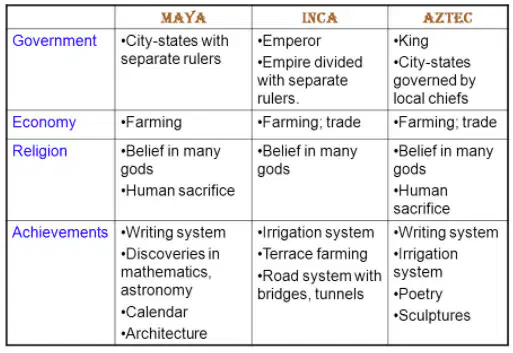
Which of the following statements is true about early American civilizations?
a)
All 3 civilizations used irrigation for farming
b)
All 3 civilizations engaged in human sacrifice
c)
All 3 civilizations had a monarchy for their government
d)
All 3 civilizations were polytheistic