wayground logo

Free Printable Worksheets

Font size

S
M
L
XL
Worksheets

Atomic Structure & Theories

Total questions: 40

Worksheet time: 41mins

Name
Class
Date
1.

Subatomic particles with a negative charge

a)

Electrons

b)

Neutrons

c)

Protons

d)

Quarks

2.
Subatomic particles with a positive charge
a)
neutrons
b)
atomic mass
c)
protons
d)
isotopes
3.
Subatomic particles that are neutral in charge
a)
Neutrons
b)
Protons
c)
Nucleus 
d)
Electrons
4.

Look at this picture of Argon off the periodic table. Which of the following is true for this element?

a)

18 protons

b)

40 protons

c)

22 protons

d)

21.9 protons

5.

Which part of an atom is used to identify it?

a)

number of protons

b)

number of neutrons

c)

number of electrons

6.
The nucleus of an atom is made of
a)
electrons and protons
b)
electrons and neutrons
c)
protons and neutrons
d)
empty space
7.

The atomic mass of an atom is equal to

a)

number of protons plus number of neutrons

b)

number of protons plus number of electrons

c)

number of electrons plus the number of neutrons

8.
Outside the nucleus of an atom are these
a)
protons
b)
neutrons
c)
quarks
d)
electrons
9.
The mass of this particle is so small that it is not counted.
a)
proton
b)
electron
c)
neutron
d)
quark
10.
The charge of the nucleus of all atoms or ions
a)
positive
b)
negative
c)
neutral
d)
sometimes positive and sometimes negative
11.
The number of these determines which element an atom is.
a)
neutrons
b)
electrons
c)
protons
12.
All atoms of a particular element have the same number of these
a)
electrons
b)
neutrons
c)
protons
13.
Which of these phrases best describes an atom?
a)
a positive nucleus surrounded by a hard negative shell
b)
a positive nucleus surrounded by a cloud of negative charges
c)
a hard sphere with postive and negative charges on the outside
d)
a negative nucleus surrounded by protons and neutrons
14.
What is true about an atom?
a)
Most of the space in an atom is taken up by the nucleus
b)
Atoms are mostly empty space
c)
Atoms have no mass
d)
Electrons have much more mass that protons or neutrons.
15.
The term "neutral" means
a)
having only a little bit of charge
b)
having a positive charge
c)
having a negative charge
d)
having no charge at all
16.
What scientist is best known for his gold foil experiment?
a)
J.J. Tomson
b)
Ernest Rutherford
c)
John Dalton
d)
Democritus
17.
Who is the first scientist to think that the atom was the smallest unit of matter?
a)
J.J. Tomson
b)
Ernest Rutherford
c)
John Dalton
d)
Democritus
18.
What scientist first developed 5 rules for atomic theory, and helped kick start modern chemistry?
a)
J.J. Tomson
b)
Ernest Rutherford
c)
John Dalton
d)
Democritus
19.
What are the two main parts of the atom?
a)
nucleus and cytoplasm
b)
nucleus and electron cloud
c)
core and electron cloud
d)
protons and neutrons
20.
What is the standard unit of mass at the atomic level?
a)
centimeters
b)
millimeters
c)
amu
d)
milligrams
21.
What is the electrical charge of a proton?
a)
1+
b)
1-
c)
neutral
d)
2-
22.
What is the name of the experiment that led to the discovery of the electron?
a)
Cathode Ray Tube (CRT) Experiment 
b)
Gold Foil Experiment
c)
Atomic Electrification Experiment 
d)
Plum Pudding Experiment
23.
Rutherford conclude that atoms were _________. 
a)
Mainly empty space 
b)
Made of protons, neutrons, and electrons
c)
Uniform throughout
d)
Dense positively charged particles
24.
Created the Planetary Model of the atom
a)
Bohr
b)
Dalton
c)
Rutherford
d)
Chadwick
25.
On the periodic table, how is atomic mass represented?
a)
As an average of the mass of different isotopes
b)
as the exact mass of every atom
c)
as the mass of the most common isotopes
d)
As the masses of all protons added together
26.
What do carbon-12 and carbon-14 have in common?
a)
they have same number of protons
b)
they have the same number of neutrons
c)
they have the same atomic mass
d)
they have the same atomic weight
27.
How is carbon-12 different from carbon-14?
a)
They have a different number of protons
b)
they have a different number of electrons
c)
they have a different number of neutrons
d)
they are different elements
28.

Isotopes of an element have a different number of...

a)

Protons

b)

Neutrons

c)

Electrons

d)

Mass

29.

Calculate the average atomic mass of silver.

a)

106.38649amu

b)

111.91896amu

c)

107.8677amu

d)

121

30.
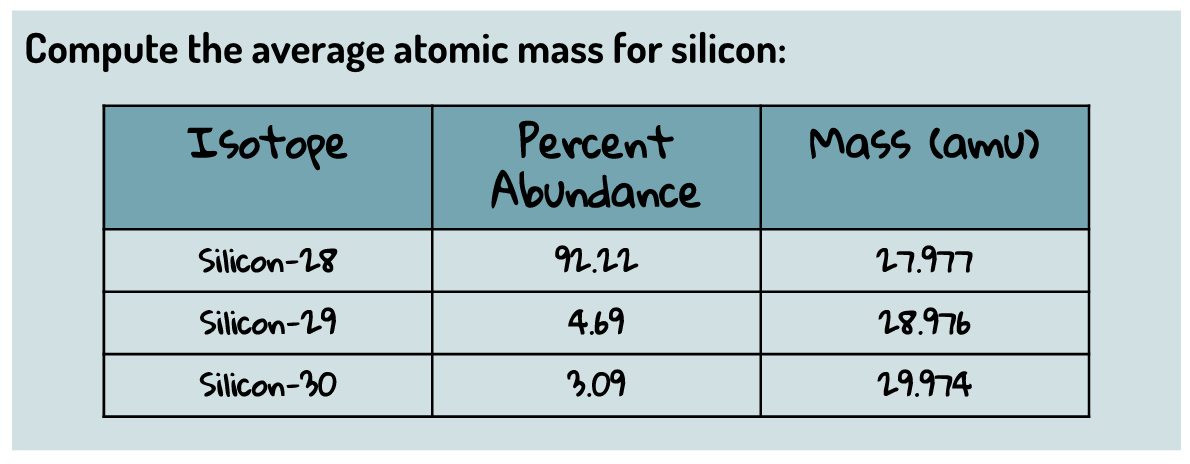
Compute the average atomic mass for silicon:
a)
27.977
b)
28.09
c)
28.976
d)
The average mass cannot be determined from provided information.
31.

Emission spectra (bright line spectra) are created when electrons move from ___.

a)

higher to lower energy levels.

b)

lower to higher energy levels.

c)

s orbitals to p orbitals.

d)

one atom to a different atom.

32.

In which state does an electron have the least amount of energy?

a)

Excited state

b)

Ground state

c)

Orbital

d)

Bohr model

33.

What part of the atom gains energy from the flame and then loses it in the form of light?

a)

Proton

b)

Neutron

c)

Nucleus

d)

Electrons

34.

What is the state when electrons move to a higher energy level upon absorption of energy?

a)

active state

b)

inactive state

c)

excited state

d)

ground state

35.

How do electrons become excited?

a)

Emitting (releasing) energy

b)

Absorbing (gaining) energy

c)

Going down an energy level

d)

Going up an energy level

36.

Flame tests like the one we did in lab are most useful for

a)

blood testing

b)

watching fireworks

c)

identification of elements

d)

none of the above

37.

Explain what was occuring during the time the flame test was producing different colors.

a)

The electrons in ground state gained energy and moved to an excited state.

b)

The electrons in excited state gained more energy and moved to an ground state.

c)

The electrons in the excited state released energy and moved to a ground state.

d)

The electrons in ground state released more energy and moved to an excited state.

38.

Based on bright spectral lines, what gases are in the unknown mixture shown at the bottom?

a)

Gas B & Gas D

b)

Gas C & Gas B

c)

Gas A & Gas D

d)

Gas D & Gas C

39.

LOOK CAREFULLY! Based on spectral lines, which 2 elements are in the unknown sample at the top?

a)

A and B

b)

B and C

c)

A and D

d)

B and D

40.

The unknown emissions spectra belongs to the element

a)

Hydrogen

b)

Mercury

c)

Neon

d)

Helium