wayground logo

Free Printable Worksheets

NEW

Font size

S
M
L
XL
Worksheets

Biology Final Exam 2022

Total questions: 50

Worksheet time: 38mins

Name
Class
Date
1.
All of the living and nonliving things in an area that interact with each other are called a/an ______.
a)
community
b)
habitat
c)
population
d)
ecosystem
2.
What does every food chain start with? (Even if it's not drawn or written there!)
a)
producers
b)
sun
c)
consumer
d)
decomposers
3.
What does a food web represent?
a)
All connections of energy flow throughout all organisms in a habitat.
b)
The specific ways that mutualism is carried out.
c)
A single pathway or energy flow between organisms. 
d)
How carnivores get their food. 
4.
The amount of energy that usually transfers from one trophic level to the next...
a)
10%
b)
20%
c)
80%
d)
50%
5.
As you move upward, from level to level, in an energy pyramid, energy _____.
a)
increases
b)
decreases
c)
stays the same
d)
increases exponentially
6.

The graph shows what type of growth?

a)

Decreasing

b)

Exponential

c)

Logistic

d)

Density Dependent

7.

What is the reason for this growth curve?

a)

There are biotic factors

b)

There are abiotic factors

c)

There are limiting factors

d)

There are NO limiting factors

8.

The graph shows what type of growth?

a)

Decreasing

b)

Logistic

c)

Exponential

d)

Density Independent

9.

What does D on the graph represent?

a)

Carrying Capacity

b)

Growth

c)

Limiting Factors

d)

Climax

10.

Which of the following are limiting factors?

a)

Temperature

b)

Food

c)

Space

d)

All of the Above

11.

An organism's role in its community is its ______________, and where it lives is its _________.

a)

habitat; niche

b)

niche; role in the community

c)

role in the community; niche

d)

niche; habitat

12.
Which organism would have the greatest concentration of pollution because of biomagnification?
a)
zooplankton
b)
large fish
c)
fish-eating birds of prey
d)
small fish
13.

Only ____________ can convert nitrogen in the atmosphere into a useable form for plants & animals.

a)

bacteria

b)

fungi

c)

worms

d)

moss

14.

When you consume an organism, you only receive 10% of the energy, but how much of the toxins do you receive?

a)

100%

b)

1%

c)

10%

d)

None of the above

15.
Hermit crabs live in shells made and then abandoned by snails. 
a)
commensalism
b)
mutualism
c)
parasitism
16.
A cuckoo may lay its eggs in a warbler’s nest. The cuckoo’s young will displace the warbler’s young and will be raised by the warbler. 
a)
commensalism
b)
mutualism
c)
parasitism
17.
Silverfish live and hunt with army ants. They share the prey. 
a)
commensalism
b)
mutualism
c)
parasitism
18.

One of the alternative forms of a gene that governs a characteristic, such as hair color

a)
allele
b)
gene
c)
trait
d)
DNA
19.
Which of the following alleles is homozygous recessive?
a)
Tt
b)
tt
c)
TT
d)
T
20.
Which of the following is a phenotype?
a)
Aa
b)
red hair
c)
heterozygous
d)
DNA
21.

A child receives a red haired gene from her mother and a blue haired gene from her father. This trait is CO-DOMINANT so the girl has...

a)

purple hair

b)

red hair with blue patches

c)

red hair

d)

blue hair

22.

Momma rat is black (Bb), Daddy rat is brown (bb), and baby rat is black (Bb). This trait is...

a)

incompletely dominant

b)

completely dominant

c)

co-dominant

23.

The trait being shown is...

a)

incompletely dominant

b)

co-dominant

c)

completely dominant

24.

The graph of skin color is illustrating which type of trait?

a)

polygenic

b)

single allele

c)

a trait with only 2 options

d)

I have no idea

25.
Put the following stages of mitosis in order: anaphase, prophase, metaphase, and telophase. 
a)
prophase, metaphase, telophase, anaphase
b)
prophase, anaphase, metaphase, telophase
c)
prophase, metaphase, anaphase, telophase
d)
prophase, telophase, metaphase, anaphase
26.

In mitosis, the two resulting daughter cells are

a)
different from the starting cell and identical to each other.
b)
different from the starting cell and different from each other.
c)
identical to the starting cell and different from each other.
d)
identical to the starting cell and identical to each other.
27.

Why do cells go through mitosis?

a)

to make food from sunlight

b)

to create proteins

c)

to get air into the cells

d)

to reproduce, grow and repair/replace

28.

Before cells can divide, what happens to the DNA?

a)

It is replicated

b)

It increases in size

c)

It is divided in half

d)

It decreases in size

29.
What is a series of events a cell goes through as they grow and divide?
a)
Cell Division
b)
Cell Cycle
c)
Cytokinesis
d)
Mitosis
30.

Human somatic cells have _____ chromosomes.

a)

46

b)

23

c)

92

31.

Human gametes have _____ chromosomes

a)

46

b)

23

c)

92

32.
Which process is necessary for the inherited traits of an organism to be passed along by sexual reproduction?
a)
mitosis
b)
meiosis
c)
mutation
d)
fission
33.
Which cellular process is shown?
a)
meiosis
b)
endocytosis
c)
mitosis
d)
phagocytosis
34.
Which statement correctly describes meiosis?
a)
cells divide only once
b)
meiosis does not occur in reproductive cells
c)
the cells produced at the end of meiosis are genetically identical to the parent cell
d)
The cells produced at the end of meiosis contain half the number of chromosomes as the parent cell
35.

What is one of the advantages to reproducing sexually versus asexually?

a)

survival of the fittest

b)

overproduction

c)

genetic variation

d)

cloning

36.

Gametes

a)

Diploid

b)

Haploid

37.

Cell E is...

a)

Diploid

b)

Haploid

38.

Human cells that contain 23 chromosomes

a)

Diploid

b)

Haploid

39.

A gamete has 12 chromosomes, how many will a body cell on the same organism have?

a)

12

b)

24

c)

6

40.

A fruit fly wing cell has 4 chromosomes, how many would be present after mitosis?

a)

4

b)

2

c)

8

41.
Each one of the boxes on the Punnett Square represents what probability of an offsprings' genotype?
a)
25%
b)
1%
c)
10%
d)
0%
42.
Aa, DD, bB, yy are all examples of
a)
genotypes
b)
phenotypes
43.
What you see, or the physical appearance.
a)
Genotype
b)
Phenotype
c)
Homozygous
d)
Heterozygous
44.

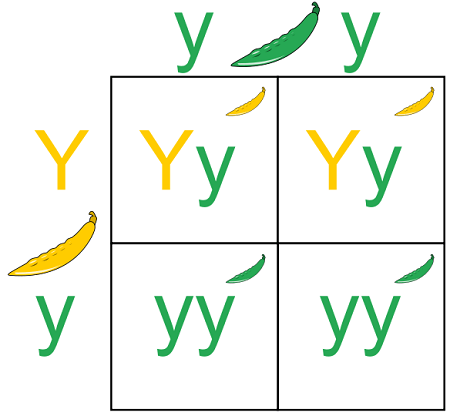
Which choice best represents the genotype ratio of this cross?
a)
1 Yy: 2 yy: 0 YY
b)
2 Yy: 2 yy: 0 YY
c)
3 Yy: 1 yy: 0 YY
d)
1 Yy: 3 yy: 0 YY
45.
What is the phenotype of the offspring? (A-Brown hair; a-blond hair) 
a)
50 % Brown Hair and 50% Blond Hair 
b)
25 % Brown Hair and 75% Blond Hair 
c)
75 % Brown Hair and 25% Blond Hair 
d)
0% Brown Hair and 100% Blond Hair 
46.
B = brown eyes
b = blue eyes
What is true about these two brothers that have brown eyes?
One has genotype BB the other Bb.
a)
they have same phenotype and genotype
b)
they have different genotypes and phenotypes
c)
they have same phenotype but different genotypes
d)
they have same genotype but different phenotypes
47.

What would be the correct way to write alleles for the Incomplete dominant phenotypes listed?

a)

Large teeth (LL), Medium teeth (MM), Small teeth (SS)

b)

Large teeth (LL), Medium teeth (LS), Small teeth (SS)

c)

Large teeth (LW), Medium teeth (WW), Small teeth (SW)

d)

Large teeth (Ll), Medium Teeth (ls), Small teeth (Ss)

48.
What type of inheritance do two alleles have if their traits blend together? 
a)
Incomplete Dominance
b)
Co-Dominance
49.
R = tongue rolling, r = no tongue rolling. An individual who is Rr can roll their tongue.  What type of inheritance pattern does this follow?
a)
Complete Dominance
b)
Incomplete Dominance
c)
Co-Dominance
d)
Sex-linked
50.

Blood type alleles that are codominant are...

a)

A and B

b)

B and O

c)

A and O

d)

Only O