wayground logo

Free Printable Worksheets

NEW

Font size

S
M
L
XL
Worksheets

Final Exam: Physical Science

Total questions: 58

Worksheet time: 2hrs 48mins

Name
Class
Date
1.

It takes more force to accelerate the iron man on the left than the iron man on the right because the iron man on the left has more mass. This best describes

a)

Newton's first law, the law of inertia

b)

Newton's second law, the law of acceleration

c)

Newton's third law, the law of action reaction

d)

The law of universal gravitation

2.

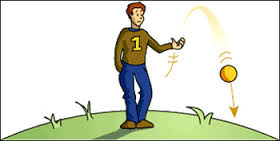
What Newtons law does this picture represent

a)

Newtons 1st law

b)

Newtons 2nd law

c)

Newtons 3rd law

d)

Newtons 4th law

3.

A fireman turns on his hose and is knocked backwards is an example of...

a)

Newton's 1st Law

b)

Newton's 2nd Law

c)

Newton's 3rd Law

d)

Newton's 4rth Law

4.

According to the Law of Conservation of Momentum, when two objects collide:

a)

both objects lose momentum.

b)

both objects gain momentum

c)

momentum is neither lost nor gained.

d)

momentum is always lost or gained.

5.
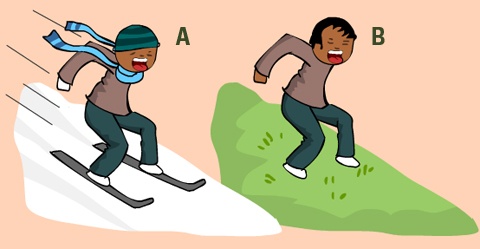
Why is it harder for the boy in Image B to get down the hill?
a)
Motion
b)
Friction
c)
Work
d)
Displacement
6.
What is the attractive force that exists between all objects that have mass?
a)
Weight
b)
Mass 
c)
Gravity
d)
Viscosity
7.
What is the formula to calculate speed?
a)
Speed = time/distance
b)
Speed = distance/time
c)
Speed = distance x time
d)
Speed = time x distance
8.
What is velocity?
a)
the quickness of an object
b)
the location of an object
c)
acceleration
d)
speed in a specific direction
9.
What is a Force?
a)
The distance
b)
Mass
c)
A push or pull
d)
Give me a  failing grade 
10.
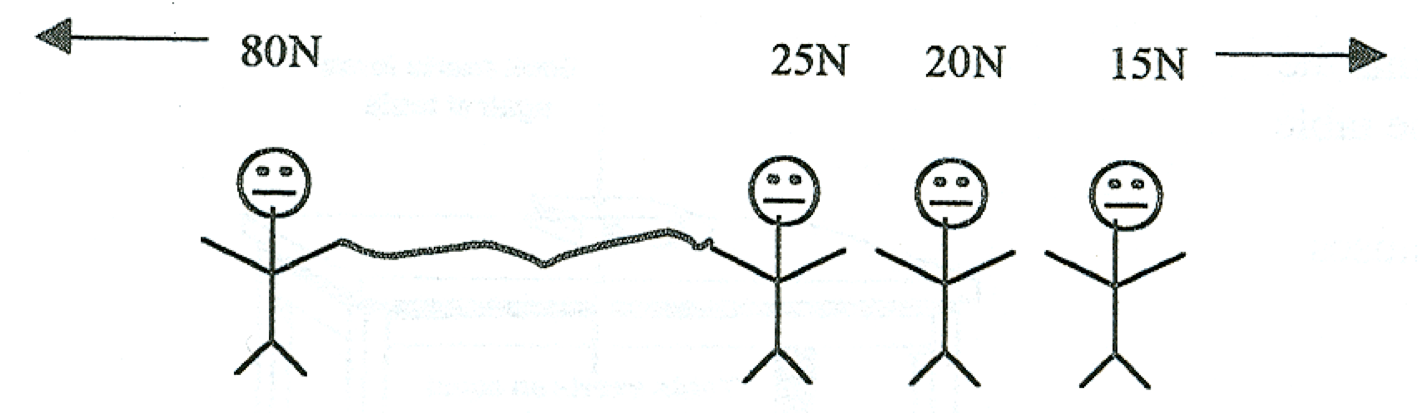
Who wins the tug of war with what net force?
a)
The person on the left with 20 N
b)
The person on the left with 80 N
c)
The people on the right with 20 N
d)
The people on the right with 100 N
11.
As mass increases, what happens to the gravitational force?
a)
It increases.
b)
It decreases.
c)
It stays the same.
d)
It acts as a 3rd degree derivative function.
12.

As the distance between 2 objects increases, what happens to gravitational force?

a)

It increases.

b)

It decreases.

c)

It stays the same.

d)

Only Ms. Boldt knows what will happen.

13.
Which of the following will not change in different gravitational fields?
a)
weight
b)
force
c)
mass
d)
pounds
14.
Acceleration can be classified as _______________
a)
Speeding up
b)
Slowing Down
c)
Changing directions
d)
All of the above
15.
What is the person doing from 5 seconds to 10 seconds?
a)
Walking 
b)
Running
c)
Standing Still 
d)
Walking Fast
16.
Any time an energy conversion takes place, some of the original energy is converted to which one of the following?
a)
a. sound energy
b)
b. potential energy
c)
c. light energy
d)
d. thermal energy
17.
After an energy conversion, you end up with the same total amount of energy as the original amount of potential energy. Which of the following laws explains this rule?
a)
a. law of energy changes
b)
b. law of conservation of energy
c)
c. law of power and energy
d)
d. law of potential energy
18.
Where is the potential energy the greatest?
a)
A
b)
B
c)
C
d)
D
19.

What is energy?

a)

moving energy

b)

stored energy

c)

renewable energy

d)

The ability to do work.

20.

At what point does the biker have the greatest Kinetic Energy?

a)

Point A

b)

Point B

c)

Point C

d)

Point D

21.

The principle of energy conservation states:

a)

Energy can be created but not destroyed

b)

Energy cannot be created, nor destroyed.

c)

Energy can be destroyed but not created
22.
Rubber is considered an _____
a)
Conductor
b)
Insulator
c)
Radiation 
d)
None of the above
23.
If an object has the same number of positive and negative charges, its electrical charge is...
a)
positive
b)
negative
c)
neutral or no charge
d)
opposite
24.
What charge does a proton have?
a)
negative (-)
b)
positive (+)
c)
neutral or no charge (0)
25.
What charge does an electron have?
a)
negative (-)
b)
positive (+)
c)
neutral or no charge (0)
26.
What is the major difference between static electricity and current electricity?
a)
Current electricity involves a continuous flow of neutrons; static electricity is a sudden transfer of protons
b)
Current electricity can be deadly; static electricity is almost always safe
c)
In current electricity, there's a single transfer of electrons; in static electricity, there's a steady flow of electrons
d)
Current electricity involves a flow of electrons; static electricity involves a single transfer of electrons
27.
An object becomes charged when the atoms in the object gain or lose
a)
electrons
b)
protons
c)
neutrons
d)
all of the above
28.
Objects that have opposite charges
a)
are attracted to each other, and the force between the objects pulls them together.
b)
are attracted to each other, and the force between the objects pushes them apart.
c)
are repelled by each other, and the force between the objects pulls them together.
d)
are repelled by each other, and the force between the objects pushes them apart.  
29.
In a ________ circuit there are multiple paths for the current to take.
a)
Series
b)
Parallel
30.
In a _________ circuit, if one bulb goes out then the entire circuit doesn't work.
a)
Series
b)
Parallel
31.
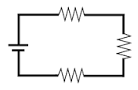
What type of circuit is pictured?
a)
series
b)
parallel
32.
A circuit made of wires, a lamp, a switch, and a cell is shown at the right. What change is needed for the lamp to glow? 
a)
The switch needs to be opened.
b)
The switch needs to be closed.
c)
The cell needs an insulator.
d)
The wire needs to be connected to the bottom of the cell.
33.
Which of the following provides stored energy to run the circuit?
a)
Battery
b)
Light Bulb
c)
Switch
d)
Wire
34.
Magnetism is generated by moving
a)
protons.
b)
electrons.
c)
neutrons.
d)
elements.
35.
What kind of magnet can be turned on and off?
a)
refridgerator magnet
b)
electromagnet
c)
magnetite
d)
iron
36.
The strongest part of a magnet is...
a)
the bars.
b)
the force field.
c)
the poles. 
d)
the middle.
37.
The lines on this image are called...
a)
magnetic field lines
b)
graphite lines
c)

longitudinal lines

38.
Magnetic poles and electric charges are similar in that...
a)
like poles repel and opposites attract
b)
magnetic force is equal to electric force
39.
Magnets stick to any materials that are made of
a)
Iron, Nickel, Copper
b)
Iron, Nickel, Cobalt
c)
Ions, Nickel, Cobalt
d)
Iron, Lead, Cobalt
40.

What is a disturbance that transfers energy?

a)

volume

b)

matter

c)

wave

41.

The highest point on a transverse wave

a)

compression

b)

rest position

c)

trough

d)

crest

42.

What kind of wave is this?

a)

transverse

b)

longitudinal

43.

A wave bends (changes speed) as it passes from one medium to another. Ex: air to water

a)

medium

b)

reflection

c)

refraction

d)

interference

44.
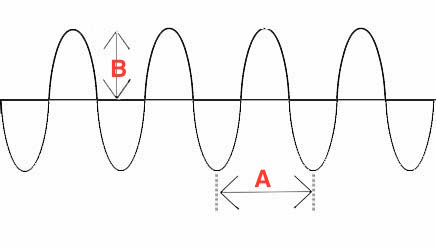
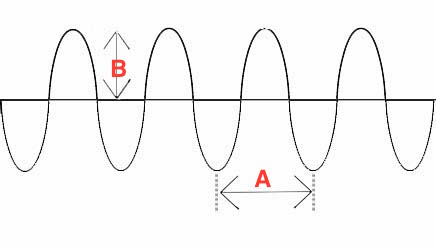
What property of this wave is represented by the letter "A"
a)
amplitude
b)
crest
c)
trough
d)
wavelength
45.
What property of the wave is represented by the letter "B"?
a)
amplitude
b)
crest
c)
trough
d)
wavelength
46.

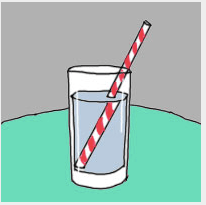
Why does the straw appear to be bent?

a)

light is reflected

b)

light is absorbed

c)

light is turned

d)

light is refracted

47.

What would you call this?

a)

Refraction

b)

Diffraction

c)

Bends

d)

Reflection

48.

What would you call this?

a)

Bounce back

b)

Reflection

c)

Diffraction

d)

Refraction

49.
A disturbance that travels through a medium as a longitudinal wave
a)
sound
b)
wavelength
c)
pitch
d)
frequency
50.
Material (matter) through which a wave travels
a)
medium
b)
Doppler Effect
c)
sound
d)
pitch
51.
Which has the LONGEST wavelength and, therefore, the lowest frequency/energy
a)
Gamma Rays
b)
Radio Waves
c)
Visible Light
d)
Infrared rays
52.
Which section of the spectrum is the ONLY one we can see?
a)
X-rays
b)
Visible Light
c)
Gamma Rays
d)
Ultraviolet Rays
53.
What are electromagnetic waves?
a)
sound waves
b)
electric & magnetic fields (energy) that travel through empty space very quickly
c)
Someone's name
d)
things like longitudinal waves
54.
What type of force is shown in the picture?
a)
The Cat force
b)
Star Wars Force
c)
Unbalanced force
d)
Balanced  force
55.
One object has twice as much mass as another object. The first object also has also twice as much...
a)
velocity
b)
gravitational acceleration
c)
inertia
d)
all of these
56.
The momentum of an object depends upon the object's ___________&_____________.  
a)
size and shape
b)
mass and speed
c)
mass and veloctiy
d)
mass and energy
57.
The total momentum before a collision is _________ the total momentum after a collision.
a)
equal to 
b)
less than 
c)
more than
d)
It depends on the type of collision
58.

Why does a semi truck have more momentum than a car if they are both traveling at 60kph?

a)

Truck is more massive

b)

Truck is less massive

c)

Car is moving faster

d)

Car is more massive