
 Worksheets
Earth Science Final Review
Total questions: 36
Worksheet time: 12mins
The movement of the tectonic plates is caused by
the rotation of the Earth.
convection currents in the Asthenosphere
the gravity of the iron-nickel core.
the Moho discontinuity.
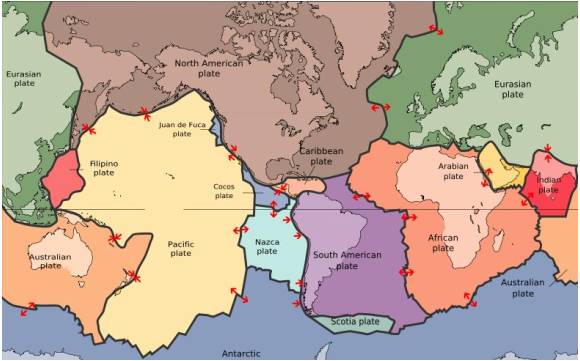
The map in the picture shows tectonic plate boundaries. This map would be useful in predicting the location of future
droughts
hurricanes
earthquakes
tornadoes
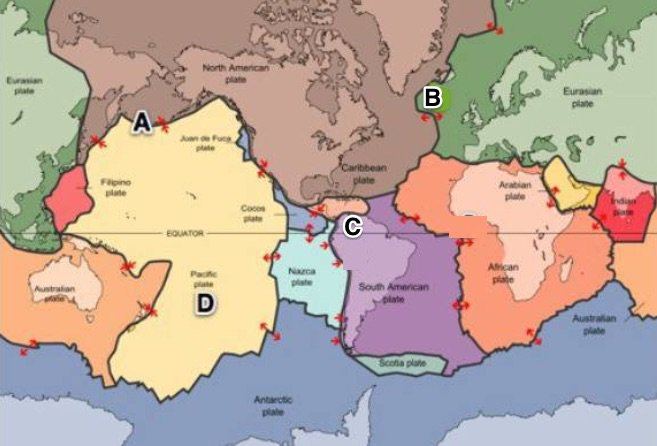
Where would sea floor spreading most likely occur?
At convergent boundaries (oceanic vs. oceanic)
At convergent boundaries (oceanic vs. continental)
At divergent plate boundaries (oceanic vs. oceanic)
At transform plate boundaries
The side of a mountain range that faces the oncoming wind and receives precipitation:
Climate
Windward
Leeward
Monsoon
A gradual increase in the average temperature of Earth's atmosphere:
Global Warming
Greenhouse Gas
El Niño
Climate
Gases in the atmosphere that trap heat; carbon dioxide (CO2) is a major one:
Greenhouse Gas
Global Warming
Sunspot
CFCs

Why do massive stars have shorter lifespans than average stars?
They have less fuel to burn
They burn their fuel faster
They are excited to get through their lifecycles faster
They have less steps in their lifecycles
What is the last step in the life cycle of the Sun (low mass star)?
Supernova
Black hole
planetary nebula
white dwarf
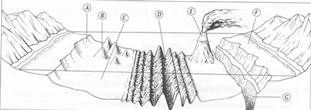
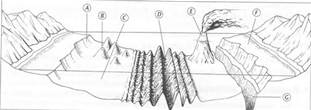
What is longshore drift?
The movement of sediment down the beach.
A pebble drifting slowly into the sea.
When a beach is really long and people sleep on it.

What is the erosional feature shown here?
Sea Arch
Tombolo
Spit
Stack

Select ALL 3 that apply. We can prevent beach erosion by building ...
Sea walls
Terraces
Jetties
Groins
Contour Plowing

A mineral always contains certain elements in definite proportions. This is referring to its
streak
definite chemical composition
luster
inorganic
The color of a mineral's powder left behind after it is scratched on a piece of unglazed tile is its
color
cleavage
luster
streak
What term means that a mineral CANNOT form from materials that were once part of a living thing?
solid
naturally occuring
inorganic
luster
Which of these BEST describes how an igneous rock forms?
cooling of magma
weathering of other rocks
colliding of tectonic plates
pressing together of smaller rocks


Uses sound waves to find the depth of the ocean floor, discovering that the ocean floor has features much like the land and it not just all flat.
radar
sonar
doplar
polar
________ and _______ affect the ocean's density and cause the Global Conveyor Belt to travel
gravity and the Coriolis Effect
temperature and salinity
wind and climate
temperature and the Coriolis Effect

