Wayground logo

Free Printable Worksheets

Font size

S
M
L
XL
Worksheets

Revision EOY

Total questions: 133

Worksheet time: 6hrs 55mins

Name
Class
Date
1.

Solve the following equation for  x.x.

  5x − 6 = 8 − 2x5x\ -\ 6\ =\ 8\ -\ 2x  

a)

x = 2x\ =\ 2  

b)

x = −4 23x\ =\ -4\ \frac{2}{3}  

c)

x= −2x=\ -2  

d)

x =−23x\ =-\frac{2}{3}  

2.

Solve the following equation for  x.x.

  −5x + 2 = 2x + 9-5x\ +\ 2\ =\ 2x\ +\ 9  

a)

x = 2x\ =\ 2  

b)

x = 1 27x\ =\ 1\ \frac{2}{7}  

c)

x = −1x\ =\ -1  

d)

x = 1x\ =\ 1  

3.

Solve: 5(3n + 10) = 40n

a)

n = 2

b)

n = -2

c)

n = 5

d)

n = -5

4.
∣ 2x + 9 ∣ = 15
a)
x = 3 
b)
x = 3
x = -6
c)
x = 3
x = -12
d)
x = 6
x = -12
5.
 |−2n| + 10 = −50
a)
{30, -30}
b)
{20,-20}
c)
{-5,5}
d)
No Solution
6.
|v + 8| − 5 = 2 
a)
{-1,-15}
b)
{-1,-5}
c)
{-15,15}
d)
No Solution
7.
5∣ x ∣ - 8 = 2
a)
x = 5
x = 2
b)
x = 2
x = 6/5
c)
x = -5
x = 10
d)
x = 18
x =  -18
8.

Solve. Select BOTH solutions.
5∣7+x∣+2=175\left|7+x\right|+2=17  

a)

−10-10  

b)

33  

c)

44  

d)

−4-4  

9.

Solve

-8|6n - 7| - 6 = -14

a)

n = 1, n = 2

b)

n = 4/3, n = 3

c)

n = 1, n = 4/3

d)

No Solution

10.
| x – 3 |= 0
a)
3
b)
-3
c)
{-3, 3}
d)
no solution
11.
What type of slope does the graph have?
a)
Positive
b)
Negative
c)
Zero Slope
d)
Undefined
12.
What type of slope does the graph have?
a)
Zero
b)
Undefined
c)
Negative
d)
Positive
13.
What type of slope does the following graph have?
a)
Postive
b)
Negative
c)
Zero Slope
d)
Undefined
14.
In the equation y=mx+b, what does the m represent?
a)
slope
b)
y-intercept
c)
linear
d)
point-slope
15.
What is the slope in the equation y=2x + 3?
a)
2
b)
3
c)
5
d)
Cannot be Determined 
16.

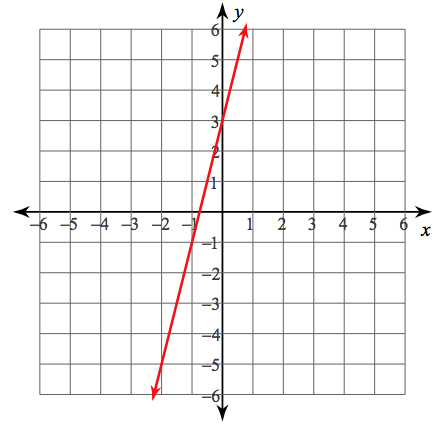
What is the y-intercept in the equation y=2x + 3?

a)

2

b)

3

c)

5

d)

Cannot be Determined

17.
What is the y-intercept?
a)
-1
b)
3
c)
-3
d)
-2
18.
Write the equation for the line in slope-intercept form.
a)
y= -1x+3
b)
y= 4x+3
c)
y=1/4x+3
d)
y= -4x+3
19.
Slope = 4  Point (-2, 1)
a)
y = 4x +9
b)
y=4x-7
c)
y=4x+7
d)
y=4x-9
20.
Goes through points (-2, -1) and (-3, 5)
a)
y = 6x + 13
b)
y = -6x - 13
c)
y = -1/6x + 1
d)
y = 1/6x - 1
21.
Write equation of the line containing (6,3) and (4,1)
a)
y = -1x + 5
b)
y = 1x - 3
c)
y = 1x + 5
d)
y = -1x + 3
22.
Convert equation from standard form to slope intercept form.
x - 7y = -21
a)
y = -1/7x - 3
b)
y = 1/7x - 3
c)
y = 1/7x + 3
d)
y = -1/7x + 3
23.

Write an equation in point-slope form of the line that passes through the point (5, 2) with a slope of 6.

a)

y + 2 = 6(x + 5)

b)

y - 5 = 6(x - 2)

c)

y - 2 = 6 (x - 5)

d)

y = 6x - 28

24.

Write y - 14 = 7(x + 5) in standard form.

a)

-7x + y = 19

b)

7x - y = -19

c)

-7x + y = 49

d)

7x - y = -49

25.

Write y + 75 = -25(x - 5) in slope-intercept form.

a)

y + 75 = -25x - 125

b)

y = -25x + 50

c)

y = -25x - 200

d)

y + 75 = -25x + 125

26.

Write an equation in point-slope form of the line that passes through the point (-10, 4) with a slope of -3.

a)

y - 4 = -3(x + 10)

b)

y + 4 = -3(x - 10)

c)

y + 10 = 4(x + 3)

d)

3x + y = -26

27.
Write in standard form.
4y - 3 = 6x + 6
a)
6x - 4y = -9
b)
6x - 4y = 3
c)
4y - 6x = -9
d)
4x + 4y = 3
28.
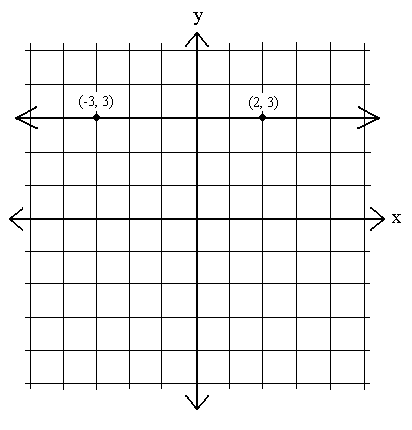
What is the equation of the line with a slope of 0 that goes through the point (2,4)?
a)
y = 2x + 4
b)
x=2
c)
y = 2
d)
y = 4
29.

Find AC

a)

3

b)

4

c)

5

d)

2

30.

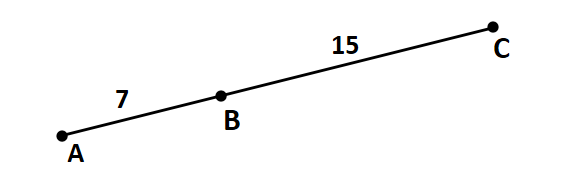
Find AC

a)

7

b)

8

c)

22

d)

23

31.

If AB = 2x+3, BC = 3x-5, and AC = 38, what is the value of x ?

a)

11

b)

12

c)

8

d)

5

32.

M is the midpoint of AB. If AM = 5x+10 & MB = 4x+16, find the value of AM.

a)

6

b)

4

c)

70

d)

40

33.
Solve for x
a)
x = 2
b)
x = 4
c)
x = 6
d)
x = 8
34.
Find AB.
a)
69
b)
20
c)
19
d)
11
35.

Find the length between H and F.

a)

-5

b)

5

c)

-6

d)

6

36.

 Find the distance between (2,3) & (4,1)

a)

3

b)

5.66

c)

2.83

d)

2.79

37.

What is the distance between AB

a)

0

b)

8

c)

9

d)

7

38.
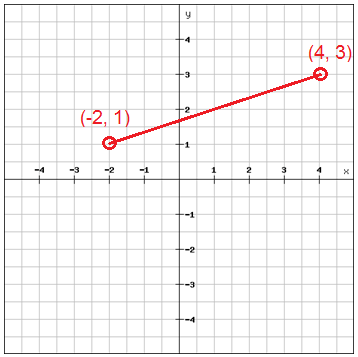
What is the distance between the two points?
a)
6.3
b)
6.5
c)
6.7
d)
16
39.

Find the value of a if the distance between the points at (-3,-2) and (a,-5) is 5 units

a)

-5 and 2

b)

-7 and 1

c)

3 and 2

d)

5 and 2

40.
Find AM. 
a)
6
b)
26
c)
52
d)
-6
41.

A polygon with five sides.

a)

pentagon

b)

triangle

c)

quadrilateral

d)

square

42.
What is the circumference of a circle with a radius of 21 cm?
a)
131.88 cm
b)
121.99 cm
c)
111.89 cm
d)
141.89 cm
43.
What is the area of this circle?
a)
62.59 cm2
b)
113.1 cm2
c)
19.81 cm2
d)
28.26 cm2
44.
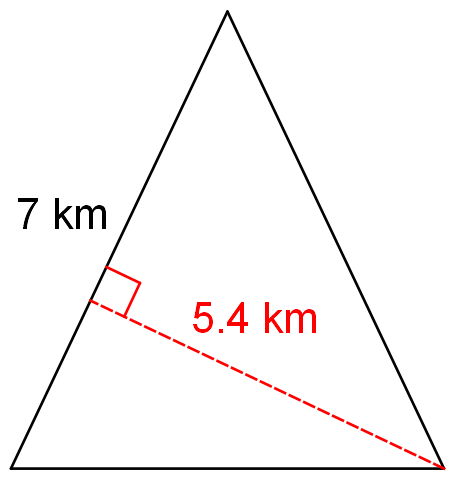
Find the Area of this triangle.
(the side length is 7km)
a)
19.8 km2
b)
37.8 km2
c)
18.9 km2
d)
35 km2
45.
What is the area of this 5cm by 8cm rectangle?
a)
40 square cm
b)
40 cm
c)
40
d)
13
46.
What is the area of this figure?
a)
52 square centimeters
b)
36 centimeters
c)
57 square centimeters
d)
40 square centimeters
47.
a)
100°
b)
80°
c)
90°
d)
180°
48.
What are complementary angles?
a)
Angles that add up to 180°
b)
Angles that add up to 90°
c)
Angles that are equal to each other
d)
Angles that are opposite of each other when lines intersect.
49.
What are supplementary angles?
a)
Angles that add up to 180°
b)
Angles that add up to 90°
c)
Angles that are equal to each other
d)
Angles that are opposite of each other when lines intersect
50.
What are vertical angles?
a)
Angles that are adjacent to each other
b)
Angles that add up to 180°
c)
Angles that are opposite of each other when lines intersect
d)
Angles that add up to 90°
51.
These are Complementary angles. Find x.
a)
15
b)
25
c)
75
d)
90
52.
If ∠BPD and ∠DPC have a sum of 72°. What is ∠APC?
a)
18°
b)
90°
c)
108°
d)
180°
53.

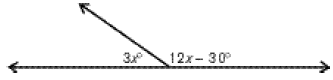
Identify the angle relationship.

a)

Adjacent

b)

Complementary

c)

Supplementary

d)

Vertical

54.

What is the relationship of the angle pair?

a)

vertical

b)

supplementary

c)

adjacent

d)

complementary

55.

What is the value of x?

a)

19

b)

20

c)

17

d)

13

56.

Find the value of x.

a)

36

b)

41

c)

42

d)

43

57.

What is the value of x?

a)

15

b)

10

c)

20

d)

17

58.
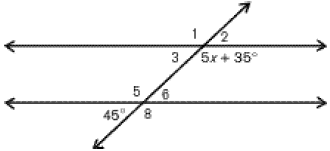
What type of angle pair is ∠1 and ∠5?
a)
alternate interior angles
b)
corresponding angles
c)
alternate exterior angles
d)
vertical angels. 
59.
In the diagram, which of the following statements are false?
a)
∠1 and ∠4 are vertical angles
b)
∠4 and ∠5 are alternate interior angles
c)
∠1 and ∠8 are alternate interior angles
d)
∠2 and ∠6 are corresponding angles
60.
Name the corresponding angle to angle 4.
a)
angle 8
b)
angle 6
c)
angle 2
d)
angle 5
61.
Name the angle relationship.
a)
Alternate Interior
b)
Alternate Exterior
c)
Corresponding
d)
Vertical Angles
62.
Name the angle relationship.
a)
Alternate Interior
b)
Alternate Exterior
c)
Corresponding
d)
Vertical Angles
63.
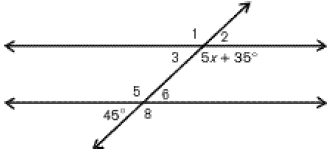
What is the measure of ∠8?
a)
55
b)
155
c)
135
d)
45
64.
Find the value of x.
a)
20
b)
135
c)
31
d)
145
65.
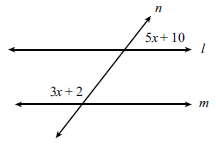
What is the value of x?
a)
60
b)
26
c)
14
d)
10
66.
What is the value of x?
a)
22
b)
26
c)
24
d)
23
67.
What is the value of x?
a)
-6
b)
22
c)
16
d)
21
68.
What are the values of the two angles? 
a)
18° and 152°
b)
30° and 150°
c)
42° and 138°
d)
45° and 135°
69.
What is the value of x?
a)
22°
b)
10°
c)
9°
d)
7°
70.
What is the measure of ∠ABC?
a)
25°
b)
75°
c)
108°
d)
150°
71.

Which equation matches the graph? 

a)

y=−14x+2y=-\frac{1}{4}x+2

b)

y=14x+2y=\frac{1}{4}x+2

c)

y=4x+2y=4x+2

d)

y=2x+4y=2x+4

72.

Are these lines parallel, perpendicular, or just intersecting (not at a right angle)? 

Feel free to graph if needed.


y=−4x+3y=-4x+3 and  y=−4x−1y=-4x-1  

a)

parallel

b)

perpendicular

c)

intersecting (not at a right angle)

73.

Are these lines parallel, perpendicular, or just intersecting (not at a right angle)? Feel free to graph if needed. y=−23x+3y=-\frac{2}{3}x+3  and  y=43x−1 y=\frac{4}{3}x-1\  


a)

parallel

b)

perpendicular

c)

intersecting (not at a right angle)

74.

What is the equation of the line that is parallel to y=5x+7y=5x+7 and goes through the point (0, -2)?

Feel free to graph.

a)

y = 5x - 2

b)

y = -2x + 7

c)

y = 5x-10

d)

y = -1/5x - 2

75.
a)
x = 2
b)
y = 2
c)
y = 2x
d)
x = -2
76.
a)
x = -3
b)
y = 3
c)
y = -3
d)
x = 3
77.
What is the slope between these points?
(5, 7) and (3, 10)
a)
-3/2
b)
2/3
c)
-2/3
d)
3/2
78.
Find the equation of the line that is parallel to the line y = 2x - 1 and passes through the points (4, 6)
a)
y = 2x - 2
b)
y = -1/2x + 8
c)
y = 2x + 8
d)
y = -2x + 2
79.
Find the equation of the line that is perpendicular to the line y = 1/3x - 7 and passes through (1, -1).
a)
y = 1/3x - 1
b)
y = 3x - 4
c)
y = -3x + 2
d)
y = -3x - 1
80.

Find the distance between the lines

a)

1

b)

3

c)

4

d)

7

81.

What is the distance from P to line n shown in the figure?

a)

-3

b)

-5

c)

4

d)

5

82.

Find the distance between the parallel lines

y = x

y = x + 2

a)

3

b)

3\sqrt{3}

c)

2\sqrt{2}

d)

2

83.

Find the distance between the line y = -3x + 8 and the point (-1, 1)

a)

2

b)

4

c)

222\sqrt{2}

d)

10\sqrt{10}

84.

Find the distance between the parallel lines

x = 3

x = 7

a)

2

b)

10\sqrt{10}

c)

-4

d)

4

85.

What is the distance from D to line t shown in the figure?

a)

2

b)

-2

c)

5\sqrt{5}

d)

7\sqrt{7}

86.
If the quadrilateral is translated 4 units to the left and 5 units down what is the coordinates for Point A'?
a)
(4,0)
b)
(0,4)
c)
(-1,5)
d)
(5,-1)
87.
If you were to rotate ABCD 180°  about the origin, what would the coordinate of A' be?
a)
(-5, 5)
b)
(-3, -5)
c)
(-5, 3)
d)
(-3, 3)
88.
If you were to rotate ABCD 90° counterclockwise about the origin, what would the coordinate of A' be?
a)
(-5, 5)
b)
(-3, 5)
c)
(-5, 3)
d)
(-3, 3)
89.
Triangle ABC is labeled with points A(5, 2), B(1, 2) and C(3, 6) on a coordinate plane. Find the coordinates of A' B' C' after a reflection over the x-axis.
a)
A’(5, -2) B' (1, -2) C' (3, -6) 
b)
A’(-5, -2) B' (-1, -2) C' (-3, -6)
c)
A’(-5, -2) B' (-2, -1) C' (-6, -3) 
90.
The point ( -2,5) is reflected over the line x = 1.  Find its image.
a)
(  4,  5)
b)
( -2  , -5)
c)
( 2  ,  5)
d)
(2   , -5)
91.
Write a rule for the translation.
a)
 (x -1, y  + 2)
b)
 (x -2, y  + 1)
c)
 (x +2, y  - 1)
d)
(x +1, y  -  2)
92.
Identify the transformation from A to D.
a)
90o Clockwise Rotation
b)
180o Rotation
c)
270o Clockwise Rotation
d)
360o Rotation
93.
Which answer shows a reflection across the y-axis?
a)
a
b)
b
c)
c
d)
d
94.

How many lines of symmetry does a square have?

a)

1

b)

2

c)

4

d)

8

95.
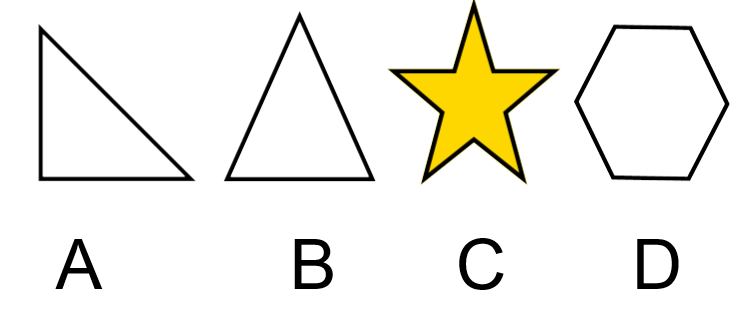
Which shape does NOT have rotational symmetry?
a)
A
b)
B
c)
C
d)
D
96.
How many lines of symmetry does this shape have?
a)
1
b)
2
c)
4
d)
6
97.
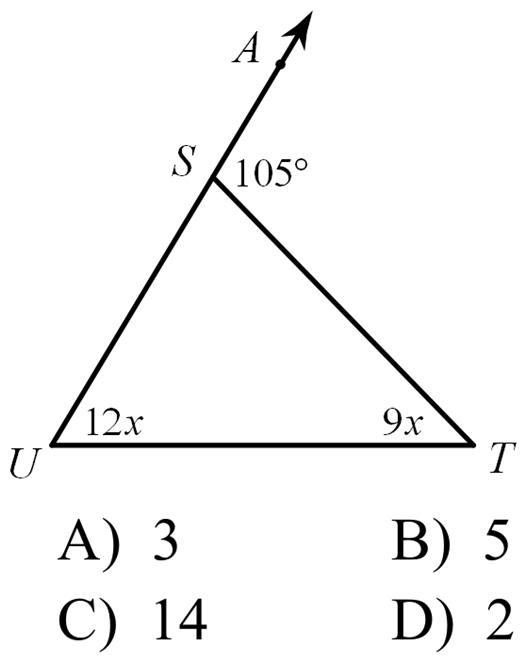
Find the measure of the indicated angle. 
a)
95
b)
85
c)
35
d)
45
98.
Find the measure of angle D.
a)
140 degrees
b)
16 degrees
c)
40 degrees
d)
90 degrees
99.
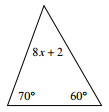
Find the missing angle.
a)
29° 
b)
39° 
c)
49° 
d)
59° 
100.
Find the measure of the indicated angle. 
a)
145
b)
113
c)
102
d)
78
101.
Solve for x.
a)
5
b)
12
c)
-7
d)
-6
102.

Find the value of x.

a)

A

b)

B

c)

C

d)

D

103.
Solve for x.
a)
16
b)
11
c)
50
d)
6
104.

Solve for x.

a)

A

b)

B

c)

C

d)

D

105.

Solve for x.

a)

A

b)

B

c)

C

d)

D

106.
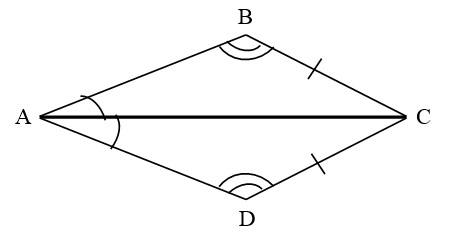
Name the postulate, if possible, that makes the triangles congruent.
a)
SSS
b)
SAS
c)
ASA
d)
Not Possible
107.
Name the postulate, if possible, that makes the triangles congruent.
a)
SAS
b)
ASA
c)
AAS
d)
Not Possible
108.
Name the postulate, if possible, that makes the triangles congruent.
a)
SSS
b)
ASA
c)
AAS
d)
Not Possible
109.
Name the postulate, if possible, that makes the triangles congruent.
a)
SSS
b)
SAS
c)
ASA
d)
AAS
110.
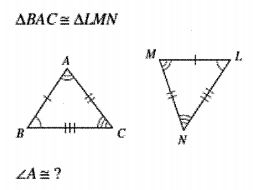
 ∠A = ≅
a)
∠M
b)
∠N
c)
∠L
111.
What is the measure of <C?
a)
5º
b)
25º
c)
100º
d)
125º
112.

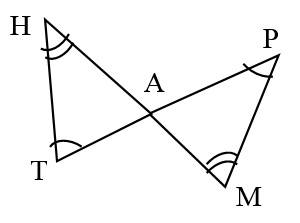
Are the triangles definitely congruent? If so, by what theorem?

a)

ASA

b)

AAS

c)

SAS

d)

Cannot be proven congruent

113.

Are the triangles definitely congruent? If so, by what theorem?

a)

ASA

b)

AAS

c)

SAS

d)

Cannot be proven congruent

114.
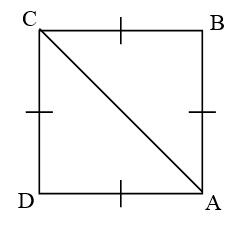
Congruent by
a)
SSS
b)
SAS
c)
ASA
d)
AAS
115.

Solve for x

a)

x = 12

b)

x = 4

c)

x = 3.33

d)

x = 10

116.

Find the value of x.

a)

x = 27

b)

x = 53

c)

x = 49

d)

x = -16

117.

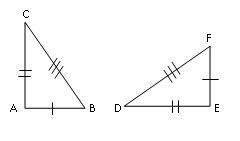
Use the Third Angles Theorem to find the value of x.

a)

x = 60

b)

x = 55

c)

x = 15

d)

x = 65

118.

Determine if the two triangles are congruent. If they are, state the postulate.

a)

SAS

b)

AAS

c)

Not enough information

d)

SSS

119.
Name the postulate, if possible, that makes the triangles congruent.
a)
SAS
b)
ASA
c)
AAS
d)
Not Possible
120.
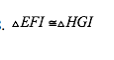
Use the congruency statement to answer the following: 
<F = ___
a)
<H
b)
<I
c)
<G
d)
not congruent to another angle
121.

A concluding statement reached using inductive reasoning is called a _______

a)

compound statement

b)

conjecture

c)

condition

d)

counterexample

122.

Which of the following is a counterexample to the following conjecture? If x2 = 4x^2\ =\ 4 , then x = 2

a)

x = 4

b)

x = -2

c)

x = 2

d)

x = -4

123.

Which number is a counterexample to the following statement?
For all numbers a, 2a + 7 ≤17\le17  

a)

a = 6

b)

a = 0

c)

a = 5

d)

a = 1

124.
Complete the conjecture.
The sum of two negative numbers is ___________.
a)
positive
b)
negative
c)
odd
d)
even
125.
How many counters would come next?
a)
5
b)
7
c)
9
d)
11
126.

What is the next term in the sequence?


1, 1, 2, 3, 5, 8, 13, ...

a)

15

b)

21

c)

19

d)

17

127.
What is the converse to this statement?
a)
If it isn't dark outside, then it is not night.
b)
If it is night, then it is dark outside
c)
If it is not night, then it is not dark outside.
d)
It is night.
128.
What is the inverse to this statement?
a)
If you live in Canada, you live in Montreal
b)
If you don't live in Montreal, then you don't live in Canada.
c)
If you don't live in Canada, you don't live in Montreal.
d)
Montreal is in Brazil.
129.
What is this mean?
a)
Conditional Statement
b)
Converse
c)
Inverse
d)
Contrapositive
130.
What is this?
a)
Conditional Statement
b)
Inverse
c)
Converse
d)
THIS IS A GEOMETRY CLASS!!! GIVE ME NUMBERS!
131.

Identify the hypothesis and conclusion:

If  3x−7=323x-7=32  , then  x=13.x=13.

a)

Hypothesis:  3x−7=323x-7=32  
Conclusion: x=13x=13  

b)

Hypothesis: x=13x=13  
Conclusion:  3x−7=323x-7=32  

132.
This symbol, ∧, means?
a)
and
b)
or 
c)
not 
d)
implies
133.
This symbol, ∨, means?
a)
and
b)
or
c)
not
d)
implies