
 Worksheets
Diffusion and Osmosis
Total questions: 50
Worksheet time: 37mins
1. The diffusion of water molecules through a selectively permeable membrane is:
homeostatis
osmosis
active transport
equilibrium
3. The movement of molecules from a place where there is a greater/higher concentration to an area where there is lesser/lower concentration is:
homeostatis
diffusion
osmosis
active transport
When put into distilled water, a red blood cell will:
inflate until it pops
stay the same
Shrink (crenate)
Double in size and then stay that way
A selectively permeable membrane:
allows all substances to enter and leave
prevents all substances from entering or leaving
allows certain size substances to enter and leave
allows only waste materials to leave
Hypotonic solution:
has a higher concentration of water and a lower concentration of solutes than other solutions
has a higher concentration of solutes and a lower concentration of water than other solutions
has an equal concentration of water and solutes as another solution
has more solutes than solvent than another solution

Which of the following best describes how water will flow through the membrane?
Nothing, the water levels are already equal.
Water will flow from side A into side B.
Water will flow from side B into side A.
A solution in which the concentration of solutes is the same inside and outside of a cell is a/ an _______________________ solution:
hypertonic
hypotonic
isotonic
homeotonic
If a red blood cell is placed in a solution that has a concentration higher than the red blood cell, this type of solution is called:
isotonic
hypotonic
hypertonic
homeotonic
If a red blood cell is placed in a hypotonic solution, it will eventually:
shrink up
swell and burst
no change will occur
swell and not burst

Which of the following scenarios is most likely to occur?
There will be a net movement of the carbon dioxide molecules from the top of the box to bottom of the box.
There will be a net movement of carbon dioxide molecules from left to right.
There will be no net movement of carbon dioxide molecules.
There will be a net movement of carbon dioxide molecules from right to left.
When placed in a hypotonic solution, plant cells:
will swell and burst
will shrink and burst
will cause the plant to wilt
will increase in turgor pressure
An animal cell has a 2%, percent salt concentration. It is placed into a solution with a 0.05% salt concentration.
What will happen to the animal cell?
Water will move out of the animal cell, causing it to swell and burst.
Water will move into the animal cell, causing it to shrivel.
Water will move into the animal cell, causing it to swell and burst.
Water will move out of the animal cell, causing it to shrivel.
An example of diffusion is:
water molecules moving into a plant cell after rain
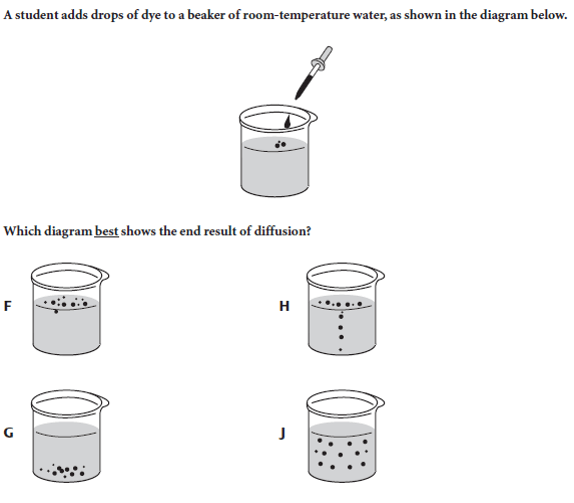
red food coloring moving through water until the water is pink
. water molecules leaving the cells of a fresh water fish, when placed in a salt water tank
none of the above
Which of the following molecules crosses through a semipermeable membrane during the process of osmosis?
Sodium
Proteins
Water
Glucose

The image shows atoms of helium gas in a box. The box is divided into two sections of equal volume by a membrane which is permeable to helium.
There will be a net movement of helium atoms from left to right.
There will be no net movement of helium atoms.
There will be a net movement of helium atoms from right to left.
There will be a net movement of the helium atoms from the top of the box to bottom of the box.
A plant cell has a 5% salt concentration. It is placed into a solution containing a 12% salt concentration.
What will happen to the plant cell?
Water will move into the plant cell, causing it to swell and burst.
Water will move out of the plant cell, causing it to shrivel.
Water will move out of the plant cell, causing it to swell and burst.
Water will move into the plant cell, causing it to shrivel.
Which way will water molecules move if a red blood cell is placed in distilled water?
out of the red blood cell
into the red blood cell
water molecules will move in and out at the same rate
no water molecules will move
Because the human body is 60% water, an important process which helps humans and all living things maintain a “normal” internal cellular environment even when external surroundings are constantly changing is:
diffusion
osmosis
active transport
carrier transport
What will happen to cut fruit pieces sprinkled with sugar?
They will gain water by osmosis
They will not change
They will lose water by osmosis
Why do plant cells become flaccid in concentrated sugar solution?
They gain water by osmosis
They lose water by osmosis
They lose water by active transport
What happens to the rate of diffusion as the temperature increases?
It decreases
It increases
It stays the same
What would happen if you gave a patient an IV of pure water?
Their blood cells would shrink.
Their blood cells would burst.
The patient would slowly become rehydrated.
I would be promoted for my outstanding level of medical care.
If you give a patient an IV of pure water, which way would water be moving?
into the blood cells
out of the blood cells
both into and out of, but with no net change
water would not be moving
I am doing an experiment on osmosis. I take some dialysis tubing (a semi-permeable membrane) and fill it with a 50% sugar solution. Sugar molecules are very big, and cannot pass through the membrane. If I want to increase the amount of sugar solution in the tubing, which beaker should I place it into?
beaker of 70% sugar solution
beaker of water
beaker of 90% sugar solution
beaker of any type of sugar solution
None of these conditions would cause the cell to gain weight
If someone sitting at the other end of a restaurant smokes a cigarette, you may still breathe in some of the smoke. The movement of smoke through the air of the restaurant is an example of what type of transport?
osmosis
diffusion
facilitated diffusion
active transport
If a cell’s cytoplasm contains 30% solute, which of the following best describes the rest of the cytoplasm?
70% solute
30% solute
70% water
30% water
30% solvent
Plants use osmosis to prevent...
respiration
photosynthesis
wilting
excretion
Why is osmosis not the same thing as diffusion?
A partially permeable membrane is needed for osmosis
A partially permeable membrane is needed for diffusion
Osmosis involves oxygen only
Diffusion involves water only
In living organisms, the partially permeable membrane is the...
nucleus
cell membrane
chloroplast
bacterium
Potato cylinders are put into a strong sugar solution. After an hour they are...
bigger
smaller
the same
sweet potato
Dilute means...
a little solute and a lot of water
a lot of solute and a little water
concentrated
the same
Osmosis takes place in this important structure.
Alveolus
Villus
Nephron
Artery
Osmosis takes place in which of the following?
Roots
Hair
Soil
The atmosphere


What would happen to an animal cell with an internal salt concentration of 9% if it were placed in a salt solution with a concentration of 3%?
It would shrink/ hypertonic
It would stay the same/ isotonic
It would swell/ hypotonic

The picture shows an example of what type of solution?
hypertonic
hypotonic
isotonic


Which gummy bear was left overnight in salt water?
Larger bear
Smaller bear

Which cell is in a hypertonic environment?
A
B
C
None of them are hypertonic


What happened to the CELL WALL and the CELL MEMBRANE in these plant cells?
Both the CELL WALL and CELL MEMBRANE shrunk
Only the CELL WALL shrunk, the CELL MEMBRANE stayed the same
The CELL WALL stayed the same, only the CELL MEMBRANE shrunk
Both the CELL WALL and CELL MEMBRANE stayed the same

