Worksheets
ES Final Review 2: Frequencies, Waves, Astronomy
Total questions: 77
Worksheet time: 42mins
A wave with a large wavelength will have a ______ frequency and _____ energy
high, low
high, high
low, high
low, low

The number of waves that pass a fixed point in a given amount of time is...
frequency
wave speed
amplitude
wavelength
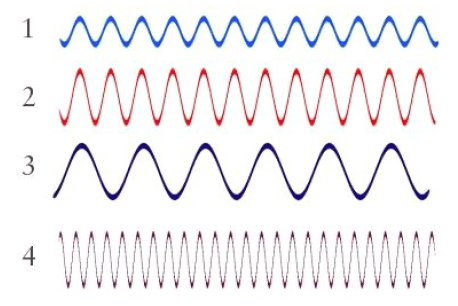


Which of the following has the most energy?
X-rays
The color green
Microwaves
ultraviolet

Which of the following has the most energy?
Red
Blue
Green
Violet

Which of the following has the shortest wavelength?
microwaves
UV rays
Infrared
the color blue

Which of the following has the least amount of energy?
UV rays
The color yellow
infrared
Gamma rays

Which of the following has the lowest energy?
The color yellow
The color blue
The color indigo
The color orange

Which of the following has the lowest frequency?
The color blue
The color green
The color yellow
The color violet
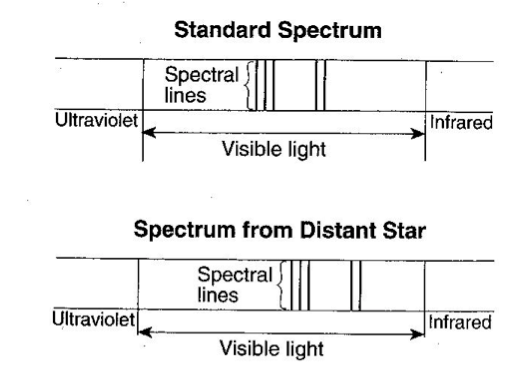
RED shift of light means the star is moving
toward Earth
away from Earth
not moving
BLUE shift of light means the star is moving
toward Earth
away from Earth
not moving
RED shift is proof that the universe is
expanding (getting bigger)
contracting (getting smaller)
RED shifted light has a
shorter wavelength
longer wavelength
BLUE shifted light has a
shorter wavelength
longer wavelength
Ever since the universe began, the universe has been
expanding
contracting
stays the same size
Which of the following is proof for the Big Bang Theory?
similar composition of Earth and the Moon
stars appear to move in the night time sky
cosmic background radiation
Ms. Phelan's dog chasing his tail
Cosmic Background Radiation is...
the remaining energy from the big bang.
incredibly hot.
visible to the human eye.
only located in certain places in the universe.

What is a solar system?
A collection of stars
A collection of planets
A collection of objects orbiting a star
A collection of stars orbiting a black hole

What is the Doppler Effect?
The apparent change in wavelength and frequency of a wave given out from a moving object.
The apparent change in speed of a wave given out from a moving object.
The apparent change in wavelength or frequency of a wave given out from a moving object.
When light from galaxies becomes red.

What is redshift?
The apparent change in colour of light when an object moves.
The apparent change in frequency and wavelength from a light source as it moves towards us.
The apparent change in frequency and wavelength of a wave from a light source as it moves.
When an object appears more red.

When will the forces of gravity between two objects be the GREATEST?
when the masses of both objects are small and the objects are far apart
when the masses of both objects are large and the objects are close together
when the masses of both objects are small and the objects are close together
when the masses of both objects are large and the objects are far apart

Which of the following correctly places these in order from LARGEST to SMALLEST?
galaxy -- local group/cluster -- planet -- solar system -- universe
universe -- galaxy -- solar system -- planet
planet -- solar system -- galaxy -- local group/cluster -- universe
universe --- solar system -- local planet galaxy -
Millions or Billions of stars, and or star systems is known as a......
Universe
Galaxy
Solar System
Planet
What are the two simplest elements that were formed after the Big Bang?
helium & carbon
hydrogen & helium
hydrogen & oxygen
oxygen and carbon
What are THREE pillars of evidence that supports the Big Bang theory?
cosmic background radiation
the spinning motion of pulsars
The abundance of hydrogen, helium, and other light elements found in the Universe
redshift of light from all galaxies (Hubble’s law of an expanding Universe)
Which statement is true about our understanding of atoms of the past and today?
We know nothing about the first atoms
The first atoms were complex, and have since broken apart into hundreds of varieties
The first atoms were complex, and have remained complex
The first atoms were simple, and have since fused into more complex varieties
You are driving in a car and honk the horn at a person standing in the street. As you approach the person, what happens to the pitch of the horn according to you in the car?
It increases
It decreases
It stays the same because you are in the car moving with the sound.
Light can change color due to the Doppler Effect.
True
False
You are standing on the side of the road when a police car races past you with its siren on. After the police car passes you, what happens to the pitch of the siren?
It increases
It decreases
It turns red
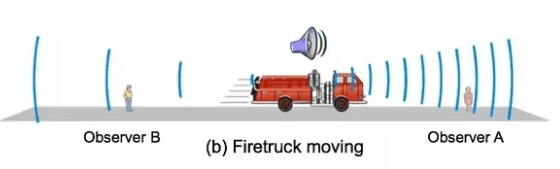
Look at the picture. Who is experiencing a higher pitched sound?
Observer A
Observer B
There's no difference
Which group of planets are only made of gases and liquids and have no solid surface?
Uranus, Neptune, Saturn
Earth, Mercury, Mars
Neptune, Venus, Jupiter
Mercury, Uranus, Earth
Which best describes the inner and outer planets?
the inner planets are gaseous and much closer together than the outer planets
the inner planets are much smaller and more spread out than the outer planets
the outer planets are terrestrial and much further apart than the inner planets
the outer planets are much larger and more spread out than the inner planets

What are the most abundant elements in a star?
Helium and Oxygen
Oxygen and Carbon
Hydrogen and Helium
Helium and Carbon

In the diagram given, what happens as we move to the left?
Stars get larger
Stars get colder
Stars get hotter
Stars get sillier

Which category is our Sun located in?
White Dwarfs
Supergiants
Main Sequence
Giants

The category that contains the most stars is...
Main Sequence
Supergiants
Giants
White Dwarf

True or False: Red Giants are considered hotter than White Dwarfs.
True
False


Which spectral class does our star, the sun, belong to?
M
K
G
B

Which property of stars is found on the x-axis of an H-R diagram?
Luminosity
(or absolute brightness)
Temperature
Star Size
Distance

What determines the color of a star?
Its size
Its temperature
Its composition
They are all the same color