Worksheets
CHAPTER 8.1-8.2 (UNTIL MOMENT OF FORCE)
Total questions: 60
Worksheet time: 33mins
Which of the following is the S.I. unit for force?
Newton
Kilogram
Watt
Joule
Which of the following is the S.I. unit for force?
Newton
Kilogram
Watt
Joule
Which of the following statement is true about force?
A student laughing loudly
Pushing or pulling of an object
Students singing the school song
Balancing an object on the hand
Which of the following examples is not a force?
Gravitational force
Elastic force
Frictional force
Mass force
A durian falls from the tree. There is a ___________.
gravitational force
normal force
elastic force
buoyant force

On earth, the object with a mass of 1 kg has a weight of ___.
1N
10N
100N
Force is a pull or a push upon an object. Which of the following shows a PULL on an object?
(Choose more than one answer.)


______________ is the thrust force acting on an object that is floating on the surface of a fluid.
Frictional force
Buoyant force
Weight
Normal force

State the type of force that resists movement between two surfaces that are in contact with each other.
Frictional force
Buoyant force
Gravitational force
Elastic force

______________ is the force produced when an object is in contact with a surface.
Frictional force
Buoyant force
Weight
Normal force

_____________ exists when a material is stretched or compressed.
Buoyant force
Elastic force
Frictional force
Gravitational force

Diagram shows a yacht floating on the surface of the sea. P and Q are the forces acting on the yacht.
What are P and Q?
P: Weight; Q: Normal force
P: Buoyant force ; Q: Weight
P: Normal force ; Q: Frictional force
P: Frictional force ; Q: Normal force
Which of the following forces causes the wear in the surface of car tyres?
Magnetic force
Elastic force
Frictional force
Normal force
Which of the following can be changed by force?
Mass
Speed
Temperature
Which of the following is not an effect of force?
Changing the shape of an object
Changing the components of an object
Changing the direction of a moving object
Stop a moving object
A student found that a spring becomes longer when it is stretched and becomes shorter when it is compressed. What can be inferred from this observation?
The effect of force cannot be observed.
Force makes stationary objects move.
Force can change the shape of an object.
Force can change the speed of an object.

At the start of a football game, a footballer kicks a ball placed in the middle of the field to move the ball.
What is the effect of force on the object?
Change the direction of a moving object
Make a moving object stop
Make a moving object move slower
Make a stationary object move

What is the effect of force shown in the diagram?
Moving a stationary object.
Stopping a moving object.
Changing the speed of an object that is in motion.
Changing the direction of motion of an object.

What is the effect of force shown in the diagram?
Changing the shape and size of an object.
Changing the direction of motion of an object.
Changing the speed of an object that is in motion.
Moving a stationary object.

What is the effect of force shown in the diagram?
Changing the shape and size of an object.
Moving a stationary object.
Stopping a moving object.
Changing the speed of an object tht is in motion.

What is the effect of force shown in the diagram?
Changing the shape of an object.
Moving a stationary object.
Stopping a moving object.
Changing the speed of an object that is in motion.
Why does object sink in water?
The object is less dense than the water.
The buoyant force is smaller than weight.
The buoyant force is greater than weight.
The object has the same density as water.
The weight of a stone is 20 N. When it is immersed in water, its weight is 15 N. What is the buoyant force acting on the stone?
2 N
3 N
4 N
5 N

Diagram shows an investigation conducted by Mazni. How much is the buoyant force exerted on the object when it was in the water?
1.07 N
0.28 N
0.27 N
1.68 N
A buoyant force is an upward force applied on an object by a ___________
substance
fluid
pressure
displacement
An object will _______ if the weight of it is equal to the weight of the water in which it is in.
float
sink
expand
shrink
An object will ______ if its' density is greater than the density of the fluid it is in.
expand
shrink
float
sink
When the weight of an object is greater than the buoyant force, the object will ...
sink
float
expand
shrink
To float in water, an object must
be less dense than water
be more dense than water
have less surface area than water
have more surface area than water
What is a lever?
A bar that can only move upwards.
A bar that rotates on a fixed point.
An organ in your body.
A type of heavy machine.
___________ is the force applied on the bar
Load
Effort
Fulcrum
___________ is the object to be moved.
Load
Effort
Fulcrum
___________ is the fixed support point.
Load
Effort
Fulcrum

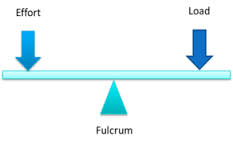


What are the main parts of a lever?
(Choose more than one answer.)
Fulcrum
Load
Energy
Power
Effort

What class lever is a pair of pliers?
1st
2nd
3rd

What class lever is a nutcracker?
1st
2nd
3rd

What class lever is a fishing rod?
1st
2nd
3rd

Diagram 2 shows part P of a lever. For which tool is part P labelled correctly?


Stapler is a _________________________.
first class lever
second class lever
third class lever
fourth class lever

The diagram shows a simple machine. Which of the following are J, K and L?
J: Fulcrum ; K: Load ; L: Effort
J: Fulcrum ; K: Effort ; L: Load
J: Effort ; K: Load ; L: Fulcrum
J: Load ; K: Effort ; L: Fulcrum
Which of the following is classified as the third class lever?


Levers are classified into first-class levers, second-class levers and third-class levers based on
the size of fulcrum, force and load
the type of fulcrum, force and load
the relative position of the fulcrum, force and load
the weight of the fulcrum, force and load

The diagram shows a type of lever. Identify J, K and L.
J: Effort ; K: Load ; L: Fulcrum
J: Load ; K: Fulcrum ; L: Effort
J: Fulcrum ; K: Load ; L: Effort
J: Fulcrum ; K: Effort ; L: Load
The moment of force depends on TWO factors, namely
the force applied
perpendicular distance of the fulcrum to the force
power in the fulcrum and force
time from fulcrum and force
Select TWO situations that involve a moment of force
Lifting a pail
Tighten the nut with a wrench
Opening a door
Raising the flag
What is the unit of moment f force?
N
m
Nm
N/cm
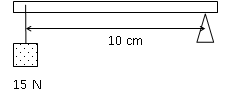
What is the moment produced by the 15 N?
15 Nm
150 Nm
1.5 Nm
0.15 Nm
The easiest way to open a heavy door is by applying the force _______
near the hinges
in the middle of the door
at the edge of the door far from the hinges
at the top of the door
A wrench is used to tighten a nut. A 15N perpendicular force is applied 50cm away from the axis of rotation, and moves a distance of 10 cm as it turns. What is the moment of force applied to the wrench?
7.5 Nm
1.5 Nm
750 Nm
150 Nm
Moment of force is bigger if the force acts further from turning point
TRUE
FALSE
Which of the following will loosen a nut more easily?
a short spanner because a larger moment of force can be produced.
a long spanner because a larger moment of force can be produced.
a long spanner because a larger force will be applied..
a short spanner because a larger force will be produced.
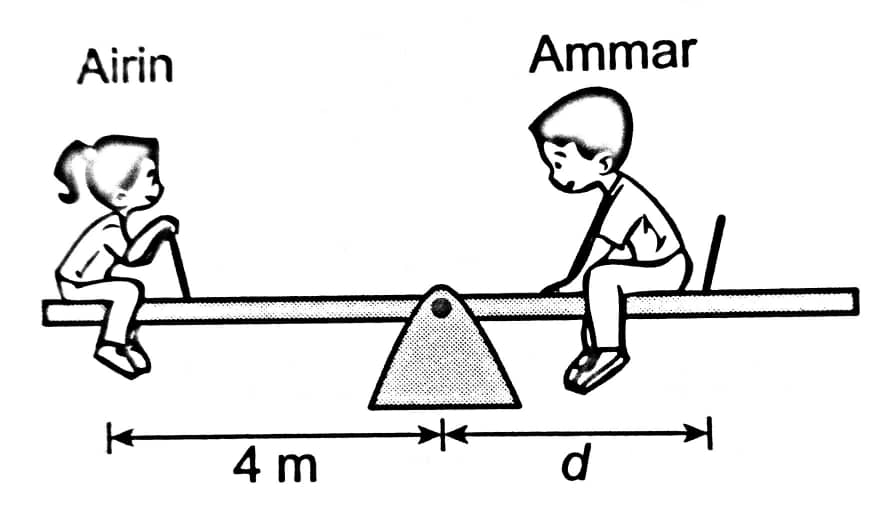
Diagram shows Airin and Ammar sitting on a see-saw. The weight of Airin is 300 N while Ammar is 400 N. What is the distance of Ammar from the fulcrum so that the see-saw is balanced?
1 m
2 m
3 m
4 m
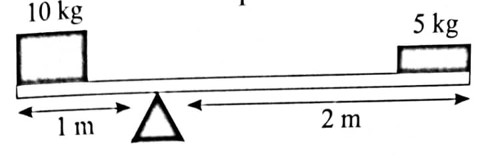
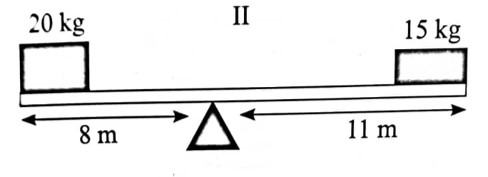
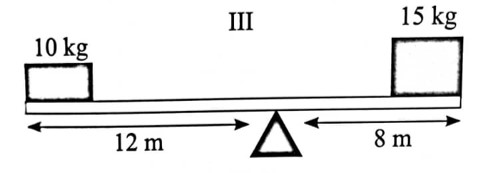
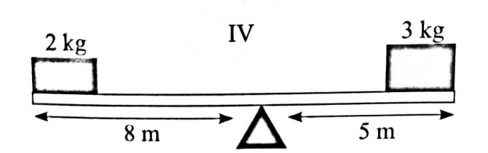
Which of the following lever is balanced?
(Choose two correct answers.)