Wayground logo

Free Printable Worksheets

Font size

S
M
L
XL
Worksheets

Biology Final 3B

Total questions: 51

Worksheet time: 35mins

Name
Class
Date
1.
When a cell divides, what do we call the 2 new cells?
a)
mother cells
b)
father cells
c)
daughter cells
d)
son cells
2.
a)
Cytokinesis
b)
Interphase
c)
Anaphase
d)
Metaphase
3.
In meiosis, the haploid number of chromosomes in a human sex cell is:
a)
46
b)
92
c)
22
d)
23
4.
After meiosis is complete how many cells will there be?
a)
1
b)
2
c)
3
d)
4
5.
Place these cells in order of mitosis.
a)
A, B, C, D, E
b)
B, E, D, A, C
c)
C, E, A, D, B
d)
B, D, A, E, C
6.
You inherited...
a)
most of your chromosomes from your mother
b)
most of your chromosomes from your father
c)
a random number of chromosomes from each parent
d)
half your chromosomes from your mother and half from your father.
7.
Human eggs and sperm are _____, and each has ____ chromosomes.
a)
diploid, 23
b)
diploid, 46
c)
haploid, 23
d)
haploid, 46
8.

In what process is mRNA synthesized?

a)

Transcription

b)

Translation

c)

DNA Replication

d)

Mitosis

9.

Where does TRANSCRIPTION occur?

a)

Nucleus

b)

Ribosome

c)

Cytoplasm

d)

Mitochondria

10.

How many codons equals 1 amino acid?

a)

1

b)

2

c)

3

d)

4

11.

How many nucleotides equal 1 amino acid?

a)

1

b)

2

c)

3

d)

4

12.

TRANSCRIBE this DNA sequence: TACGTTACT

a)

AUGCAAUGA

b)

ATGCAATGA

c)

AUGGATUGA

d)

TACGTTACT

13.

Which of the following are differences in the structure between RNA and DNA

a)

DNA uses deoxyribose sugar, RNA uses sugar ribose

b)

DNA pairs Adenine with Uracil, RNA pairs Adenine with Thymine

c)

DNA is a double helix, RNA is a single helix

d)

DNA pairs Adenine with Thymine, RNA pairs Adenine with Uracil

14.

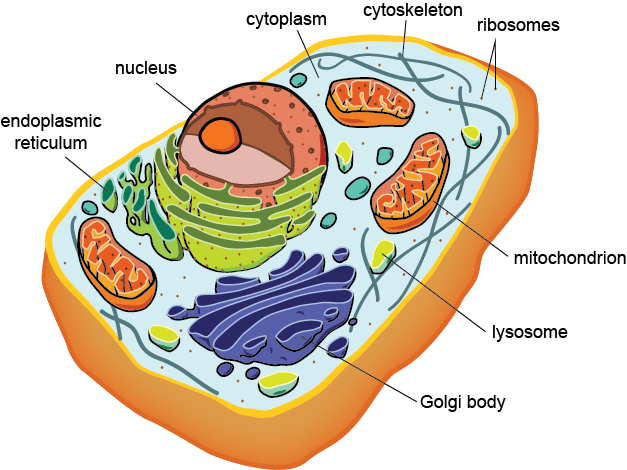
Which organelle is the location where protein is made?

a)

Ribosome

b)

Nucleus

c)

Cytoplasm

d)

Nucleotide

15.
The process to go from DNA to mRNA is _______
a)
translation
b)
transcription
c)
replication
16.
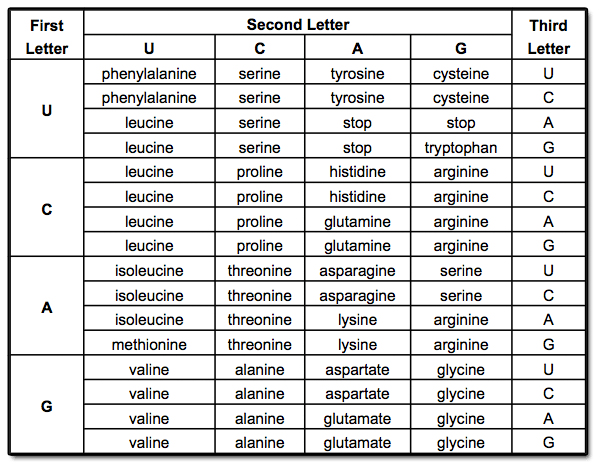
What amino acid is represented by the codon UUA?
a)
Phenylalanine
b)
Tyrosine
c)
Leucine
d)
Stop codon
17.

Which organelle controls what goes in and out of the cell?

a)

nucleus

b)

nucleolus

c)

cell membrane

d)

nuclear membrane

18.

Which organelle contains DNA and controls the cell?

a)

Cell membrane

b)

nucleus

c)

nucleolus

d)

lysosme

19.

This organelle makes useable energy for the cell

a)

chloroplast

b)

mitochondria

c)

ribosome

d)

nucleolus

20.

In _______ cells, the vacuole is large and located in the center of the cell.

a)

plant

b)

animal

c)

both plant and animal

d)

all

21.

Which of the following organelles is found only in a plant cell?

a)

mitochondria

b)

chloroplast

c)

centrioles

d)

vacuole

22.
Which of the following statements is not part of the cell theory?
a)
Cells are the basic unit of structure and function in all living things.
b)
All cells are produced from other cells.
c)
Only animal cells are composed of cells.
d)
All living things are composed of cells.
23.
Which statement reflects one of the major components of the cell theory?
a)
All living things are multi-cellular.
b)
Organs are the basic unit of structure and function for all living things.
c)
All cells come from previously existing cells.
d)
Every organism has a reproductive system to ensure survival of the species.
24.
The ___ is the basic unit of sturucture and function of organisms
a)
atom
b)
cell
c)
matter
d)
all other answers are correct
25.
Living Things are made of cells.
a)
True
b)
False
26.
Movement is not a characteristic of a living thing.
a)
True
b)
False
27.
Bacteria are considered living things.
a)
True
b)
False
28.
Which characteristic of life would be represented by a baby giraffe getting taller?
a)
growth
b)
respiration
c)
excretion
29.
Which of the following is true for ALL living things? 
a)
All living things can move independently.
b)
All living things need insulin to survive.
c)
All living things have brain cells.
d)
All living things grow.
30.
Which of the following is true for ALL living things? 
a)
All living things eat other organisms to survive.
b)
All living things have muscle fibers.
c)
All living things need oxygen.
d)
All living things reproduce.
31.
All living things use energy.
a)
True.
b)
False.
32.

Which means of particle transport requires energy?

a)

diffusion

b)

osmosis

c)

facilitated diffusion

d)

active transport

33.

An animal cell that is surrounded by fresh water will burst because the osmotic pressure causes

a)

water to move into the cell

b)

water to move out of the cell

c)

solutes to move into the cell

d)

solutes to move out of the cell

34.

Which means of particle transport is shown in the picture?

a)

endocytosis

b)

exocytosis

c)

facilitated diffusion

d)

protein pump

35.

Molecules tend to move from an area of high concentration to low concentration is called

a)

facilitated diffusion

b)

diffuson

c)

osmosis

d)

receptor

36.

Some materials can move across the cell membrane against a concentration gradient by

a)

active transport

b)

facilitated transport

c)

osmosis

d)

diffusion

37.

What would happen to to an animal cell with an internal salt concentration of 9% if it were placed in a salt solution with a concentration of 3%?

a)

It would shrink/ hypertonic

b)

It would stay the same/ isotonic

c)

It would swell/ hypotonic

38.

The passing of traits from parent to child is known as _______________.

a)

heredity

b)

gene

c)

DNA

d)

RNA

39.

Which genotypes are homozygous?

a)

EE

b)

tt

c)

Rr

d)

Both EE and tt

40.

Which genotypes are homozygous dominant?

a)

EE

b)

tt

c)

Rr

d)

Both EE and tt

41.

_____ is the genetic makeup of an organism.

a)

phenotype

b)

genotype

42.

The ____ is the physical appearance of an organism.

a)

genotype

b)

phenotype

43.

When you cross two parents, each parent is responsible for passing _______ of their two alleles for each individual trait.

a)

1

b)

2

c)

3

d)

4

44.

True or False: Human cells have a diploid number of 40

a)

true

b)

false

45.
What type of "square" helps us solve genetic problems?
a)
carpenter square
b)
Mendel square
c)
Punnett square
d)
genetic square
46.
Females-XX; MalesXY.  A couple has 4 girls.  What is the chance the next child will be a boy?
a)
75%
b)
100%
c)
25%
d)
50%
47.
Females-XX; MalesXY.  A couple has 4 girls.  What is the chance the next child will be a boy?
a)
75%
b)
100%
c)
25%
d)
50%
48.

Alternant or different genes that code for the same trait are called?

a)

chromosomes

b)

segments

c)

alleles.

d)

homozygous.

49.

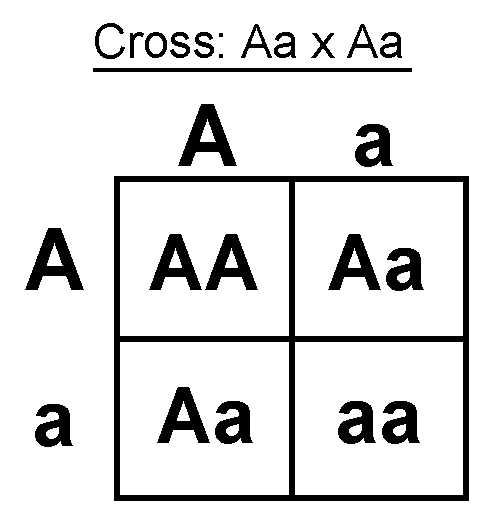
What is the genotypic ratio of the offspring?

a)

3:1

b)

1:3

c)

1:2:1

d)

2:2

50.
What are the possible genotypes for this cross?
(Click the picture to see it without the text)

a)
TT = 25% Tt= 50% tt=25%
b)
all tall
c)
TT= 75% tt = 25%
d)
Tt = 100%
51.
TT,tt,PP,pp,SS,ss are examples of alleles that are?
a)
homozygous
b)
heterozygous
c)
different
d)
homologous