wayground logo

Free Printable Worksheets

NEW

Font size

S
M
L
XL
Worksheets

Final Exam Review

Total questions: 39

Worksheet time: 1hrs 1mins
Name
Class
Date
1.
What is a dichotomous key used for in science?
a)
To organize biomes
b)
Classify organisms
c)
Identify bacteria only
d)
None of these
2.
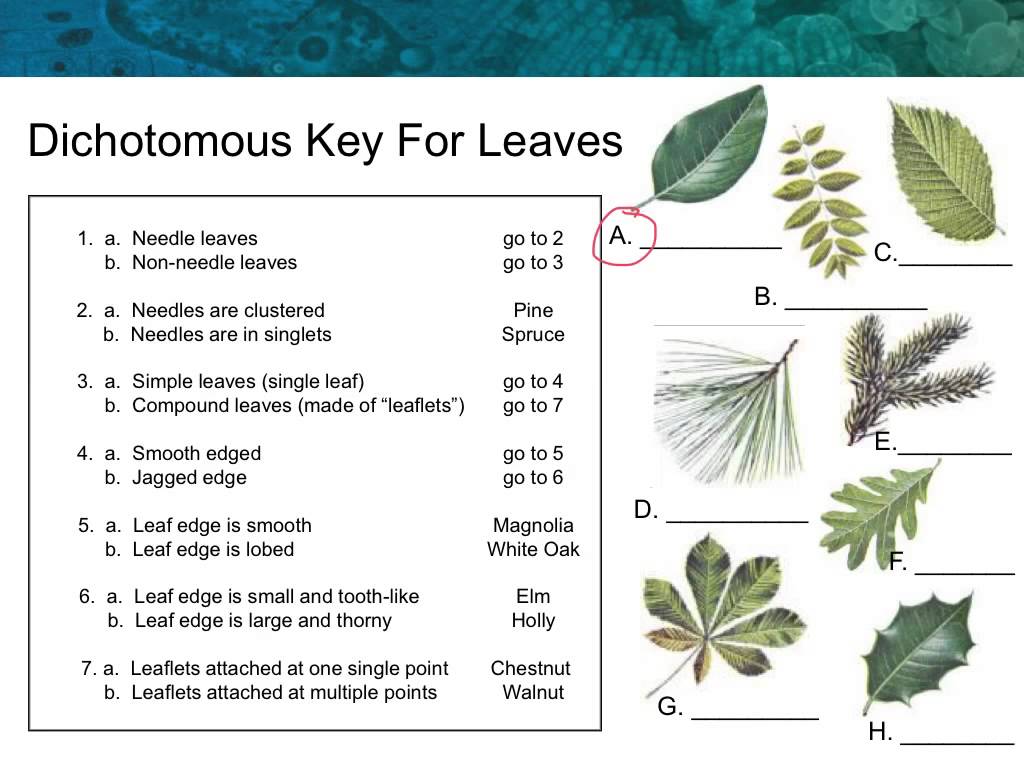
Using this dichotomous key, identify the name of the circled Fish, J.
a)
peacock flounder
b)
band-tail puffer
c)
trumpet fish
d)
spotted goat fish
3.
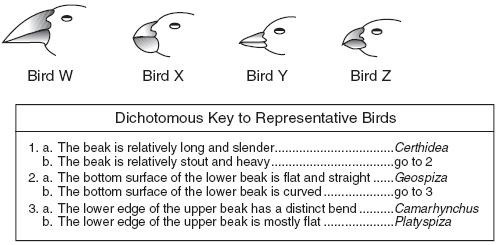
What is the name of bird W?
a)
Certhidea
b)
Geospiza
c)
Camarhynchus
d)
Platyspiza
4.

Primary succession occurs in an area that has:

a)

soil

b)

no soil

c)

some soil

d)

none of these

5.

___ are the first organisms to colonize an area and begin the process of ecological succession.

a)

foundational organisms

b)

introductory organisms

c)

primary organisms

d)

pioneer species

6.

What is the main difference between primary and secondary ecological succession?

a)

Primary begins WITHOUT soil; Secondary begins WITH soil

b)

Primary is the first state and secondary is the second stage

c)

Primary builds plant community; secondary builds animal community

d)

Primary begins WITH soil; Secondary begins WITHOUT soil

7.
What is the order of succession shown in this figure?
a)
A, B, C, D
b)
B, A, D, C
c)
C, D, A, B
d)
D, A, B, C
8.
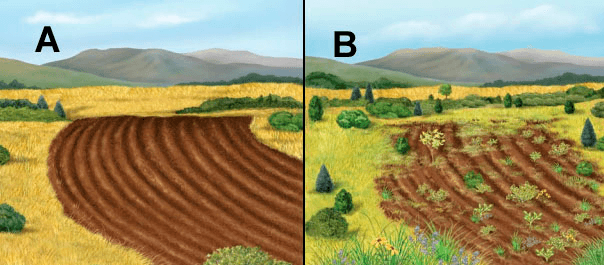
What type of succession is shown going from figure A to figure B?
a)
primary succession
b)
ecological succession
c)
secondary succession
d)
intermediate
9.
A ___________________ is the area of land that collects runoff and channels it into a main river.
a)
rill
b)
gully
c)
stream channel
d)
watershed
10.
The illustration provided shows a river and four cities on that river. When the water from the river was sampled at location X, it was determined to be polluted with various chemicals. What would be the most likely source for this pollution?
a)
City 1 and City 2
b)
City 2 and City 3
c)
City 3 and City 4
d)
City 1 and City 4
11.
A large storm associated with low pressure, forms over water is called...
a)
Flood
b)
Hurricane
c)
Tsunami 
d)
Blizzard
12.
A spinning funnel cloud which causes much destruction is called a...
a)
Tornado 
b)
Earthquake
c)
Tsunami 
d)
Hurricane 
13.
A large wave created by an underwater earthquake is called a...
a)
Earthquake 
b)
Hurricane
c)
Tsunami 
d)
Flood
14.

What would happen to the bird if the green fish died out?

a)

the bird population would grow

b)

the bird population would die out

c)

the smaller fish will die out

15.
In the energy pyramid here, how much of the energy in the producers gets passed to the herbivores?
a)
10%
b)
20%
c)
80%
d)
90%
16.
Which organism in figure 1 contains the most available energy?
a)
plants
b)
mountain lions
c)
hawks
d)
none of the above
17.
Which statement about photosynthesis is correct?
a)
Plants get the energy they need for photosynthesis from water.
b)
Plants get the energy they need for photosynthesis from soil.
c)
Plants get the energy they need for photosynthesis from sunlight.
d)
Plants do not require energy to perform photosynthesis.
18.
Which sentence correctly describes photosynthesis. (assume there is enough sunlight)
a)
CO2 and water combine and make O2 and glucose
b)
O2 and water combine to make glucose and CO2
c)
O2 and CO2 combine to make water and glucose
d)
CO2 and glucose combine to make O2 and water
19.
What is the end product of photosynthesis ?
a)
carbon dioxide
b)
water
c)
glucose
d)
methane
20.
Which of the following is the correct equation for PHOTOSYNTHESIS?
a)
CO+ light + H2O --> O+ glucose
b)
CO+ glucose + H2O --> O+ light
c)
O2 + light + H2O --> CO+ glucose
d)
CO+ O2 + H2O --> Light+ glucose
21.
The process by which water, ice, wind or gravity moves weathered rock and soil from one place to another.
a)
weathering
b)
erosion
c)
deposition
d)
dumptruck
22.
These rocks were broken apart from the continuous freeze/thaw of water in the cracks of the rocks. This is an example of:
a)
ice wedging
b)
acid rain
c)
permeability
d)
abrasion
23.
How is mechanical weathering different from chemical weathering?
a)
Chemical weathering happens over much shorter time frame than mechanical weathering.
b)
Chemical weathering changes the chemical composition of rocks; mechanical weathering does not.
c)
Chemical weathering occurs only in tropical climates; mechanical weathering occurs only in cool climates.
d)
Chemical weathering occurs only in the mountains; mechanical weathering occurs only on flat land.
24.
Which diagram represents mechanical weathering?
a)
G
b)
F
c)
H
d)
J
25.
What are adaptations?
a)
traits that help an organism to survive and reproduce
b)
traits that help an organism hide
c)
traits that help an organism to seek protection
d)
traits that help an organism to see.
26.
What adaptation does this squirrel have that allows it to glide through the air?
a)
Extra skin under the arms and legs to capture air as it falls.
b)
Big ears to capture are as it falls
c)
Small eyes to see where it will land
d)
A short thin tail
27.

A tropism is...

a)

a change in the environment

b)

plant movement in response to a stimulus

c)

something that causes a response

d)

when photosynthesis takes place

28.

Roots of a tree growing towards the water line of a house.

a)

Geotropism

b)

Phototropism

c)

Thigmotropism

d)

Hydrotropism

29.
When there is higher biodiversity
a)
more organisms are likely to die because they can't adapt to environmental changes.
b)
there is less diversity.
c)
there is more diversity and higher sustainability of life.
d)
there is more diversity and lower sustainability of life
30.
High biodiversity is 
a)
having a lot of the same organism.
b)
having a few of the same organism.
c)
having a lot of variety of different organisms.
d)
only having one of each organism. 
31.

The protective covering of the body.

a)

respiratory system

b)

cardiovascular system

c)

integumentary system

d)

endocrine system

32.

Muscles inside many internal organs.

a)

Smooth

b)

Cardiac

c)

Skeletal

33.

Lungs

a)

Small blood vessels where materials are exchanged between the blood and the body’s cells (oxygen and carbon dioxide)

b)

Where the exchange of gas occurs. Oxygen enters and carbon dioxide exits.

c)

Muscular tube connecting the mouth to the stomach

d)

Force pathogens out of the body

34.

a)

Integumentary

b)

Nervous

c)

Circulatory

d)

Respiratory

35.

a)

Skeletal

b)

Muscular

c)

Circulatory

d)

Respiratory

36.
Which system collects and removes wastes?
a)
Muscular
b)
Circulatory
c)
Digestive
d)
Excretory
37.

Which three body systems allow you to move?

a)

muscular, skeletal, digestive

b)

nervous, respiratory, digestive

c)

nervous, muscular, skeletal

d)

Muscular, skeletal, circulatory

38.
List the levels of organization in the human body in order from least complex to most complex…
a)
Tissues, cells, organ systems, organs, and organism
b)
Cells, tissues, organ systems, organs, and organism
c)
Cells, tissues, organs, organism, and organ systems
d)
Cells, tissues, organs, organ systems, and organism
39.

Regulation of body processes is the function of the __________________________ system.

a)

nervous

b)

lymphatic

c)

endocrine

d)

digestive