Font size
 Worksheets
science-cells
Total questions: 69
Worksheet time: 59mins
_______ are the smallest units of life because they grow, reproduce, respond, and use energy.
atoms
elements
cells
all of the above
Cells come from______.
other preexisting cells
cytoplasm
organelles
prokaryotes
The cell theory states that_________
cells come from cells
all organisms are made of cells
cells are the basic unit of structure and function for life
all of the above
________ is the scientist who saw small chambers when looking at cork, and named them “cells”.
Newton
Hooke
Carson
Manning
The size of an organism is determined -
by the size of the cells that make up the organism.
by the number of cells that the organism has.
The cell theory is a result of the work of one very important scientist name Hooke.
True
False
A multicellular organism is made of
one cell
multiple cells
unicellular cells
there is no such thing as a "multicellular" organism
One common feature of all cells is their ability to -
work with other cells in a "unicellular" organism.
reproduce themselves.
be formed by spontaneous generation.
exist without needing a cell membrane
When a cell is ready to reproduce, it duplicates its contents, then divides into two similar (and sometimes exact duplicate) cells.
True
False
Regardless of type, all cells
have a cell membrane
have cytoplasm
can duplicate themselves by undergoing cell division
all of the above
Contains chlorophyll (green pigment) and uses the sun to make food
cell membrane
cell wall
chloroplast
cytoplasm
rigid outer layer that supports and allows it to grow tall
cell membrane
cell wall
chloroplast
cytoplasm
controls movement of materials in and out of the cell, maintains homeostasis
cell membrane
cell wall
chloroplast
cytoplasm
jelly like material that protects cell organelles
cell membrane
cell wall
chloroplast
cytoplasm
"power house" of the cell - converts sugar into energy
cytoplasm
mitochondrion
nucleus
vacuoles
fluid-filled sacs that store food
cytoplasm
mitochondrion
nucleus
vacuoles
the brain of the cell
cytoplasm
mitochondrion
nucleus
vacuoles
Which of these is not found in the animal cell and is found in the plant cell? Pick more than one
cell membrane
cell wall
chloroplast
cytoplasm
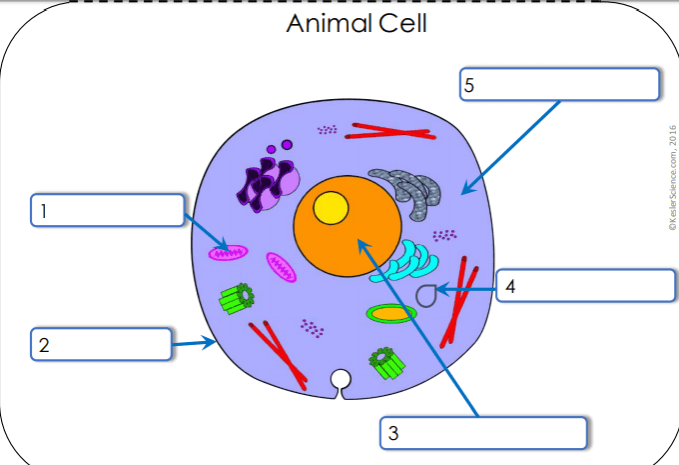
What is #1 in the diagram?
nucleus
cell wall
cytoplasm
mitochondrion
What is #2 in the diagram?
vacuoles
cell membrane
chloroplast
nucleus
What is #3 in the diagram?
vacuoles
cell membrane
chloroplast
nucleus
What is #4 in the diagram?
vacuoles
cell membrane
chloroplast
nucleus
What is #5 in the diagram?
nucleus
cell wall
cytoplasm
mitochondrion
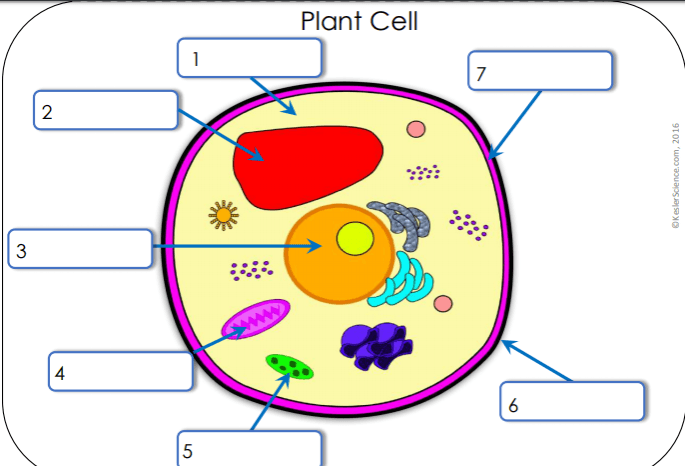
What is #1 in the diagram?
nucleus
cell wall
cytoplasm
mitochondrion
What is #2 in the diagram?
vacuoles
cell membrane
chloroplast
nucleus
What is #3 in the diagram?
vacuoles
cell membrane
chloroplast
nucleus
What is #4 in the diagram?
nucleus
cell wall
cytoplasm
mitochondrion
What is #5 in the diagram?
vacuoles
cell membrane
chloroplast
nucleus
What is #6 in the diagram?
nucleus
cell wall
cytoplasm
mitochondrion
What is #7 in the diagram?
vacuoles
cell membrane
chloroplast
nucleus

This is the brain or control center of the cell.
Cytoplasm
Nucleus
Cell membrane

What cell part is NOT found in all cells?
Chloroplasts
Cell Membrane
Cytoplasm
Nucleus
True or False:
Plant cells have a more rigid structure than animal cells.
True
False
This type of cell needs a cell wall and chloroplasts
Animal Cell
Plant Cell
This cell part is in ALL cells. It is the gel-like substance that provides cell shape.
Chloroplasts
Cell membrane
Cytoplasm
Nucleus
Plants perform photosynthesis through this organelle. It captures energy from the sun and uses it to produce food for the cell.
Cytoplasm
Chloroplasts
Cell Wall
Nucleus
What shape are most plant cells?
round
rectangular
What shape are most animal cells?
round
rectangular

What type of cell is pictured above?
Plant Cell
Animal Cell

What type of cell is pictured above?
Plant Cell
Animal Cell

Both a plant and animal cells have a cell wall
True
False
What is the power house in the plant and animal cell?
nucleus
mitochondria
Cell membrane
none of the above
What is the large sac that holds food, water, and waste?
Cytoplasm
Vacuole
Nucleus
Mitochondria
Which cell has a cell wall?
Animal Cell
Plant Cell
Both
Which cell has chloroplast?
Plant cell
Animal cell
Both
Neither one of them have chloroplast
What is the cell membrane?
Power House
Its the outer layer of a cell
Large sac that holds food, water, and waste
Jelly like substance
This cell part is in ALL cells. It is the gel-like substance that provides cell shape.
Chloroplasts
Cell membrane
Cytoplasm
Nucleus
Plants perform photosynthesis through this organelle. It captures energy from the sun and uses it to produce food for the cell.
Cytoplasm
Chloroplasts
Cell Wall
Nucleus
organs, organ systems, organisms, cells, tissues