
 Worksheets
REMOVAL EXAMS IN HUMAN ANATOMY AND PHYSIOLOGY
Total questions: 100
Worksheet time: 48mins
A layer of smooth muscle that walls the scrotum.
Dartos Muscle
Cremaster Muscle
Dartos Muscle and Cremaster Muscle
Corpus Cavernosum
This contains the base of the scrotum.
Perineum
Urogenital Triangle
Penis
Prepuce


Latissmius Dorsi
Erectors
Deltoids
Abdominal

Rectus Abdominal
Oblique
Erectors
Pectoral

Tricep
Deltoid
Hamstring
Biceps


Gluteus Maximus
Hamstring
Quadricep
External Oblique


Rectus Abdominus
External Oblique
Pectorals
Trapezius


Which of the following structures closes off the larynx during swallowing
glottis
epiglottis
esophagus
palate

#1
Renal capsule
Minor calyx
Major calyx
Ureter
#2
Renal capsule
Major calyx
Minor calyx
Ureter
#3
Renal pelvis
Major calyx
Renal medulla
Renal pyramids
#4
Renal pelvis
Major calyx
Renal medulla
Renal pyramids
#6
Renal pelvis
Major calyx
Renal medulla
Renal pyramids
#7
Ureter
Major calyx
Renal medulla
Renal cortex
#8
Ureter
Major calyx
Renal medulla
Renal cortex
#9
Ureter
Major calyx
Renal medulla
Renal cortex
Pulmonary circulation occurs only between the heart and the
organs
lungs
brain
limbs
Chemicals that target specific bacteria and fungi inside the body and prevent them from reproducing are called
toxoids
vaccines
antiseptics
antibiotics
Gluteus Maximus
Hamstring
Quadricep
External Oblique
Rectus Abdominus
External Oblique
Pectorals
Trapezius

What is the vertebral arch?
Red Portion
Blue Portion
What is the vertebral body?
Red Portion
Blue Portion
What structure is not apart of the vertebral arch?
Pedicle
Transverse Process
Lamina
Intervertebral Disc
Spinous Process

What is number 1? Bony projection posteriorly.
Transverse Process
Spinous Process
Body
Pedicle
What is number 2? Bony projection that articulates with the vertebra above it.
Demifacet
Superior Articular Facet
Lamina
Pedicle
What is number 3? Bony projection laterally from the vertebra.
Demifacet
Superior Articular Facet
Transverse Process
Lamina
What is number 4? Portion that connects the vertebral body with the vertebral arch.
Pedicle
Superior Articular Facet
Transverse Process
Lamina
What is number 5? Bony projection that articulates with the vertebra below it.
Pedicle
Superior Articular Facet
Transverse Process
Inferior Articular Facet
What is number 6? C'mon. EASY!
Pedicle
Body
Transverse Process
Inferior Articular Facet
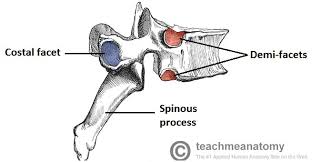
This vertebra is from what portion of the spine?
Cervical
Thoracic
Lumbar
None of these
The demi-facet and the costal facet is an articular surface for what?
Fingers
Ribs
Toes
Vertebrae

The arrow is pointing to this, where the spinal cord traverses through.
Vertebral Foramen
Foramen
Intervertebral Foramen
Hole in vertebra
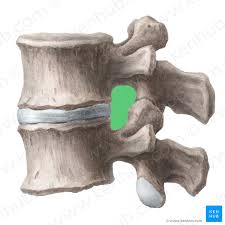
The green portion is? Where the spinal nerve roots exit the spinal cord/column.
Vertebral Foramen
Foramen
Intervertebral Foramen
Hole in vertebra

What curves are located in the cervical and lumbar spine?
Lordosis
Kyphosis
Scoliosis
What curves are located in the thoracic spine?
Lordosis
Kyphosis
Scoliosis
The numerous muscles of the vertebral column serve what purpose?
Help move the spine
Provide active support of the structure
Prevent excessive, injury causing movement
Help hold everything in place
All of the above
How many cervical VERTEBRAE are there and how many cervical NERVE ROOTS are there?
6, 10
7, 8
12, 12
7, 7
None are correct
The green portion is? Where the spinal nerve roots exit the spinal cord/column.
Vertebral Foramen
Foramen
Intervertebral Foramen
Hole in vertebra
Which organ releases digestive enzymes into the small intestine?
pancreas
small intestine
esophagus
salivary glands
What organ is responsible for the majority of the absoption that occurs in the digestive system?
large intestine
small intestine
stomach
oral cavity
The teeth and tongue of the oral cavity break foodstuff down physically. This is an example of
mechanical digestion
chemical digestion
absorption
peristalsis
Which of the following is an accessory organ of the digestive system?
stomach
small intestine
esophagus
liver
Which of the following answers correctly sequences the pathway food takes from the beginning to end?
mouth, esophagus, stomach, small intestine, large intestine
mouth, esophagus, stomach, large intestine, small intestine
mouth, stomach, esophagus, small intestine, large intestine
mouth, stomach, esophagus, large intestine, small intestine
Which organ stores and releases bile?
liver
gallbladder
pancreas
Which organ makes bile?
liver
gallbladder
pancreas

Structure 12 is the
pancreas
salivary glands
mouth
esophagus
Structure 16 is the
pancreas
salivary glands
larynx
esophagus
Structure 4 is the
pancreas
liver
stomach
gall bladder
Structure 17 is the
pancreas
liver
stomach
gall bladder
Structure 5 is the
pancreas
appendix
salivary gland
gall bladder
Structure 20 is the
pancreas
stomach
large intestine
small intestine
Structure 8 is the
pancreas
stomach
large intestine
small intestine
Structure 11 is the
gall bladder
appendix
large intestine
small intestine
Structure 22 is the
anus
rectum
large intestine
small intestine
What organ is responsible for the absorption of water and movement of waste?
large intestine
small intestine
stomach
oral cavity


A major male sex organ that produces and stores sperm.
Prostate Gland
Testicle
Ovary
Vas deferens
A muscular tube that transports sperm-filled semen.
Vas deferens
Fallopian tube
Scrotum
Penis
What part of male reproductive system that function as a sac that holds the testes?
Vas deferens
Scrotum
Penis
Prostate gland
A set of coiled tubes that connect to the vas deferens.
Fallopian tube
Epididymis
Urethra
Seminal Vesicle

Using the diagram, which letter is the Vas Deferens?
H
I
J
K

Which letter corresponds to Urethra?
D
I
H
J

Which Letter corresponds to the Prostate Gland?
B
D
G
K
The head of the penis is what we called?
Prostate gland
Glans
Root
Shaft
What is the primary sex hormones of males?
Prostate gland
Testosterone
Urine
Semen
When semen is pushed through and out of a males body through the urethra is a process called_______.
Ejaculation
Erection
Menstruation
Transportation
What is the function of vas deferens?
A muscular tube that passes upward alongside the testes and transports mature sperm to the urethra.
Sperm storage organ.
Feces holding area.
It produces sugar- rich fluid that provides sperm with a source of energy to help them move.
Which statement is true about epididymis?
A set of oily openings that release sperm
A set of coiled tubes which transport and stores sperm cells.
Producer of male sex hormones.
Transport mature sperm to the urethra.
Tiny male cell that unites with the female ovum to form a fertilized egg or zygote.
Testes
Scrotum
Sperm
Semen
What fluid contains millions of sperms that is produced by the sex organs of males?
Testosterone
Semen
Urine
Estrogen

