wayground logo

Free Printable Worksheets

Font size

S
M
L
XL
Worksheets

Chemistry of Life

Total questions: 144

Worksheet time: 3hrs 40mins

Name
Class
Date
1.

A positively charged particle found in the nucleus of an atom is

a)

a quark.

b)

an electron.

c)

a proton.

d)

a neutron.

2.

A  negatively charged particle located outside the atom's nucleus is

a)

a neutron.

b)

a proton.

c)

an electron.

d)

a quark.

3.

A subatomic particle that has no charge and that is found in the nucleus of an atom is

a)

a quark.

b)

a proton.

c)

a neutron.

d)

an electron.

4.

The center of an atom is 

a)

a neutron.

b)

a nucleus.

c)

a quark.

d)

a bohr.

5.

An area around an the center of the atom where electrons are located

a)

is deep space.

b)

is a quark.

c)

is a nucleus.

d)

is an electron cloud.

6.

Smaller particles that make up protons and neutrons 

a)

are used in Lewis Dot diagrams

b)

are found in the different energy levels.

c)

are particle accelerators.

d)

are quarks.

7.

A _____ moves nuclei faster and faster until they have reached very high speeds.

a)

quark

b)

nucleus

c)

rutherford

d)

particle accelerator

8.

Greek philosopher who developed an atomistic theory of matter

a)

Aristotle

b)

Democritus

c)

John Dalton

d)

James Chadwick

9.

An English chemist and physicist who formulated the atomic theory with evidence.

a)

Neil Bohr

b)

James Chadwick

c)

JJ Thompson

d)

John Dalton

10.

Discovered that electrons move in definite orbits around a positive nucleus.

a)

Neil Bohr

b)

Ernest Rutherford

c)

James Chadwick

d)

John Dalton

11.

He was a student of the scientist that discovered how electrons move; however, he discovered neutrons.

a)

Neil Bohr

b)

Ernest Rutherford

c)

James Chadwick

d)

JJ Thompson

12.

He discovered the electron.

a)

Democritus

b)

James Chadwick

c)

Ernest Rutherford

d)

JJ Thompson

13.

He discovered the nucleus of an atom.

a)

Neil Bohr

b)

Ernest Rutherford

c)

James Dalton

d)

James Chadwick

14.

The smallest particle of an element that still retains the element's properties is

a)

an atom.

b)

a nucleus.

c)

a quark.

d)

an electron.

15.
What quantities vary between isotopes of an element?
a)
protons, electrons, and atomic mass
b)
protons, electrons, and atomic number
c)
neutrons and electrons
d)
neutrons and atomic mass
16.

Atoms of the same element which have a different number of neutrons are called _________________.

a)

ions

b)

isotopes

c)

quarks

d)

molecules

17.

ALL atoms of the same element have:

a)

same number of proton

b)

same number of nucleon

c)

different number of neutron

d)

different number of electron

18.
A positive ion is called a...
a)
Posion
b)
Anion
c)
Cation
d)
Proton
19.
What are ionic bonds?
a)
Valence electrons transferred between atoms
b)
Inner most electrons transferred between atoms
c)
Sharing electrons
20.
An electron has what kind of charge?
a)
no charge
b)
positive 
c)
negative
d)
it depends
21.
a proton has what charge?
a)
positive
b)
negative
c)
no charge
d)
it depends
22.
Atoms that gain electrons become...
a)
negatively charged
b)
positively charged
c)
remain neutrally charged
d)
21
23.
if METALS are more likely to LOSE electrons, they will form ...
a)
anions
b)
neutral atoms
c)
positive ions
d)
negative ions
24.
How many valence electrons do all elements in the Carbon family have?
a)
6
b)
5
c)
4
d)
7
25.
Ionic bonds occur between...
a)
A metal and a nonmetal
b)
Two metals
c)
Two nonmetals
d)
Two gases
26.
In a bond between Sodium and Chlorine, what will the final charges on each ion be?
a)
Sodium -1, Chlorine +2
b)
Sodium +2, Chlorine -1
c)
Sodium +1, Chlorine -1
d)
Sodium -2, Chlorine +2
27.
What bond involves the sharing of electrons?
a)
Ionic
b)
Transitive
c)
Covalent
28.
What types of elements are involved in a covalent bond?
a)
A nonmetal and a metal
b)
Two nonmetals
c)
Gases Only
d)
Metalloids Only
29.
What would the correct formula be for Hydrogen + Hydrogen?
a)
2H
b)
H2
30.
In an electron dot diagram, two pairs of shared electrons represents a ...
a)
single bond
b)
double bond
c)
triple bond
d)
quadruple bond
31.
The chemical bond formed when two atoms share electrons  is called a(an) IONIC bond. 
a)
True
b)
False
32.
Covalent bonds usually form when a nonmetal combines with a(an) METAL.
a)
True
b)
False
33.
A(n) ION is a neutral group of atoms joined by covalent bonds.
a)
True
b)
False
34.
In a(an) POLAR bond, one atom pulls on the shared electrons more than the other atom. 
a)
True
b)
False
35.
The forces between molecules are much STRONGER than the forces between ions. 
a)
True
b)
False
36.
How are covalent bonds formed?
a)
Sharing of electrons
b)
Transfer of electrons
37.
Why do elements bond?
a)
To be friends
b)
To create a new element
c)
To become stable
38.
Same repel, opposites
a)
avoid
b)
attract
c)
push
d)
pull
39.
What is a valence electron?
a)
The sum of neutrons and protons.
b)
The # of electrons in the last shell.
c)
A type of bond.
d)
A popular compound.
40.
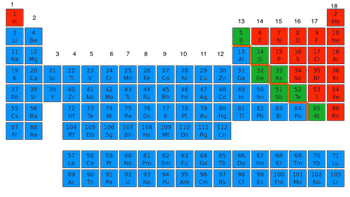
Where are metals located on the periodic table?
a)
Blue
b)
Green
c)
Red
41.
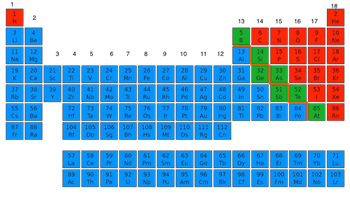
Where are the nonmetals located on the periodic table? 
a)
Blue
b)
Red
c)
Green
42.
Where are the metalloids located on the periodic table?
a)
Blue
b)
Red
c)
Green
43.
Two or more atoms held together by a chemical bond is called what?
a)
A molecule
b)
A molecure
44.
Which of these is not a real bond in chemistry?
a)
James
b)
Ionic
c)
Covalent
45.

When atoms bond it is called a ___________________ because they make a new substance.

a)

chemical reaction

b)

physical reaction

46.

Covalent Bonds ______________ valence electrons.

a)

give

b)

take

c)

keep

d)

share

47.
How do covalent bonds form?
a)
Donating & receiving valence e- between atoms.
b)
Opposite slight charges attract each other between compounds.
c)
Scientists are still not sure how they form.
d)
Sharing valence e- between atoms.
48.
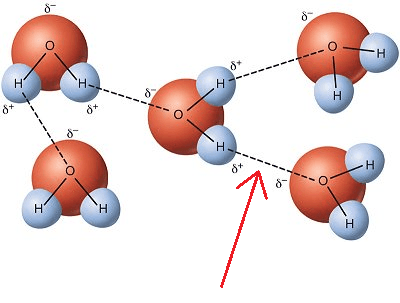
What type of bond is shown in this picture?  It is the WEAKEST type & attracts one water compound to another!
a)
Ionic bond
b)
Polar Covalent
c)
Nonpolar Covalent
d)
Van der Waals force
49.

The attraction that exists between carbon dioxide molecules in solid carbon dioxide is due to

a)

covalent bonding

b)

Hydrogen bonding

c)

dipole-dipole attractions

d)

van der Waal forces

50.

Which term represents an intermolecular force in a sample of water?

a)

hydrogen bonding

b)

covalent bonding

c)

metallic bonding

d)

ionic bonding

51.
How many Hydrogen atoms does a single water molecule have?
a)
1
b)
2
c)
3
d)
4
52.
What does "polar" mean?
a)
A molecule is cold
b)
A molecule has ionic bonds
c)
A molecule has covalent bonds
d)
A molecule has areas of positive and negative charge
53.
This atom in a water molecule has more of a negative charge
a)
Oxygen
b)
Hydrogen
54.
Why does alcohol evaporate faster than water?
a)
It heats up quicker
b)
It has bigger molecules
c)
The molecules are not as attracted to each other
55.
What causes water to "bead up" and stick together better than oil or alcohol?
a)
Surface Tension
b)
molecular bonds
c)
Electricity
d)
Stickiness
56.
Salt dissolves in water because
a)
The water molecules wiggle between the Na and Cl atoms
b)
Water gets warm and moves around too much
c)
The polar areas of water molecules stick to the Na and CL ions
57.
When two substances are mixed, the substance that is dissolved is called the:
a)
solvent
b)
solute
58.
When two substances are mixed, the substance that does the dissolving is the:
a)
solvent
b)
solute
59.
True or false: Sucrose (sugar) is a polar molecule like water
a)
True
b)
False
60.
True or false: Each substance dissolves in water differently, depending on its atoms and bonds
a)
True
b)
False
61.

When water molecules stick to other water molecules, beads form. This is because of...

a)

cohesion

b)

adhesion

c)

solution

d)

nonpolarity

62.

Molecule in which opposite ends have opposite electric charges because of the uneven sharing of electrons.

a)

cohesion

b)

polar molecule

c)

hydrogen bond

d)

solution

63.

The building block of matter and the smallest part of an element.

a)

quark

b)

electron

c)

shell

d)

atom

64.

Substances that have only one kind of atom are called:

a)

elements

b)

nitrogen

c)

electrons

d)

nucleus

65.

Is water an element or a compound?

a)

element

b)

compound

c)

neither

d)

both

66.

Surface tension is the property of water in which...

a)

water molecules at the surface tend to stick together.

b)

water spills easily.

c)

water tends to be see-through.

67.
What two elements make up water?
a)
Helium and oxygen
b)
Hydrogen and oxygen
c)
helium and carbon
d)
oxygen and carbon
68.
Water droplets take a spherical shape (as pictured) because of ____________
a)
adhesion
b)
cohesion
c)
capillary action
d)
solubility
69.

Surface tension is the property of water in which...

a)

water molecules at the surface tend to stick together.

b)

water spills easily.

c)

water tends to be see-through.

70.
Which characteristic of water will allow a paperclip to remain floating on water when the paperclip is gently placed on top of the water?
a)
adhesion
b)
surface tension
c)
solvent properties
d)
nonpolar
71.

Table sugar and table salt are examples of ...

a)

atoms

b)

elements

c)

mixtures

d)

compounds

72.

Weak tea is an example of a...

a)

dilute solution

b)

concentrated solution

c)

suspension

d)

solvent

73.

When you add so much solute that no more dissolves, you have a

a)

saturated solution

b)

unsaturated solution

c)

neutralization

d)

suspension

74.
A solution that is considered dilute would be....
a)
Dark in color
b)
Have a strong scent
c)
Have a large amount of solute
d)
Have a small amount of solute
75.
In the above picture, a powder is about to be poured into the liquid. Which of the following should be done to make this powder dissolve faster?

a)
stir the powder in the liquid
b)
freeze the mixture
c)
add more powder to the liquid
d)
store the mixture in a dark place
76.

In which beaker does salt dissolves faster?

a)

Hot water

b)

Room temperature

c)

Ice watet

77.

Why does salt dissolves faster in hot water?

a)

Hot water hive high kinetic energy to solvent and solute perticles

b)

More collision between solute and solvent particles

c)

Higher temperature gives more surgace area to the solute

78.
Type of mixture in which all substances are evenly distributed is a?
a)
Solution
b)
Solute
c)
Solvent
79.
What is a solvent?
a)
The substance that does the dissolving in a solution.
b)
The substance that is being dissolved in a solution.
c)
The mixing of different substances.
d)
The process in which neutral molecules lose or gain electrons
80.
What is a solute?
a)
The substance that does the dissolving in a solution.
b)
The substance that is dissolved into the solution.
c)
The mixing of different substances.
d)
The process in which neutral molecules lose or gain electrons
81.

You make a pitcher of lemonade by adding lemon juice, sugar, ice and water. Which of the following are the solutes in the solution?

a)

Lemon juice

b)

Sugar

c)

Water

d)

Ice

82.

A latte is made by taking freshly brewed coffee and mixing in warm milk. Is the freshly brewed coffee the solute or solvent?

a)

Solvent

b)

Solute

83.

For heartburn relief some take an Alka-Seltzer tablet (an antacid) and dissolve it in water. Is the Alke-Seltzer tablet the solute or sovent?

a)

Solute

b)

Solvent

84.

When you open a bottle of sparking water, gas bubbles suddenly appear. These gas bubbles are dissolved in the water. Which is the solute in this solution?

a)

water

b)

gas bubbles

85.

Air is made up of almost 4 parts nitrogen to 1 part oxygen. Which is the solvent in this solution of gas?

a)

nitrogen

b)

oxygen

86.

Vinegar is a solution that is made up of acetic acid dissolved in water. Which part of the solution is the solute?

a)

water

b)

acetic acid

87.

Which of the following actions will NOT increase the rate of dissolution (dissolving)?

a)

Stirring the solution

b)

Decreasing the temperature

c)

Increasing the surface area of the

solute

d)

Increasing the temperature

88.

Which of the following will allow for more solute than normal to be dissolved in a solvent?

a)

freezing the solution

b)

shaking the solute

c)

cooling the solution

d)

heating the solution

89.
Water and Kool-Aid are mixed together. Hot water, coffee and sugar are mixed together. Which substance is the solvent in both?
a)
Water
b)
Coffee
c)
Kool-aid
d)
Sugar
90.
A solution with a high amount of solute
a)
concentrated
b)
supersaturated
c)
saturated
d)
diluted
91.

An acid has a pH

a)

higher than 7

b)

lower than 7

c)

7

d)

greater than 14

92.

the H in pH stands for

a)

hood

b)

happy

c)

hydrogen

d)

help

93.

a base has a pH of

a)

lower than 7

b)

higher than 7

c)

7

d)

it only has a pOH

94.

the more H+ ions the

a)

stronger the acid

b)

weaker the acid

c)

it neutralizes

95.

lemon juice is a

a)

acid

b)

base

96.

bleach is

a)

an acid

b)

a base

97.

what did we use to test the pH

a)

litmus paper

b)

licking paper

c)

diabetic test strips

98.

if you add an acid to a base what will happen?

a)

BOOM

b)

it will neutralize

c)

it wont mix

99.
A solution with a pH of 8.6 would be...
a)
Acid
b)
Base
c)
Neutral
d)
Acid and Base
100.
According to the pH range which substance is more acidic than lemon juice
a)
Hydrochloric acid
b)
cabbage
c)
milk
101.
If an acid is combined with a base of equal strength, the result will most likely be
a)
a neutral solution.
b)
a stronger acid.
c)
impossible to tell without testing the pH.
d)
a stronger base
102.
The pH of a solution is tested, and it is found to be a basic solution. Of the following choices, what could the pH have been?
a)
3
b)
9
c)
7
d)
5
103.
Human blood has a pH between 7.35 and 7.45. Which of the following best describes human blood?
a)
strongly acidic
b)
slightly acidic
c)
strongly basic
d)
slightly basic
104.
Which of these pH values would indicate that a solution is a weak base?
a)
4
b)
5.6
c)
8
d)
13
105.
When dissolved in water, acids produce:
a)
bases
b)
salts
c)
hydrogen ions
d)
hydroxide ions
106.
Which type of ion does a base produce when it is dissolved in water?
a)
oxide
b)
oxygen
c)
hydrogen
d)
hydroxide
107.
Which of the following is true about acids and bases?
a)
The lower the pH, the stronger the acid
b)
the higher the pH, the stronger the acid
c)
The lower the pH, the more neutral the acid
d)
The higher the pH, the weaker the base
108.
The pH scale measures...
a)
...the strength of an acid.
b)
...the strength of hydrogen ions.
c)
...the concentration of hydrogen ions.
d)
...the concentration of an acid
109.
Buffer is defined as
a)
ability to resist pH change
b)
ability to prevent pH from decreasing
c)
ability to resist a pH increase
d)
ability to resist pH change when small amount of acid added
110.

What might happen if buffers did not exist within the human body?

a)

Our blood and other bodily fluids might become too acidic or basic.

b)

Our stomach acid would not be able to break down food.

c)

We would not be able to process glucose within our cells.

d)

We would not be able to inhale oxygen into our lungs.

111.

Why would a potato have a buffering system?

a)

To survive if its environment changes

b)

To vary the pH according to the environment

c)

To keep the pH of the potato low

d)

To keep the pH very acidic

112.

Why were the biological samples generally good buffers?

a)

Water is a poor buffer

b)

They need to maintain a pH of 8.0 at all times

c)

All living organisms need to maintain homeostasis in terms of pH

d)

The samples came in liquid form

113.
Proteins are polymers formed from 
a)
lipids.
b)
carbohydrates.
c)
amino acids.
d)
nucleic acids.
114.
DNA is a polymer formed from 
a)
fatty acids. 
b)
monosaccharides.
c)
amino acids.
d)
nucleotides.
115.
Protein = polymer of amino acids
RNA = ?
a)
polymer of acids
b)
polymer of fatty acids
c)
polymer of nucleotides
d)
polymer of ribose sugars
116.
Living organisms use which macromolecule to store and transmit genetic information?
a)
Fat
b)
Protein
c)
Sugar
d)
Nucleic acid
117.
A compound is a substance which contains .......
a)
only one type of atom
b)
only two types of atom
c)
two or more chemicals which can be easily separated
d)
two or more elements chemically joined together
118.
Which one isn't a biomolecule?
a)
Carbohydrate
b)
Lipids
c)
Protiens
d)
Nucleic bases
119.
Which is a Carbohydrate's monomer?
a)
fatty acids
b)
Amino acids
c)
Monosacharide
d)
Nucleotide
120.
Which one is NOT a function for Carbohydrates?
a)
Short Term Energy
b)
Cell walls
c)
Digestion
d)
Plant Structure
121.
Which IS a function for Nucleic Acids?
a)
Code your genes
b)
To create a nucleus
c)
To balance out your bases
d)
To create energy
122.
Which two bio molecules have only Carbon, Hydrogen, and Oxygen?
a)
Carbs/Nucleic Acids
b)
Lipids/Carbs
c)
Proteins/Nucleic Acids
d)
Carbs/Proteins
123.
Which bio molecule has Carbon, Hydrogen, Oxygen, Nitrogen, Phosphurus?
a)
Carbs
b)
Lipids
c)
Nucleic Acids
d)
Proteins
124.
Organic molecules that always contain carbon, oxygen and hydrogen, often in a 1:2:1 ratio
a)
carbohydrates
b)
functional groups
c)
enyzme
d)
monosaccaride
125.
What is the primary function of carbohydrates in your body?
a)
Speed up chemical reactions.
b)
Give immediate energy.
c)
Help to store energy.
d)
Build cell walls in plants.
126.
A type of biological molecule that includes fats, oils, hormones, waxes, and components of cellular membranes ...
a)
lipids
b)
proteins
c)
carbohydrates
d)
nucleic acids
127.
Which polymer group is used as STORED energy?
a)
carbohydrate
b)
lipid
c)
protein
d)
amino acid
128.
Carbohydrates are broken down into smaller molecules for what purpose?
a)
to form cell membranes
b)
to form muscle
c)
to transmit genetic information
d)
to provide energy
129.
Glucose is an example of a
a)
Carbohydrate
b)
Lipid
c)
Protein
d)
Nucleic Acid
130.
Which biomolecule helps form muscles?
a)
Nucleic Acid
b)
Carbohydrate
c)
Protein
d)
Lipids
131.
Which biomolecule is this a picture of?
a)
Protein
b)
Nucleic Acid
c)
Lipid
d)
Carbohydrate
132.
Which formula represents an amino acid?
a)
a.
b)
b. 
c)
c.
d)
d.
133.

A process that changes one set of chemicals into a new set of chemicals.

a)

chemical reaction

b)

physical reaction

c)

synthetic reaction

d)

chemical production

134.

____ are the elements and compounds that go into a reaction.

a)

Reactants

b)

Products

c)

Molecules

d)

Ingredients

135.

___ are the elements and compounds that are created by a reaction.

a)

Products

b)

Reactants

c)

Molecules

d)

Ingredients

136.

The energy needed to start a reaction is called the

a)

activation energy

b)

starting energy

c)

promoting energy

d)

reacting energy

137.

A catalyst is an enzyme that

a)

A) speeds up the rate of a reaction.

b)

B) reduces the amount of energy needed for a reaction to start.

c)

Both A and B are correct

d)

Neither A nor B are correct

138.

Enzymes contain a(n) ___ where reactants can bond to react with each other.

a)

active site

b)

reaction site

c)

substrate site

d)

enzyme site

139.

Once an enzyme has helped a reaction take place, it can then

a)

be reused for another reaction with the same reactants.

b)

be broken down.

c)

be stored in the cell until it is needed again.

d)

be used to help different reactants go through a reaction.

140.

Some factors can change the shape of an enzyme and when an enzyme's shape has changed it no longer works. When this happens we say that the enzyme has been ___.

a)

denatured

b)

altered

c)

modified

d)

renatured

141.

Which of the following can cause a protein's shape to change?

a)

A) pH

b)

B) high temperatures

c)

Both A and B

d)

Neither A nor B

142.

Compare the two pathways, which pathway shows the reaction that has taken place with the help of an enzyme?

a)

Pathway 1

b)

Pathway 2

c)

You cannot tell from these graphs.

d)

Both reactions involved an enzyme.

143.

At the end of this reaction, has energy been released or absorbed?

a)

Absorbed

b)

Released

c)

There is not enough information to tell.

d)

There is not change in the amount of energy in the system.

144.

Looking at the graph, how would you know which reaction took place with the help of an enzyme?

a)

The peak for the activation energy is lower.

b)

The peak for the activation energy is higher.

c)

There is less energy in the products than the reactants.

d)

There is no way to really tell which line on the graph shows a reaction that takes place with a reaction.