
 Worksheets
Nervous system pathophysiology for Paramedics
Total questions: 37
Worksheet time: 27mins

Neurons come in different types. What do we call neurons which are sensory?
(a)

Neurons come in different types. What do we call neurons which carry information from the CNS to the rest of the body??
(a)

Sensory receptors can originate in the skin. When stimulated an action potential is generated and transmitted by sensory nerves to the brain, where the sensation is perceived. Common senses include
1. pain
2. touch
3. temperature
Match these to the appropriate type of sensor.
1. nociceptor
2. mechanorecpetor
3. thermoreceptor
1. mechanorecpetor
2. nociceptor
3. thermoreceptor
1. thermoreceptor
2. nociceptor
3. mechanoreceptor

Proprioceptors originate in joints and muscles. They enable
temperature sensation
detection of pain stimuli
balance and maintenance of posture
detection of pressure
Autonomic afferent nerves are associated with reflex regulation (automatic, no conscious control) of involuntary activity and visceral (related to internal organs) pain. Examples might include:
baroreceptors (controlling BP)
chemoreceptors (eg controlling breathing)
Greater splanchnic nerve
vagus nerve
Phrenic nerve

Gnawing
Twisting
Colicky
Deep
Pressure
These words might be used by a patient to describe which kind of pain?
visceral
somatic
periodic
imaginary
Efferent nerves are divided into two types. They originate in the brain and spinal cord, transmitting impulses to effector muscles, organs and glands.
Autonomic nerves (involuntary) are responsible for control of smooth muscle, glandular secretions) and (a) nerves are under voluntary control

Which type of neuron causes a muscle to contract in a reflex arc?
Motor Neuron
Sensory Neuron
Interneuron
Effector

What is the neuron in a reflex arc found only in the spinal cord?

Where would the nerve impulse start in this reflex arc?
A
C
D
E

What type of neuron is A?
Sensory
Inter
Motor
Which is the correct order of neurons in a reflex arc?
Sensory neuron, motor neuron, relay neuron
Relay neuron, sensory neuron, motor neuron
Sensory neuron, relay neuron, motor neuron
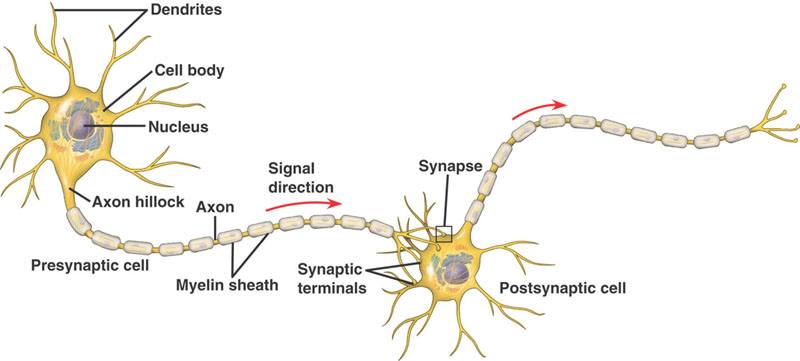

When a neuron is "at rest" the inside of the cell is negatively charged compared to the outside (which is positively charged). This means that nerve transmission is possible because the opposite charges produce a "potential difference" across the membrane.
true
false
depends

When a nerve is "resting" there are more potassium ions inside the neuron than sodium ions outside the neuron.
true
false
depends

When a neuron is "depolarized" by a stimulus, _______ ions rapidly enter the cell through fast channels in the cell membrane. This means that there are now more positively charged ions inside than outside the cell.
sodium, Na+
potassium K+
Calcium Ca2+
Chloride Cl-

How does a nerve cell "repolarise" after an impulse?
It pumps potassium K+ ions OUT of the cell to restore normal charge balance
It pumps sodium Na+ ions OUT of the cell to restore normal charge balance
It pumps potassium K+ ions INTO the cell to restore normal charge balance
It pumps Na+ ions ions INTO the cell to restore normal charge balance

The sodium-potassium pump cycle in the neuron cell membrane restores the correct balance of Na+/K+ ions after an impulse. This is a kind of active transport mechanism (against a concentration gradient). What molecule does it need to do this?
ATP
ADP
phosphate group
haemoglobin

During a nervous impulse, action potential "jumps" from one _________ __ _________ to the next, speeding up action potential propagation down the axon considerably.
(a)

The autonomic nervous system (ANS) is not under voluntary control; it has an important function - homeostasis. Effects are rapid. It is split into two parts, the effects of which usually oppose each other.
sympathetic nervous system
pathetic nervous system
parasympathetic nervous system
extra pathetic nervous system
The sympathetic nervous system (SNS) is often described as the "fight or flight", enabling the body to deal with additional demands placed on it like illness, fright, physical activity etc. Which of the following is the SNS able to do?
dilate bronchioles
increase heart rate
dilate pupils
stimulate perspiration
increase peristalsis and amount of enzyme production in the gut
The Parasympathetic nervous system (PNS) is often called "rest and digest". Which of the following is the PNS able to do?
dilates bronchioles
increase heart rate
dilate pupils
relax sphincters in the bladder
increase peristalsis and amount of enzyme production in the gut

Which letter represents a neurotransmitter?
(a)
Which letter represents a neurotransmitter receptor?
(a)

A nerve impulse is transmitted in which direction
1 to 2 to 3
3 to 2 to 1

How does neurotransmitter cross the synaptic cleft?
exocytosis
simple diffusion
carrier mediated transport
osmosis
If Cell 1 is a receptor and Cell 2 is a cell in the CNS, then a nerve impulse passes across a synapse from the
Dendrites of Cell 1 to the axon terminals of Cell 2
Axon terminals of Cell 1 to the dendrites of Cell 2
Dendrites of Cell 2 to the axon terminals of Cell 1
Axon terminals of Cell 2 to the dendrites of Cell 1

Which one of these is not a neurotransmitter chemical?
adrenaline (fight or flight)
dopamine (pleasure)
serotonin (mood)
GABA (calm)
ATP (energy)

Which one of these is not a neurotransmitter chemical?
noradrenaline concentration
acetylcholine (learning)
glutamate (memory)
endorphins (euphoria)
prostaglandin (tissue repair)

The part of the brain involved with touch, pain & temperature. It relays impulses to the cerebral cortex for refined perception. Is also involved with sexual arousal and other emotions.
(a)

Part of the brain which regulates hormone release (linked to the pituitary gland). Regulates appetite, thirst & water balance in the body, temperature, basic emotions and circadian rhythms (day/night & wake/sleep!)
(a)

A part of the brain stem which processes information form cranial nerves for touch, hearing and balance. Also works with the medulla oblongata to control respiration.
Pons
Mid-brain
cerebellum
hypothalamus

Controls force & rate of cardiac contraction, regulates BP and vasomotor control. Works alongside the pons to control rate & depth of breathing
Medulla oblongata
Mid-brain
Cerebellum
Hypothalamus

What is shown in this diagram? It illustrates the cross over of the motor tracts in the medulla oblongata - left side of brain controlling right side of body (and vice versa)
decessation of the pyramids
pharaohs swapping
decussation of the pyramids
decussation of the reticulum

Plays a crucial role maintaining balance, posture and co-ordination.
Control is subconscious.
Receives information from the eyes, inner ear and proprioceptors in the muscles and joints.
Possibly plays a role in language and learning.
Which part of the brain am I?
(a)

An area of skin that’s supplied by a single spinal nerve. Your spinal nerves help to relay sensory, motor, and autonomic information between the rest of your body and your central nervous system (CNS).
(a)

A disease caused by the herpes zoster virus (chickenpox) which, when it becomes active, travels to the end of the nerve causing a painful rash, often with blisters. Generally affects a band of skin supplied by the affected nerve (so - a dermatome!)
shingles
HIV
measles
rubella

