
 Worksheets
Week 9 Quiz EES102
Total questions: 60
Worksheet time: 30mins
AC generators used to produce alternating current by converting
kinetic energy into potential energy
potential energy into electrical energy
kinetic energy into electrical energy
electrical energy into kinetic energy
AC generators works based on
Faraday's Law
Lenz Law
Newton's Law
electrostatic law
In AC generator, maximum emf generated at an angle of
0 and 90
90 and 180
90 and 270
180 and 360
The distance of the waveform travel in one cycle is referred to
amplitude
wavelength
time
frequency
The effective voltage value is
25%
50%
71%
90%
The average current/ voltage value will not be zero only if it is
step up
rectified
amplified
intensified
The resistor in an AC will cause
no phase difference
V lead I
I lead V
I lags V
Voltage leads the current in an AC generators can be referred to
resistance
capacitance
inductance
The combination of resistance, capacitance and induntance is referred to
impedance
reactance
angular frequency
amplitude
High potential voltage produced by three-phase generators commonly used in
filament
X-ray tube
transformer
anode
All of the following have the same units except:
inductance.
capacitive reactance.
impedance.
resistance.
A resistor is connected to an AC power supply. On this circuit, the current
leads the voltage by 90°.
lags the voltage by 90°.
is in phase with the voltage.
none of the given answers
A pure inductor is connected to an AC power supply. In this circuit, the current
leads the voltage by 90°.
lags the voltage by 90°.
is in phase with the voltage.
none of the given answers.
If the frequency of the AC voltage across an inductor is doubled, the inductive reactance of that inductor
increases to 4 times its original value.
increases to twice its original value.
decreases to one-half its original value.
decreases to one-fourth its original value.
Quantity of charge can be measured in
time (s)
Ampere (A)
coulombs (C)
Joule (J)
The formula for inductive reactance is
ωL1
ωC
ωC1
ωL
A Capacitor blocks
Only a.c.
Only d.c.
Both ac and dc
None of these
The instantaneous current in an ac circuit is i=2.0 sin314t, what is its frequency?
100 Hz
60 Hz
50 Hz
2π
The instantaneous current in an ac circuit is i=2.0 sin314t, what is rms value of the current.
1.414 A
2.828A
1 A
2 A
Which one of the below AC parameters show the effective Dc value?
Peak Value
RMS value
Peak to peak value
Frequency
An inductor of inductance 22.0 mH is connected to an a.c. supply with frequency f. If the reactance of the inductor is 660 Ω, what is the value of f?
1.45 ×10³ Hz
3.00undefined Hz
4.77undefined Hz
7.16undefined Hz
The electricity in our house is
AC
DC
BC
AD
What will happen, if we connect capacitor to DC Supply.
It allows DC
It blocks DC
t rectifies
None of these
Hint: Diode is unidirectional and uncontrolled device. In rectifier circuit, diode use as a switch to convert ac to dc for rectification purpose.
Which image shows the output of a sine-wave after it has gone through a diode? (Half-wave rectified)


The induced emf in a closed coil of wire, according to Faraday’s Law, is proportional to:
I. The magnitude of the magnetic flux
II. The magnetic flux density
III. The number of turns
IV. The rate of change of magnetic flux
I
II
II and III (
III and IV
IV

A changing magnetic field B induces an emf Ɛ in a coil of radius R, as shown figure. What is the induced emf in the coil of radius 2R?
Ɛ
2 Ɛ
4 Ɛ
Ɛ/2
Ɛ/4

A uniform magnetic field is distributed in the space of a circle of radius r, as shown in figure. The changing field induces an emf Ɛ in the loop with radius r. What is the induced emf in the loop with radius 2r?
Ɛ
2 Ɛ
4 Ɛ
Ɛ/2
Ɛ/4
The number of turns in a long solenoid is doubled; how does the inductance of the solenoid change?
It doesn’t change
It doubles
It quadruples
It is cut to a half
It is cut to a quarter
Which of the following is true about an inductor?
I. It stores energy
after the current stops flowing
II. It opposes the
change of current
III. It can produce a
magnetic field
I
III
I and II
II and III
All of the above
Which of the following can act as an inductor?
I. A long coil
II. A long wire
III. A conducting sphere
I
III
I and II
II and III
All of the above

At time t = 0, the switch is closed. Which of the following graphs best describes the voltage V across the resistance R as a function of time t?


If L is inductance measured in H (Henry), what is 1 H equivalent to?
1 Vs/A
1 A/Vs
1 AV/s
1A∙s/V
1 s/A V
If R is 1 Ω and L is 1 H, then L/R is:
1 V
1 F
1 A
1 C
1 s

In the circuit given, what is the current at point P immediately after the switch is closed?
Ɛ/R
2Ɛ/R
Ɛ/2R
LƐ/R
0

In the circuit above, what is the current at point P after the switch is closed for a long time?
Ɛ/R
2Ɛ/R
Ɛ/2R
LƐ/R
0

The switch is closed for a long time in the circuit above; what is the energy stored in the inductor?
LƐ/2R
LƐ2/2R2
LƐ2/2R
LƐ/2R2
0

In the circuit above, the switch is initially open and then it is closed at time t = 0. What is the current in the resistor at this time?
3 A
1 A
0
0.5
0.3

In the circuit above, the switch has been closed for a long time, then it is reopened at time t = 0. Which of the following graphs best represents the electric current, i, as a function of time t?


In the circuit above, the switch is closed for a long time. What is the energy stored in the inductor?
3 J
6 J
18 J
0.5 A
0.3 A

In the circuit above, at time t = 0, the switch is placed at position A. What is the current in the resistor at this time?
0.3 A
0.6 A
0 A
0.1 s
0.6 s

In the circuit above, the make before break switch has been kept at position A for a long time and then at time t = 0, is placed at position B. What is the current in the resistor at this time?
0
0.3 A
0.6 A
3 A
6 A
The equations for alternating emf and alternating current in a circuit containing capacitor are
V = V0 sin ωt, I = I0 sin(ωt−2π)
V=V0 sin ωt , I = I0 sin(ωt +2π)
V = V0 sinωt, I =I0 sin ωt
V = V0 sin(ωt +2π), I = I0 sin ωt

What happens at resonance?
Current is maximum
Impedance is maximum
Resistance is maximum
Power factor is maximum
A pure resistor is connected to an a.c. source where its current is given by I=5.0 sin 628t. Which of the following statements is not true about the circuit?
The peak value of current flowing through the resistor is 5.0 A
The root mean square current flowing through the resistor is 3.5 A
The frequency of the current flowing through across the resistor is 120 Hz
The equivalent direct current which gives the same average heating power in the resistor is 3.5 A

Find the ratio of power dissipated through R in (b)mean power dissipated through R in (a)
2
21
4
41

The variation of voltage across an inductor with time t in an a.c. circuit is as shown in the graph. Which graphs shows the variation of the current I which flows through the inductor with time t?


The r.m.s value of an alternating current is given by steady (D.C) current which when flowing through a given circuit for a given time produces
the more heat than produced by A.C when flowing through the sam circuit
the less heat than produced by A.C when flowing through the sam circuit
the same heat than produced by A.C when flowing through the same circuit
A resistor is connected to an AC power supply. On this circuit, the current
leads the voltage by 90°.
lags the voltage by 90°.
is in phase with the voltage.
none of the given answers
Quantity of charge can be measured in
time (s)
Ampere (A)
coulombs (C)
Joule (J)
An electric current that continually reverses direction over time is known as a(n)?
Alternating current
direct current
simple current
current is measured in?
Volt
ampere
watt
The electricity in our house is?
AC
BC
DC
the number of complete oscillations of the signal per unit time Is defined by?
period
peak current
frequency
A proton ( q = 1.60 x 10⁻¹⁹ C) moves 10.0 cm on a path parallel to the direction of a uniform electrical field of strength 3.0 N/C. What is the electrical potential energy?
4.8 x 10⁻²⁰ J
1.6 x 10⁻²⁰ J
-4.8 x 10⁻²⁰ J
-1.6 x 10⁻²⁰ J
What will be the electrical potential at a distance of 0.15 m from a point charge of 6.0 µC? (kc = 8.99 x 10⁹ N · m2/C2)
5.4 x 10⁴ V
3.6 x 10⁵ V
2.4 x 10⁶ V
1.2 x 10⁷ V
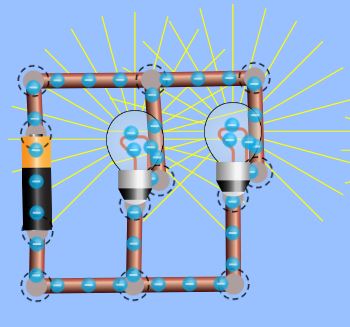
Electromotive force of a battery can be defined with the formula of
E = IR
E = IR + I
E = IR + r
E = IR + Ir

