wayground logo

Free Printable Worksheets

Font size

S
M
L
XL
Worksheets

Rotation/Revolution/Seasons(Part 1)

Total questions: 56

Worksheet time: 33mins

Name
Class
Date
1.

The path one objects in space takes around another.

a)

tilt

b)

orbit

c)

revolution

d)

rotation

2.

The star at the center of the Solar System that supplies light and heat to Earth

a)

moon

b)

Star

c)

earth

d)

sun

3.

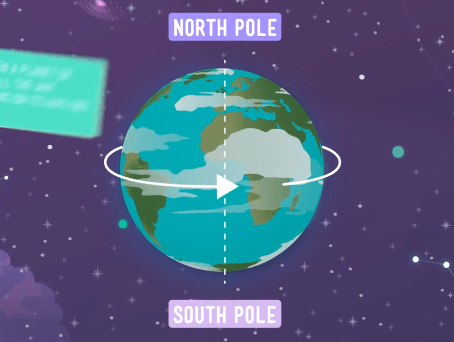
The spinning of an object on an axis.

a)

rotation

b)

revolution

c)

axis

d)

orbit

4.

How long does it take Earth to make one complete rotation

a)

24 hours

b)

One year

c)

One hour

5.

_________ is when sunlight shines on a given point on the surface of Earth.

a)

Nighttime

b)

Daytime

c)

Noon

d)

Evening

6.

When we are on the part of Earth that does not get sun, we are experiencing _____________.

a)

Daytime

b)

Party time

c)

Pizza time

d)

Nighttime

7.

a dark area caused when an object blocks light falling on a surface

a)

axis

b)

compass

c)

shadow

8.

Earth faces the Sun and is lighted

a)

rotation

b)

day

c)

night

9.
Why does the sun appear to change positions in the sky at different times of the day?
a)
The sun revolves around Earth once a day.
b)
Earth completes one rotation every 24 hours.
c)
The sun completes one rotation every 24 hours.
d)
Earth revolves around the sun once a day.
10.

What causes day and night?

a)

Earth's rotation

b)

Earth's revolution around the sun

c)

The movment of the sun

11.

When the Earth completes a full revolution around the Sun, it has completed _____ rotations or days

a)

7

b)

30

c)

91

d)

365

12.
The spinning movement of the Earth about its axis is called the Earth's _____
a)
revolution
b)
rotation
c)
precession
d)
orbit
13.
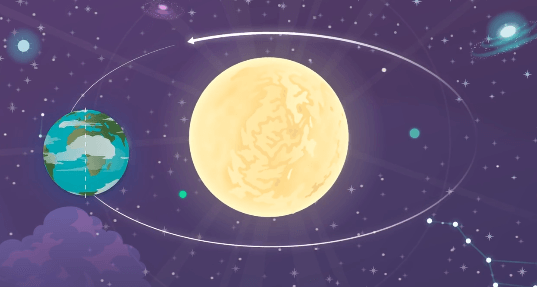
The movement of the Earth around the Sun is called its _____
a)
revolution
b)
rotation
c)
precession
d)
gyration
14.

Rotation is_____

a)
b)
15.

Revolution is_____

a)
b)
16.

Earth spinning on it's axis is called

a)

Rotation

b)

Revolution

c)

Summer

d)

Fall

17.

Earth's movement around the sun is called

a)

Rotation

b)

Revolution

c)

Summer

d)

Fall

18.

Select all the correct answers about REVOLUTION

a)

Moving around the sun

b)

Seasons

c)

Day and Night

d)

Takes 1 year

19.

Select all correct about ROTATION

a)

Spinning around the axis

b)

Seasons

c)

Day and Night

d)

Takes 24 Hours

20.

You are getting ready for school. On the other side of the world students are getting ready for

a)

School

b)

breakfast

c)

bed

d)

lunch

21.

When it is Summer in the Northern Hemisphere, What season is it in the southern Hemisphere?

a)

Also Summer

b)

Winer

c)

Spring

d)

Fall

22.

When the Northern Hemisphere of Earth is leaning away from the Sun, What season is the Southern Hemisphere Experiencing?

a)

Summer

b)

Winer

c)

Spring

d)

Fall

23.

Why is it warmer in the summer?

a)

Closer to the sun

b)

More direct light from Earth's Tilt

c)

Stronger light from the sun

d)

Earth Spins Slower

24.

When part of the world that you're living in is leaning toward the sun, it is

a)

Winter

b)

Spring

c)

Summer

d)

Fall

25.

Why is the Equator warmest?

a)

Because it is closest to the sun

b)

Because it receives the most direct sunlight

c)

Because no clouds form here

d)

Because it is far from the sun

26.
In winter, the axis of the earth is pointed away or toward the sun?
a)
towards
b)
up
c)
down
d)
away
27.
In summer, the axis of the earth is pointed away or toward the sun?
a)
towards
b)
up
c)
down
d)
away
28.
Why is the Equator warmest?
a)
Because it is closest to the sun.
b)
Because it receives the most direct sunlight
c)
Because no clouds form here.
d)
Because it is far from the sun
29.
Which season is taking place in the Northern Hemisphere in Position 1?
a)
Winter
b)
Spring
c)
Summer
d)
Fall
30.
Which season is taking place in the Northern Hemisphere in Position 3?
a)
Winter
b)
Spring
c)
Summer
d)
Fall
31.
If its ____ in the Northern hemisphere, then its summer in the Southern hemisphere. 
a)
spring
b)
summer
c)
fall
d)
winter
32.
What are the reasons for the season?
a)
Earth's tilt & rotation
b)
Earth's tilt & revolution
c)
Earth's rotation & size
d)
Earth's tilt & resolution
33.
The term equinox means....
a)
equal amount of day light and equal amount of night
b)
Equal amount of winter and summer
c)
Equal amounts of hot dogs for everyone
d)
The longest day of the year
34.
What happens when the area in which you live tilts away from the sun?
a)
It is summer.
b)
It is spring.
c)
It is winter.
d)
It is fall.
35.
The Earth's axis is tilted _____ degrees.
a)
23.5
b)
25.3
c)
30.2
d)
24
36.
Why does the area around the equator stay the same temperature all year?
a)
The equator rotates slower than the poles.
b)
The equator remains the same distance from the sun.
c)
The equator always receives direct sunlight.
d)
The equator has 18 hour days.
37.
One rotation of Earth is equal to
a)
a day.
b)
a year.
38.
If its ____ in the Northern hemisphere, then its fall in the Southern hemisphere. 
a)
spring
b)
summer
c)
fall
d)
winter
39.
If its ____ in the Northern hemisphere, then its summer in the Southern hemisphere. 
a)
spring
b)
summer
c)
fall
d)
winter
40.
The Earth's _______ is an imaginary line that goes from the North Pole to the South Pole.
a)
vernal equinox
b)
axis
c)
solar eclipse
d)
solar flare
41.

What causes the seasons?

a)

The earths moon

b)

The earths tilt

c)

The ocean

d)

The star

42.

What does revolution mean?

a)

Revolution means an object moving around something

b)

The shadows get longer as seasons go on

c)

  The earth is moving around the sun

d)

The sun is moving horizontally

43.

What is a solstice?

a)

  A solstice is a character

b)

 When the sun reaches its highest or lowest point in the sky at noon

c)

 A solstice is a part of a movie


d)

Is a name of the star

44.

How many solstices are there?

a)

5 solstices

b)

2 solstices

c)

1 solstices

d)

10 solstices

45.
Which  of the following best describes the tilt of the earth during the spring and fall equinoxes?
a)
The earth is tilted away from the sun (Northern hemisphere)
b)
The earth is tilted neither toward or away from the sun (tilt is side to side)
c)
The earth is tilted toward the sun (Northern hemisphere)
d)
The earth is not tilted during spring and fall
46.
Which of the following best describes equinoxes?
a)
The earth is tilted neither toward or away from the sun
b)
The norther hemisphere is tilted toward the sun
c)
The northern hemisphere is tilted away from the sun
d)
The southern hemisphere is tilted toward the sun
47.
Which of the following best describes solstice.
a)
Either the longest or shortest day of the year for a hemisphere
b)
December 21 or 22
c)
June 21 or 22
d)
All of the above
48.

Which hemisphere do we live in?

a)

Northern Hemisphere

b)

Southern Hemisphere

c)

Western Hemisphere

d)

Eastern Hemisphere

49.

Around June 22nd we have the greatest amount of day time hours. This day is also known as the

a)

Summer Equinox

b)

Summer Solstice

c)

Summer Hemisphere

d)

Direct Summer

50.

What season would we be experiencing with Earth #3?

a)

Winter

b)

Spring

c)

Summer

d)

Fall

51.
What are the reasons for the season?
a)
Earth's tilt & rotation
b)
Earth's tilt & revolution
c)
Earth's rotation & rovolution
d)
Earth's tilt & resolution
52.
Day & night are caused by the ______________ of earth on its axis
a)
revolution
b)
orbit
c)
rotation
d)
tilt of the axis
53.
At position A, which hemisphere would have summer?
a)
Northern hemisphere
b)
Southern hemisphere
54.
What happens when the area in which you live tilts away from the sun?
a)
It is summer.
b)
It is spring.
c)
It is winter.
d)
It is fall.
55.
Why is it warmer in the summer?
a)
Closer to the sun
b)
More direct light from Earth's tilt
c)
Stronger light from the sun
d)
Earth spins slower
56.
When the Northern Hemisphere learns toward the sun, daylight is - 
a)
shorter
b)
longer
c)
equal