wayground logo

Free Printable Worksheets

Font size

S
M
L
XL
Worksheets

7 Science Biology Overview

Total questions: 51

Worksheet time: 42mins

Name
Class
Date
1.

What does it mean to classify living things?

a)

To group them based on similar characteristics

b)

To give them names

c)

To rank them from most to least important

d)

To describe them

2.
The ___ is the basic unit of sturucture and function of organisms
a)
atom
b)
cell
c)
matter
d)
all other answers are correct
3.
Eating lunch is an example of which life process?
a)
Nutrition 
b)
Growth
c)
Excretion
4.
A tree getting taller is an example of which life process?
a)
Excretion
b)
Respiration 
c)
Growth
d)
Nutrition 
5.

What is one of the "R's" in MRSGREN?

a)

Resolution

b)

Respiration

c)

Recitation

d)

Repulsion

6.

What does the "M" in MRSGREN stand for

a)

Movement

b)

Molecules

c)

Momentum

d)

Magma

7.

All living things carry out life processes (MRSGREN). Which one means getting rid of waste?

a)

respiration

b)

excretion

c)

nutrition

d)

sensitivity

e)

growth

8.

What does MRSGREN stand for?

a)

Morning, Respiration, Sensitivity, Growth, Reproduction, Excretion, Nutrition

b)

Movement, Respiration, Sensitivity, Growth, Reproduction, Excretion, Nutrition

c)

Movement, Respiration, Seductive, Growth, Reproduction, Excretion, Nutrition

d)

Movement, Respiration, Sensitivity, Growth, Reproduction, Excretion, Neutron

9.

Is Sun a living thing?

a)

No

b)

Yes

10.

What is the acronym for the characteristics of life?

a)

MSGREN

b)

MRSGREN

c)

MRGREN

d)

DRGREN

11.

What does the "N" in MRSGREN stand for?

a)

Nutrition

b)

Nutella

c)

Nothing

d)

Nematodes

12.
A living thing
a)
classify
b)
organism
c)
vertebrates
d)
invertebrates
13.

Here is a table that shows the level of classification for a dog. What is the correct label for X?

a)

Domain

b)

Genus

c)

Order

d)

Phylum

14.

Here is a table that shows the level of classification for a dog. What is the correct label for Y?

a)

Domain

b)

Genus

c)

Order

d)

Phylum

15.

Here is a table that shows the level of classification for a dog. What is the correct label for Z?

a)

Domain

b)

Genus

c)

Order

d)

Phylum

16.

Use the following to decide which tree this leaf belongs to:

a)

Blue Atlas Cedar

b)

Arizona Cypress

c)

Southern Catalpa

d)

Lilac Chaste Tree

17.

The scientific name for a human is Homo sapiens. Select the two levels of classification this name represents.

a)

family

b)

order

c)

species

d)

phylum

e)

genus

18.
Who first proposed binomial nomenclature as a way of classifying organisms?
a)
Carolus Linnaeus
b)
Thomas Jefferson
c)
Charles Darwin
d)
Albert Einstein 
19.

The scientific name for an organism is made from the:

a)

class and family name

b)

genus and species name

c)

domain and kingdom name

d)

kingdom and phylum name

20.

Term given to describe the 2 part (name) naming system is:

a)

dichotmous key

b)

binomial nomenclature

c)

2 scientific names

d)

binomial key

21.

Which taxonomic group will have organisms that share the most traits?

a)

domain

b)

kingdom

c)

species

d)

class

22.
Which of the lists below has all of the levels of classification in the correct order?
a)
Kingdom class phylum genus order species family
b)
Class Phylum Kingdom Species Family Order Genus
c)
Kingdom Family Class Order Phylum Genus Species
d)
Kingdom Phylum Class Order Family Genus Species
23.

the largest classification category

a)

Kindgom

b)

Phylum

c)

Order

d)

Species

24.

the smallest, most specific classification category

a)

Genus

b)

Phylum

c)

Order

d)

Species

25.

How many levels of classification systems are there?

a)

4

b)

5

c)

6

d)

7

26.

How many kingdoms there are?

a)

5

b)

3

c)

6

d)

4

27.

MUSHROOMS ARE IN WHAT KINGDOM

a)

PLANT

b)

ANIMAL

c)

FUNGI

d)

PROTIST

28.
What is the purpose of a dichotomous key?
a)
to find a common ancestor
b)
to show the evolution of organisms
c)
to show relationships between organisms
d)
to identify organisms
29.
What step do we always start with when using dichotomous keys?
a)
1
b)
2
c)
3
d)
4
30.
When using a dichotomous key to identify organisms, what do we look at?
a)
physical features
b)
weather patterns
c)
environment
d)
diet
31.
A dichotomous key for insects is given. To what order does an insect with two pairs of scaly wings belong?
a)
Coleoptera
b)
Heteroptera
c)
Diptera
d)
Lepidoptera
32.

How many options should every branch in a dichotomous key have?

a)

1

b)

2

c)

3

d)

4

33.
A student discovers an arachnid with a segmented abdomen, long legs, and a tail with no stinger. The student uses the dichotomous key below to identify it. Which arachnid has the student found?
a)
Whip Scorpion
b)
Wind Scorpion
c)
Daddy long legs
d)
Scorpion
34.
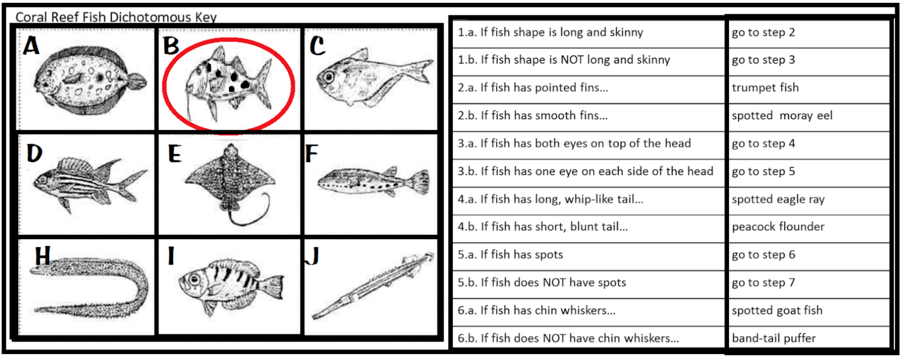
Using this dichotomous key, identity the name of the circled fish.
a)
band-tail puffer
b)
spotted goat fish
c)
peacock flounder
d)
trumpet fish
35.
Which best describes what a food chain shows you?
a)
Energy flow through an ecosystem
b)
Food flowing through an ecosystem
c)
Consumers going into other consumers
d)
Who eats who
36.
Where does the energy start in this food chain?
a)
Plant
b)
Sun
c)
Deer
d)
Wolf
37.
What is the role of decomposers in a food chain?
a)
Use sunlight to make food
b)
Eat other organisms to gain energy
c)
Make the food for the whole food chain
d)
Break down dead organisms and add nutrients to the soil
38.
Which of these organisms would receive energy from the snake?
a)
Plant
b)
Rabbit
c)
Mouse
d)
Hawk
39.

Observe the food chain above. Which organism’s population would increase if finches were removed from the ecosystem?

a)

Grass

b)

Grasshopper

c)

Snake

d)

Hawk

40.
Which organism is the apex (top) predator in this ecosystem?
a)
algae/seaweed
b)
sea lion
c)
killer whale
d)
penguin
41.

In this food chain, where does the lizard get its energy from?

a)

plant

b)

grasshopper

c)

mushrooms

d)

sun

42.

Which are examples of decomposers in an ecosystem?

a)

bees, butterflies, and caterpillars

b)

mushrooms, earthworms, and bacteria

c)

grasshoppers, spiders, and soil

d)

rocks, soil, and leaves

43.

Which organisms in this food web are consuming insects?

a)

shrew and hare

b)

red fox and white spruce

c)

lynx and shrew

d)

shrew and red fox

44.

The mayfly is a direct food source for which 3 orgnisms?

a)

frog, dragonfly, salamander

b)

frog, dragonfly, snake

c)

frog, salamander, trout

d)

frog, phytoplankton, trout

45.

A food chain always begins with a

a)

producer

b)

consumer

c)

decomposer

d)

scavenger

46.
What is a producer?
a)
an organism that gets energy from eating other organisms
b)
an organisms that uses sunlight to make its own food
c)
an organism that gets energy from eating dead organisms, non-living material or waste
d)
an organism that uses chemical energy to make its own food
47.

Which of these is a possible food chain for this environment?

a)

Sun → grass → fly → frog

b)

frog → fly → grass → Sun

c)

Sun ← grass ← fly ← frog

d)

Sun → fly → frog → snake

48.

If the mouse population becomes sick and decreases, which statement about the food web will be true?

a)

The grass population will decrease.

b)

The hawk population will increase.

c)

The grass population will increase.

d)

The wildflower population will decrease.

49.
Recently, a family of bobcats moved into an area with a large rabbit population. What changes may occur in the ecosystem?
a)
The rabbit population may increase
b)
The rabbit population may decrease
c)
The rabbit population may increase first, then decrease
d)
The rabbit population will remain the same
50.

Fertilizers used to improve lawns and gardens may interfere with the equilibrium of an ecosystem because they

a)

cause mutations in all plants

b)

cannot be absorbed by roots

c)

can be carried into local water supplies

d)

cause atmospheric pollution

51.
What term describes all nonliving factors in an environment?
a)
abiotic
b)
zoological
c)
biotic
d)
biological