
 Worksheets
Chemistry of Life
Total questions: 63
Worksheet time: 40mins
Water is often called the “universal solvent” because many substances can be dissolved in water. What property of water allows it to be such a universal solvent?
Purity
Polarity and cohesion
High heat capacity
Expansion upon freezing
Any compound that removes H+ ions to an aqueous solution and measures more than 7 on the pH scale:
Base
Solvent
Acid
Solute
Substance in a solution that dissolves the other substance and is present in the greater amount:
Solute
Acid
Solution
Solvent
The ability of water molecules to stick together is called:
Adhesion
Cohesion
Transpiration
Solvency
Water is polar because:
The molecule has two poles, at which it is colder than the other regions of the molecule.
The water molecule is neutral
The unequal sharing of electrons gives the water molecule a slight negative charge near its oxygen atom and a slight positive charge near its hydrogen atoms.
The unequal sharing of electrons gives the water molecule a slight negative charge near its hydrogen atoms and a slight positive charge near its oxygen atom.
The bonds within a water molecule are:
Polar covalent
Hydrogen
Ionic
Non-polar covalent
Any compound that donates H+ ions to an aqueous solution and measures less than 7 on the pH scale:
Acid
Base
Solvent
Solute
Which of the following is a function of a carbohydrate?
Provides long term energy to body
Supports the body in building structures necessary for survival
Provides short term energy to the body
Gives the body instructions for how to build our body's structures
A scientist is analyzing different biomolecule structures. They notice an influx of Phosphorus. Which biomolecule are they looking at?
Lipids
Protein
Carbohydrate
Nucleic Acid
Which of the following best compares the structures of lipids and carbohydrates?
Both are made up of monosaccharide monomers, but lipids are hydrophobic and carbohydrates are hydrophilic.
Both consist of carbon, hydrogen, and oxygen, but carbohydrates have repeating structural units and lipids do not.
Both contain carbon and hydrogen, but carbohydrates also contain oxygen and lipids contain nitrogen.
Both have a carbon backbone, but lipids also have an amino group and carbohydrates have a carboxylic acid group.
Some proteins catalyze biochemical reactions. If a genetic defect prevented a protein catalyst from being produced, which of the following do you predict would happen in the cell?
The cell would find a different type of protein to catalyze the reaction.
The reaction the protein catalyzes would proceed very slowly or not at all.
The reaction the protein catalyzes would only occur in some places in the cell.
The reverse reaction of the one the protein catalyzes would begin to proceed.
As food travels through the digestive system, it is exposed to a variety of pH levels. The stomach has a pH of 2 due to the presence of hydrochloric acid (HCl), and the small intestine has a pH ranging from 7 to 9. HCl converts pepsinogen into pepsin, an enzyme that digests proteins in the stomach. Which of the following most likely happens to pepsin as it enters the small intestine?
It becomes inactive
It begins to replicate
Its shape changes to engulf large proteins
Its activity increases to ingest more proteins
Covalent compounds form with atoms _________ electrons?
Exchange
Lose
Share
Gain
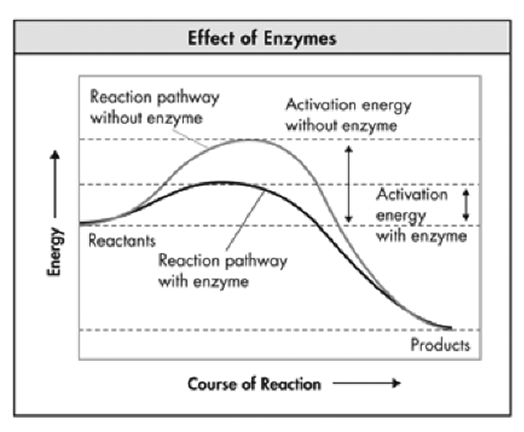
Enzymes help chemical reactions proceed by
Forcing more Products to be created by using up all the energy
Raising Activation Energy
Creating more Reactants
Lowering Activation Energy
What is a solution?
A uniform mixture
Liquid Elements
A mixture where you can clearly see the items separated (oil and water)
Covalent compounds together
A (a) is a substance that dissolves a solute.
Carbohydrates, lipids, proteins, and nucleotides are all (a) compounds.
When molecules have regions of asymmetric charge, they are....
bad at dissolving
polar
lipids
non polar

What makes carbon so important to life?
bonding properties
its place on the Periodic Table
it is a reactant in all chemical reactions
it is an enzyme

Which of the following solutions has the highest Hydrogen ion concentration?
a solution with a pH of 1
a solution with a pH of 4
a solution with a pH of 7
a solution with a pH of 10
Enzymes act on
products
proteins
amino acids
substrates
Activation energy
is the term for the amount of energy in each reactant
helps the enzyme to increase the rate of the reaction
is the term for the amount of energy that needs to be added for a chemical reaction to start
is the term for the amount of energy released by the reaction after it starts
What are the 4 types of carbon-based molecules in organisms?
carbohydrates, lipids, fatty acids, and monomers
polymers, monomers, acids, bases
adhesion, cohesion, evaporative cooling, and high specific heat
nucleic acids, proteins, lipids, and carbohydrates
What are proteins made of?
amino acids
monosaccharides
nucleic acids
fatty acids
Which carbon-based molecule includes sugar and starches?
carbohydrates
lipids
proteins
nucleic acids
What is the primary function of DNA?
to make nucleic acids
long term energy storage
store genetic information
to function as RNA

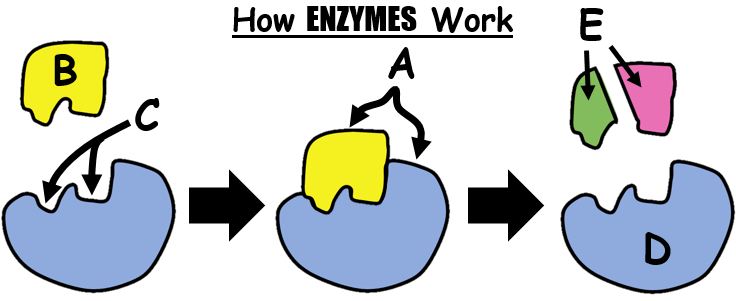
What is happening in this picture?
an enzyme is binding a substrate together to form a product
an enzyme is breaking down a substrate to release new products
the active site of the enzyme does not fit the substrate
a change in pH has damaged the enzyme


Fat, oil, butter and cream cheese are apart of which macromolecule group?
amino acids
carbohydrates
lipids
protein
What is the monomer for carbohydrates? Remember: its the fancy word for sugar
nucelotide
monosaccaride
nucleic acid
polymer
Which macromolecule has the function of quick energy?
Lipids
Carbohydrates
Protein
Nucleic Acids
Which macromolecule has the function of long term energy or energy storage
Nucleic Acids
Carbohydrates
Lipids
Protein
What are two factors that can affect an enzymes ability to function?
No changing
temperature and pH
night and day
hot and cold
How does an enzymes shape relate to its function?
the shape of the enzyme has no relation to its function
the enzyme is shaped specially for certain substrates to perform a specific reaction
the enzyme shape acts as a receptor to certain products
the enzyme shape can fit into specific substrates to cease a reaction
Enzymes are an example of
Lipids
Carbohydrate
Protein
Nucleic Acid
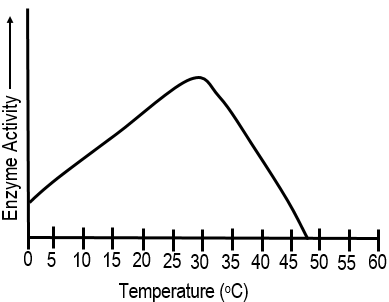
Changes in pH and temperature can ___________________ an enzyme which causes it to lose its shape and affects its function.
puncture
denature
double
delete

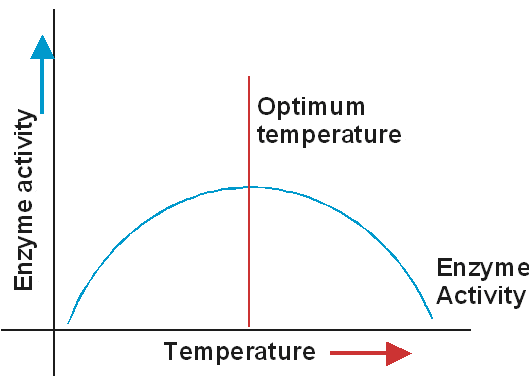
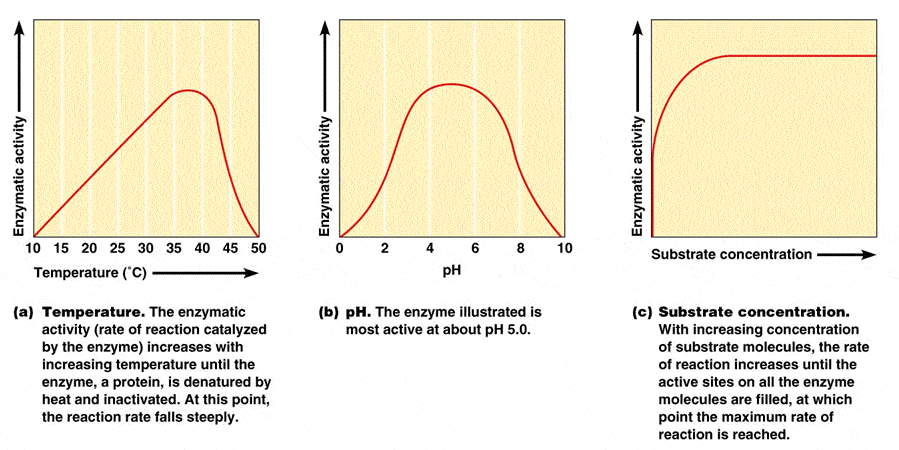
The graphs show the reaction rate for an enzyme across a range of temperatures and pH. Based on these data, the enzyme functions best at what temperature and pH?
temperature of 27 degrees C and pH of 4
temperature of 37 degrees C and pH of 6
temperature of 40 degrees C and pH of 8
temperature of 50 degrees C and pH of 10
Which of the following has the correct monomer matched?
Protein -> Nucleotide
Carbohydrate -> Monosaccharide
Lipids -> Amino Acid
Nucleic Acid -> Glycerol & Fatty Acid

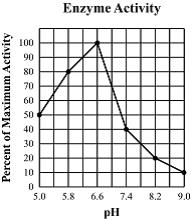
Based on the graph, what pH does Enzyme C work best at?
1.5
6
8
9
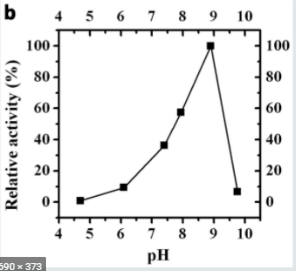
What is the optimal pH for this enzyme?
6
10
9
7
A change that releases kinetic energy.
Potential Energy
Kinetic Energy
Endothermic
Exothermic
A change that absorbs kinetic energy.
Potential Energy
Kinetic Energy
Endothermic
Exothermic
O2(g) + 2 H2 (g) → 2 H2O (g) + Energy
endothermic
exothermic
6 CO2+ 6 H2O + Energy → C6H12O6 + 6 O2
endothermic reaction
exothermic reaction

Which type of reaction does this graph represent?
exothermic reaction.
endothermic reaction.

The graph above is from which type of reaction?
Endothermic reaction
Exothermic Reaction

