
 Worksheets
Nitrogen cycle
Total questions: 50
Worksheet time: 25mins
Which nitrogen cycle process is occurring when bacteria convert ammonium to nitrite and then into nitrate?
nitrogen fixation
nitrification
denitrification
ammonification
assimilation
Which of these nitrogen cycle processes converts atmospheric nitrogen to a soil form of nitrogen that is usable by plants?
nitrogen fixation
nitrification
denitrification
ammonification
assimilation


What is true about nutrients in the ecosystem (such as water, carbon, and nitrogen)?
They are not affected by humans in the ecosystem.
They cannot be recovered if they are lost in the ecosystem.
They cycle through the ecosystem in different forms to support life.
They are usually only found in one form in the ecosystem to support life.
What is the chemical equation for photosynthesis?
Sun+water+co2=o2+sugar
sun+photosynthesis
O2+sugar=water+co2+energy
what is the equation for respiration
Something
What’s respiration
o2+sugar=water+co2+energy
Sun+water+co2+energy
How do humans influence the carbon cycle?
Burning fossil fuels
Farting
Crash bandicoot nitrocart
Gex
The process of turning ammonia(NH3) into ammonia salts (NH^4+) is called what?
Gex 2 return of the gecko
Carbonization
Fossilization
denitrification
The rein of the ape is no more
How do plants and animals interact in the carbon cycle?
They eat plants
They eat animals
They eat captain crunch
Time travel
Why is combustion an important process in the carbon cycle?
It turns fossil fuels into carbon dioxide.
It turns once living things and organic matter into fossil fuels.
It turns carbon dioxide into glucose, so animals can eat the carbon.
It turns glucose into carbon dioxide, which gets released into the air.
What is true about nutrients in the ecosystem (such as water, carbon, and nitrogen)?
They are not affected by humans in the ecosystem.
They cannot be recovered if they are lost in the ecosystem.
They cycle through the ecosystem in different forms to support life.
They are usually only found in one form in the ecosystem to support life.
Why is decomposition an important process in the carbon cycle?
It turns fossil fuels into carbon dioxide.
It turns once living things and organic matter into fossil fuels.
It turns carbon dioxide into glucose, so animals can eat the carbon.
It turns glucose into carbon dioxide, which gets released into the air.
Why is respiration an important process in the carbon cycle?
It turns fossil fuels into carbon dioxide.
It turns once living things and organic matter into fossil fuels.
It turns carbon dioxide into glucose, so animals can eat the carbon.
It turns glucose into carbon dioxide, which gets released into the air.
Why is photosynthesis an important process in the carbon cycle?
It turns fossil fuels into carbon dioxide.
It turns once living things and organic matter into fossil fuels.
It turns carbon dioxide into glucose, so animals can eat the carbon.
How does a lion obtain the carbon it needs from a grass plant?
The lion breathes in carbon given off by the grass.
The lion cannot obtain the carbon in a grass plant.
The lion absorbs the carbon given off by transpiration.
The lion eats the antelope that ate the grass.
Within the carbon cycle, anything that absorbs more carbon from the atmosphere than it releases.
carbon sink
carbon source
Within the carbon cycle, anything that releases more carbon into the atmosphere than it absorbs.
carbon sink
carbon source
Carbon can be released into the atmosphere by...
Cell respiration in plants and animals on land
Combustion of fossil fuels
Cell respiration in plants and animals in the ocean
Photosynthesis
What is the process in which dead plants and animals become fossil fuels?
Respiration
Photosynthesis
Combustion
Decomposition
What converts nitrogen gas into a usable form for plants and animals?
bacteria
rain
fungi
car exhaust
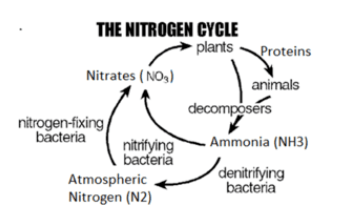
According to this diagram, plants use nitrogen to make _________________________
carbohydrates
cellulose
proteins
unsaturated fats

According to this diagram, what turns atmospheric nitrogen into NH3 ?
nitrogen fixing bacteria
plants
denitrifying bacteria
animals
Which of the following is true about nitrifying bacteria?
They turn ammonium into Nitrates and Nitrites.
They come from animal waste.
They do the process of denitrification.
It comes from lightning.

How does nitrogen get into the soil in the first place? Select all that apply.
Animal waste
Lightning
Dead and decaying organisms
Photosynthesis
Burning fossil fuels lead to ____________
Greenhouse effect
Cleaner air
Less humidity
Nuclear energy
Nitrogen goes through the process of ________ to become plant use.
Transformation
Transpiration
Denitrification
Fixation

A particular golf course is using large amounts of nitrogen fertilizer. What process could move this nitrogen into a local stream?
volatilization
nitrogen fixation
runoff and leaching
ammonification
What is the largest reservoir for nitrogen?
the ocean
rocks and minerals
the atmosphere
bacteria
In an ecosystem, what happens to the atoms of certain chemical elements, such as carbon, oxygen, and nitrogen?
They move into and out of living systems.
They are only found in abiotic factors.
They move out of living systems and do not return.
They move into living systems and remain there.
The water cycle is driven by
water
wind
the sun
Earth's rotation

According to the diagram, geologic activity, such as volcanoes,
Increases the levels of CO2 in the atmosphere.
Decreases the levels of CO2 in the atmosphere.

Nitrogen in the atmosphere is unusable. What form is nitrogen in the atmosphere?
Nitrites
Ammonia
Nitrates
N2 gas
Denitrifying bacteria
Turn nitrogen gas into nitrates so that plants can synthesize amino acids.
Turn nitrates into nitrites so that nitrogen fixing bacteria can synthesize DNA.
Returns nitrogen into the atmosphere in the form of N2 gas.
Use phosphorus as fertilizer.

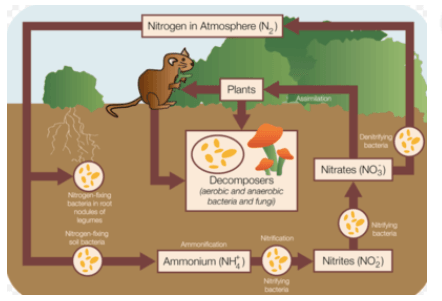
A correct path that nitrogen could take would be
air -> animals -> plants -> bacteria
animals -> air -> bacteria -> plants
bacteria -> air -> plants -> animals
air -> bacteria -> plants -> animals

Decomposition is part of all cycles except _______
the carbon cycle
the nitrogen cycle
the water cycle
the phosphorus cycle
An Aquifer is
porous rock that allows water to flow through it
water that flows through and collects in rock pores
water that soaks into the ground
Infiltration is
porous rock that allows water to flow through it
water that flows through and collects in rock pores
water that soaks into the ground
Which of the following is correct about the carbon cycle?
Photosynthesis of plant life is one of the main producers of CO2
Burning fossil fuels decreases atmospheric CO2
Glucose is a form of carbon storage in plants
Cellular respiration is a process that decreases CO2

