
Font size
 Worksheets
Unit 1 - Ecology Review
Total questions: 30
Worksheet time: 30mins

The original source of energy for a food web is...
plants
sun
producers
decomposers

Decomposers get energy from...
the sun
eating plants
eating animals
dead things and waste

Producers are ...
plants
able to do photosynthesis
also called autotrophs
all of these are true
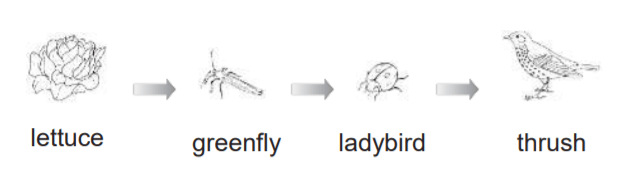
Who is the producer?
lettuce
greenfly
ladybird
thrush

An animal that hunts other animals for food is a ___________
herbivore
predator
prey
omnivore

A connection of food chains with many food energy paths in an ecosystem is a ____________
ecosystem
food web
environment

Which of the following is NOT a consumer
grass
dog
shark
fish


If there is 2000 kcal of energy in this particular ecosystem, how many kcal of energy will be available for hawk?
(a)
study of relationships
dna
ecology
photosynthesis
biology
individual member
of a species or
population
population
community
organism
ecosystem
community PLUS all
of the abiotic factors
in the environment
organism
population
community
ecosystem
multiple populations
of different species
living together
community
population
ecosystem
biodiversity
the zone
of life on Earth,
encompassing all of
Earth’s ecosystems
biosphere
biome
ecosystem
community
multiple
ecosystems that share
similar characteristics but
are located in different
parts of the planet
population
community
biome
biodiversity

Predation

Symbiosis

Commensalism

Parasitism
The amount of organisms that an ecosystem can support is known as (a)

What is the carrying capacity of this graph?
1-15 years
2300
21 years
500

What happened to the animal's population?
It decreased and they are at a lower carrying capacity
They evolved to be smaller and need less food
The are extinct
They went to a lower area where there was no competition

What trophic cascade will happen to the larva if the wasp disappears?
The larva will overgrow and eat all of the plants
The larva will go extinct
The larva will overgrow, but will eat just enough plants to survive
The larva will not be affected

What trophic cascade will happen if the shark disappears?
The mesopredator will grow because there is nothing eating it
The herbivore will overgrow without the sharks
The mesopredator will begin to eat algae now that sharks aren't a threat
The algae will become extinct

What is the carrying capacity of this graph?
0.5
1.0
1.7
2.0


