wayground logo

Free Printable Worksheets

NEW

Font size

S
M
L
XL
Worksheets

Unit 2 Chemistry Review

Total questions: 55

Worksheet time: 57mins

Name
Class
Date
1.

What is the name of HNO3

a)

Hydronitric Acid

b)

Nitric Acid

c)

Nitrous Acid

d)

Hydrogen nitrate

e)

Hydrogen nitrite

2.
The covalent compound N2O5 would be named
a)
nitrogen oxide.
b)
dinitrogen oxide.
c)
nitrogen pentoxide.
d)
dinitrogen pentoxide.
3.

What is the chemical formula for Tetraphosphorous Pentachloride ?

a)

4P5Cl

b)

PCl

c)

P4Cl5

d)

P5Cl4

4.

What is the correct name for P4S5

a)

Pentaphosphorous tetrasulfide

b)

Tetrapotassium pentasodium

c)

Tetraphosphorous pentasulfide

d)

Pentapotassium tetrasodium

5.

What is the correct name for H2CrO4?

a)

Chromic acid

b)

Dihydrogen chromium tetraoxide

c)

Hydrochromic acid

d)

Chromium chromate

6.

What is the correct formula for Hexaboron monosilicide?

a)

BSi6

b)

Bo6S

c)

B7Si

d)

B6Si

7.
What is the name of C3Cl?
a)
Carbon octachloride
b)
Tricarbon octachloride
c)
Carbon trichloride
d)
Octacarbon trichloride
8.
What is the name of CO
a)
Carbon oxide
b)
Carbon dioxide
c)
Carbon monoxide
d)
Carbon II oxide
9.
What is the chemical formula for Fluorine trisulfide ?
a)
S3F
b)
FS3
c)
FS
d)
none of the above
10.

What is the formula for hydronitric acid?

a)

HN3

b)

H3N

c)

HNO3

d)

H3NO3

11.
carbonic acid
a)
H2CO3
b)
H2CrO4
c)
H2C2O4
d)
HCO3
12.
chlorous acid
a)
HClO3
b)
HClO2
c)
HClO
d)
HCl
13.
HI
a)
iodic acid
b)
hydroiodic acid
c)
iodous acid
d)
hypoiodous acid
14.
H2SO3
a)
sulfuric acid
b)
hydrosulfuric acid
c)
sulfurous acid
d)
persulfuric acid
15.

HF

a)

flouric acid

b)

hydrofluoric acid

c)

fluorate acid

d)

hydrogen fluoridic acid

16.
What is the formula for phosphorous acid?
a)
H3PO4
b)
H2PO4
c)
H3P
d)
H3PO3
17.
What is the formula for perchloric acid?
a)
H3ClO3
b)
H3ClO4
c)
HClO3
d)
HClO4
18.
Phosphorous trichloride
a)
PCl3
b)
P3Cl
c)
P3Cl3
d)
PCL
19.
What name results when Ca+2  and  Br- ions bond?
a)
calcium bromine
b)
calcium boron
c)
calcium boride
d)
calcium bromide
20.
MgF2
a)
magnesium fluoride
b)
manganese Phosphide
c)
magnesium(III) fluoride
d)
magnesium fluoride(II)
21.
What is the formula for magnesium phosphide?
a)
Mg3P2
b)
Mg2P3
c)
Mg2PO3
d)
Mg3(PO3)2
22.
Name the following ionic compound: BeCl2
a)
beryllium chlorine
b)
beryllium II chloride
c)
beryllium chloride
d)
beryllium dichloride
23.
Name the following ionic compound: MgSO4
a)
magnesium sulfoxide
b)
magnesium sulfide
c)
magnesium sulfate
d)
magnesium oxide
24.
copper(II) chloride
a)
CuCl2
b)
CuCl
c)
Cu2Cl
d)
Cu2Cl2
25.
What is the correct formula for Sodium Oxide?
a)
NaO
b)
NaO2
c)
Na2O
d)
Na2O2
26.

What is the correct name of Mg(C2H3O2)2?

a)

magnesium acetate

b)

magnesium carbohydroxide

c)

magnesium glucose

d)

magnesium diacetate

27.

What is the correct name of Ag2SO4?

a)

silver sulfoxide

b)

silver sulfate

c)

silver sulfite

d)

silver tetrasulfoate

28.

Name this formula:

KNO3

a)

Potassium Nitrogen Oxide

b)

Potassium Nitride

c)

Potassium Nitrate

d)

Potassium (I) Nitrite

29.

Name the compound CuO

a)

copper (II) oxide

b)

copper oxide

c)

copper (I) oxide

d)

carbon uranium oxide

30.
Which of the following is an ionic compound:
a)
CH4
b)
I2
c)
LiBr2
d)
CO
31.
Name the following compound: FeCl3
a)
iron chloride
b)
iron III chloride
c)
iron chlorate
d)
iron III chlorate
32.
Which of these combinations is an ionic compound made of?
a)
Metal and Metal
b)
Nonmetal and Nonmetal
c)
Metal and Nonmetal
d)
Cation and Cation
33.
Name the ionic compound SnSe2
a)
Tin diselenide
b)
Tin (IV) Selenide
c)
Tin selenide
d)
Tin (II) triselenide
34.
NH4Cl
a)
ammonium chloride
b)
ammonium chlorine
c)
nitrogen hydrogen chloride
d)
nitrogen chloride
35.

Why are sodium and chlorine attracted to each other?

a)

they have opposite charges

b)

they both have negative charges

c)

they both have positive charges

36.

Which of these combinations is an ionic compound made of?

a)

Metal and Metal

b)

Nonmetal and Nonmetal

c)

Metal and Nonmetal

d)

Cation and Cation

37.
Metals tend to 
a)
gain electrons
b)
lose electrons
38.
Nonmetals tend to 
a)
gain electrons
b)
lose electrons
39.
When naming ionic compounds you always write the name of the positive element  _______ .
a)
first
b)
second
c)
with "ide"
d)
with a prefix
40.
In most cases, when naming you change the ending of the second element to ________.
a)
-ate.
b)
-ite.
c)
-ide.
d)
-ine.
41.

How is an ionic bond formed?

a)

Sharing of electrons

b)

Delocalised electrons

c)

Transfer of electrons

42.

Valence electrons are found

a)

in the innermost energy level of an atom

b)

in the middle energy levels of an atom

c)

in the outermost energy levels of an atom

43.

How many valence electrons does hydrogen have?

a)

1

b)

2

c)

3

d)

4

44.
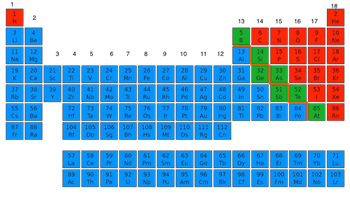
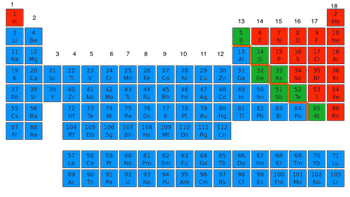
Where are the nonmetals located on the periodic table? 
a)
Blue
b)
Red
c)
Green
45.
Where are metals located on the periodic table?
a)
Blue
b)
Green
c)
Red
46.

What is the strongest intermolecular force between the following bond types?

a)

Dispersion Forces

b)

Dipole-Dipole

c)

Hydrogen-Bonding

47.

What is the weakest intermolecular force between the following bond types?

a)

London Dispersion Forces

b)

Dipole-Dipole

c)

Hydrogen-Bonding

48.

What is the 2nd strongest intermolecular force between the following bond types?

a)

London Dispersion Forces

b)

Dipole-Dipole

c)

Hydrogen-Bonding

49.

Which of the following molecules is nonpolar?

a)

CH2Cl2

b)

CO2

c)

H2O

d)

NH3

50.

What type of bond is formed when there is a significant difference in electronegativity between two atoms?

a)

Nonpolar covalent bond

b)

Ionic bond

c)

Polar covalent bond

d)

Metallic bond

51.

Which statement best describes the polarity of water (H2O)?

a)

Water is a metallic compound.

b)

Water is a nonpolar molecule because it has a linear shape.

c)

Water is a polar molecule due to its bent shape and unequal sharing of electrons.

d)

Water is an ionic compound.

52.

What does each dot in a Lewis Dot Diagram represent?

a)

A proton

b)

A valence electron

c)

An energy level

d)

A neutron

53.

Which type of diagram is commonly used to show the arrangement of atoms and bonds in a molecule?

a)

Pie chart

b)

Periodic table

c)

Lewis dot structure

d)

Bar graph

54.

Which of these is a correct Lewis structure for phosphorus pentafluoride (PF5)?

a)

b)

c)

d)

55.

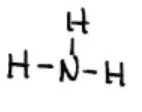
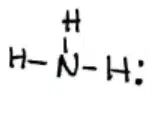
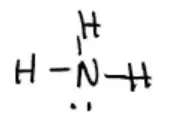
What of the following is the Lewis formula for ammonia (NH3)?
a)

b)

c)