Wayground logo

Free Printable Worksheets

Font size

S
M
L
XL
Worksheets

Unit 1: Chemistry of Life Test Review

Total questions: 49

Worksheet time: 39mins

Name
Class
Date
1.
Proteins are made of monomers called ___________
a)
Nucleotides
b)
Monosaccharides
c)
Amino Acids
d)
Glycerol and fatty acids
2.
The element _______is found in all of the organic compounds.
a)
Iron
b)
Nitrogen
c)
Carbon
d)
Oxygen
3.
DNA and RNA are examples of 
a)
Carbohydrates
b)
Lipids
c)
Proteins
d)
Nucleic Acids
4.
Nucleotides are monomers of
a)
Carbohydrates
b)
Lipids
c)
Proteins
d)
Nucleic Acids
5.
Monosaccharides are monomers of
a)
Carbohydrates
b)
Lipids
c)
Proteins
d)
Nucleic Acids
6.
Waxes, oils and fats are examples of
a)
Carbohydrates
b)
Lipids
c)
Proteins
d)
Nucleic Acids
7.
Glycerol and fatty acids are the monomers of
a)
Carbohydrates
b)
Lipids
c)
Proteins
d)
Nucleic Acids
8.

Which macromolecule is shown?

a)

lipid

b)

protein

c)

nucleic acid

d)

carbohydrate

9.
What is the function of nucleic acids?
a)
store genetic information
b)
store energy (long-term)
c)
store energy (short-term)
d)
build skin, hair, nails, muscles
10.

Which macromolecule is shown?

a)

lipid

b)

protein

c)

nucleic acid

d)

carbohydrate

11.
What type of macromolecule are enzymes?
a)
Protein
b)
Carbohydrate
c)
Lipid
d)
Nucleic Acid
12.
Which macromolecule stores energy, insulates us, and makes up the cell membrane?
a)
lipids
b)
proteins
c)
carbohydrates
d)
nucleic acids
13.
What are the four macromolecules?
a)
proteins, nucleic acids, carbohydrates, and lipids
b)
monosaccharides, lipids, polysaccaharides, and proteins
c)
RNA, DNA, proteins, and carbohydrates
d)
proteins, DNA, RNA, and steroids
14.

What characteristic is shown: A giraffe gives birth to a healthy baby

a)

Reproduce

b)

Change Over Time

c)

Acquire and Use Energy

15.

What characteristic is shown: A bacteria cell divides itself in two.

a)

Reproduce

b)

Respond to a Stimulus

c)

Homeostasis

d)

Grow and Develop

16.

Which characteristic is shown: A tadpole grows legs and becomes a fully grown frog.

a)

Homeostasis

b)

Grow and Develop

c)

Acquire and Use Energy

d)

Change Over Time

17.

Which characteristic is shown: A deer runs from a dog after hearing barking.

a)

Made of Cells

b)

Respond to a Stimulus

c)

Acquire and Use Energy

d)

Homeostasis

18.

Which characteristic is shown: Your body sweats to maintain body temperature.

a)

Respond to a Stimulus

b)

Homeostasis

c)

Made of Cells

d)

Change Over Time

19.

Which characteristic is shown: Carbon Dioxide is used in your blood to maintain the blood pH.

a)

Respond to a Stimulus

b)

Homeostasis

c)

Reproduce

d)

Grow and Develop

20.

Many bacteria have become resistant to the antibiotics we use(antibiotic no longer kill the bacteria).

a)

Respond to a Stimulus

b)

Made of Cells

c)

Evolution: Change Over Time

d)

Homeostasis

21.
Over three years, Tim's height has increased from 5'4" to 5'11".
a)
All living things contain cells
b)
All living things maintain homeostasis
c)
All living things use energy
d)
All living things grow
22.

Living things are based on a universal genetic

code. What molecule is responsible for that code?

a)

RNA

b)

Lipid

c)

Protein

d)

DNA

23.
In order for something to be considered a living organism, it must display _____ of the eight characteristics of living things.
a)
one
b)
some
c)
all
d)
more than half
24.

What does evolution mean?

a)

There is a change in the genetic makeup of a population

b)

A change in the genetic makeup of an individual

c)

The growth of a new body part

d)

Happens when a person grows over time.

25.

Leilani's pet turtle is what kind of organism?

a)

Unicellular

b)

Multicellular

c)

Bacteria

d)

Nonliving organism

26.

Mr. Torres gets pumped up at the gym when "War" by Drake comes on his playlist. What is the stimulus?

a)

The song, "War" by Drake

b)

The gym

c)

The muscle pump

d)

None of the above

27.
What is a substance called if it speeds up a chemical reaction?
a)
reusable
b)
catalyst
c)
specific
d)
fragile
28.
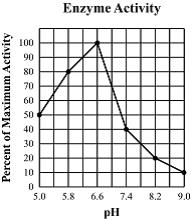
Which of the following conclusions can be drawn from this graph?
a)
The optimum pH of the enzyme is 6.6.
b)
The optimum pH of the enzyme is 5.8
c)
The enzyme’s activity increases as pH increases 5.0 to 9.0
d)
The enzyme’s activity is greater around pH of 8.0 .
29.
Enzymes are...
a)
nucleic acids
b)
proteins
c)
lipids
d)
carbohydrates
30.
An enzyme speeds up a chemical reaction in the cell but can only be used once.  True or False? 
a)
true
b)
false
31.
What is the function of an enzyme?
a)
enzymes break themselves into small pieces
b)
enzymes slow down chemical reactions
c)
enzymes speed up chemical reactions
d)
enzymes combine products to form reactants 
32.
What happens when enzymes are heated to a high temperature?
a)
The enzymes die.
b)
The shapes of the enzyme are altered denature
c)
The enzymes' amino acid sequence changes.
d)
The enzymes remain the same
33.
Where do substrates bind on an enzyme?
a)
voltage-gated channels
b)
surface receptor
c)
calcium channels
d)
active site
34.
can a change in pH alter the active site of an enzyme
a)
yes
b)
no
35.

What 2 factors can cause an enzyme to Denature?

a)

PH & Temperature

b)

atoms and lipids

c)

sugars & lipids

d)

Sugars

36.

Enzymes are made of Proteins. The monomers of proteins are....

a)

Fatty Acids

b)

nucleotides

c)

amino acids

d)

monosaccharides

37.

What is the chemical symbol of water?

a)

H2O

b)

CO2

c)

O2

d)

N2

38.

What is cohesion?

a)

The ability of a molecule to "stick" to itself

b)

The ability of a molecule to "stick" to other molecules

c)

Large amounts of energy are required to change the temperature of a substance

d)

A well-organized and efficient team

39.

What characteristic is shown in the image?

a)

Polarity

b)

Hydrogen Bonds

c)

Cohesion

d)

Adhesion

40.

What property of water results in the accumulation of small amounts of water into larger amounts of water? The results in the rivers, lakes, streams, and even the oceans.

a)

Cohesive Behavior

b)

Expansion Upon Freezing

c)

Ability to Moderate Temperature

d)

Universal Solvent

41.
What word describes when water is attracted to other substances?
a)
cohesion
b)
adhesion
c)
capillary action
d)
surface tension
42.
What two elements make up water?
a)
Helium and oxygen
b)
Hydrogen and oxygen
c)
helium and carbon
d)
oxygen and carbon
43.
Why does ice float?
a)
As water freezes, it expands and its density decreases.
b)
As water freezes, it takes up more hydrogen from the atmosphere, causing it to have a greater buoyancy.
c)
As water freezes, air becomes trapped between the hydrogen bonds of water molecules.
d)
As water freezes, it takes up more oxygen from the atmosphere, causing it to have a greater buoyancy.
44.
Water is a universal solvent because it...
a)
It can be found anywhere
b)
It freezes when it gets cold
c)
floats when frozen
d)
Dissolves most substances
45.
Which of the following is LEAST likely to dissolve in water?
a)
nonpolar fats and oils
b)
polar sugar molecules
c)
salt made of a positive sodium ion and a negative chloride ion
d)
all of the substances will dissolve easily in water
46.
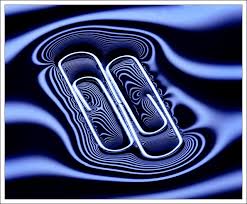
The tightness across the surface of water that enables paper clips to float is ____________.
a)
adhesion
b)
capillary action
c)
surface tension
d)
polarity
47.
When a molecule has an opposite electrical charge on each end, it is known as what?
a)
cohesion
b)
polar molecule
c)
hydrogen bond
d)
solution
48.
Which is considered neutral?
a)
pH of 4
b)
pH of 9
c)
pH of 14
d)
pH of 7
49.
Tomato juice has a pH of 4. Determine if it's an acid, base, or neutral. 
a)
acid
b)
base
c)
neutral