
 Worksheets
2.4 Enzymes 2 2023
Total questions: 50
Worksheet time: 34mins
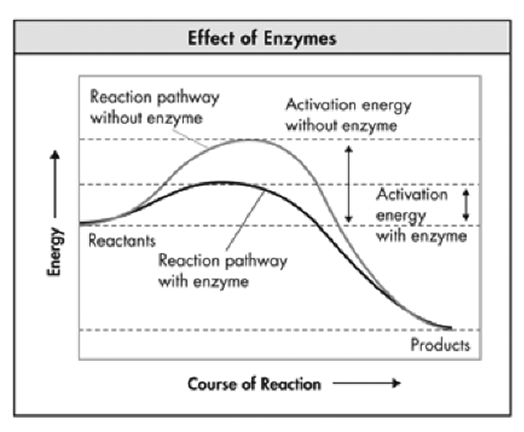
The graph shows how enzymes affect reactions in cells. Which statement best summarizes the information shown in the graph?
Enzymes increase the energy of the reactants.
Enzymes decrease the energy level of the products.
Enzymes decrease the activation energy of the reaction.
Enzymes reverse the direction of the reaction.
When an enzyme denatures it means it can______________.
function properly
no longer function
be okay
need oxygen
What does inhibit mean?
To change the shape of an enzyme
To slow or stop an enzyme from binding correctly with its substrate
To create new products
To destroy the substrate
An enzyme could denature due to extreme temperatures or pH. Denature means ______________
to unfold or change shape
to make bigger
to increase the function
to speed up

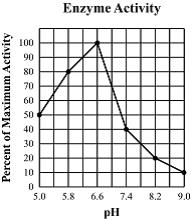
At what pH has the enzyme most likely becoming denatured?
6
7
8
9
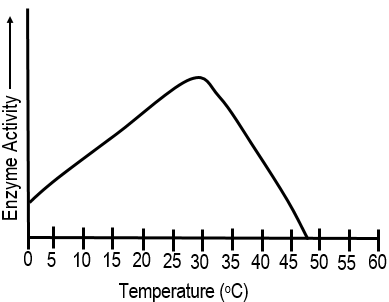
What happens when enzymes are heated to a high temperature?
The enzymes die.
The shapes of the enzyme are altered.
The enzymes' amino acid sequence changes.
The enzymes remain the same

The enzyme on the left is working correctly. What is happening to the enzyme on the right?
It is being denatured
Nothing; it is working correctly
It is being inhibited
It is creating a product.
What happens when enzymes are heated to a high temperature?
The enzymes die.
The shape of the enzyme are changed and it denatures
The enzymes' amino acid sequence changes.
The enzymes remain the same
An enzyme is heated until its shape changes and it no longer fits its substrate. The enzyme has been:
(a)
An enzyme has a small molecule blocking its active site. The enzyme has been:
(a)
Tick all the properties of enzyme.
speed up metabolic reaction
remain unchanged at the end of reaction
made of fats
known as biocatalysts
Competitive inhibition involves a molecule, other than the substrate, binding to the enzyme’s _____ site.
BInding
Allosteric
Kinetic
Active
Which of the following correctly describes enzyme structure and function?
The shape of an enzyme is responsible for its function.
All enzymes can bind to all substrates.
The substrate is responsible for the shape of the enzyme.
The location of an enzyme determines its function.

Enzymes are biological ________________.
agitators
spurs
catalysts
stimulants

Enzymes _________________________ chemical reactions without being changed.
Speed up
Slow down
Stop
Start

The substance that an enzyme attaches to is called its _____________.
Active Site
Catalyst
Product
Substrate

The new substances formed by an enzyme are called its ______________________.
Substrate
Active site
Products
Complex

Enzymes bind to specific substrates. Because of this, each ______________ requires its own enzyme.
active site
reaction
substrate
cell

Each enzyme works best under specific conditions. Each enzyme works best at a specific _______________________.
Temperature, time
pH, time
Temperature, pH
Time, place

When temperature and pH change too much, enzymes become __________________ and stop working.
devalued
decomposed
denatured
debrided

________________________ bind to enzymes and keep substrates from attaching. This keeps enzymes from working.
Inhibitors
Catalysts
Active sites
Proteins

Enzymes often work together to complete processes. If even one enzyme stops working, the entire pathway is _____________.
Accelerated
Denatured
Activated
Disrupted

What is the optimum pH of this enzyme?
(a)

What is the optimum temperature of this enzyme?
(a)
Which Graph shows that an enzyme works best at a pH of 4?


Which Graph shows that an enzyme works best at a pH of 7?
Which Graph shows that an enzyme works best in a NEUTRAL pH?
Which graph shows that an enzyme works best at 15 degrees?


Which graph shows that an enzyme works best at 100 degrees?
Which graph shows that the enzyme works best at 100 degrees?


Which line shows that an enzyme works best at a pH pf 9?
A
B
C
Which line shows that an enzyme works best at an ACIDIC pH?
A
B
C

Which Enzyme works best at a temperature of 37?
Enzyme A
Enzyme B
Which Enzyme works best at a pH of 7.5?
Enzyme A
Enzyme B

What can we conclude from the graph? At a temperature of 62 ...
Enzyme activity is highest
Enzyme activity is low but working
Enzyme is denatured

Which substrate would this enzyme catalyze?


What can we conclude from the graph? At a a pH of 3..
Enzyme A works best
Enzyme B works best
Enzyme A works but low activity
Enzyme B works but low activity
What can we conclude from the graph? At a a pH of 8..
Enzyme A works best
Enzyme B works best
Enzyme A works but low activity
Enzyme B works but low activity
What can we conclude from the graph? At a a pH of 6...
Enzyme A works best
Enzyme B works best
Enzyme A works but low activity
Enzyme B works but low activity
What can we conclude from the graph? At a a pH of 10...
Enzyme A works best
Enzyme B works best
Both enzymes are denatured

