
 Worksheets
County Assessment Review
Total questions: 50
Worksheet time: 50mins

Is this factor ABIOTIC or BIOTIC
abiotic
biotic

Is this factor ABIOTIC or BIOTIC
abiotic
biotic

Is this factor ABIOTIC or BIOTIC
abiotic
biotic

Is this factor ABIOTIC or BIOTIC
abiotic
biotic
What are the ecological levels of organization from smallest to the largest?
organism, population, community, ecosystem, biosphere
organism, community, population, ecosystem, biosphere
organism, population, community, ecosystem, ecosphere.
organism, community, population, ecosystem, ecosphere

What level of ecological organization do the animals represent?
Species
Population
Community
Ecosystem

What level of ecological organization do the organisms represent?
Species
Population
Community
Ecosystem

What level of ecological organization does this entire picture represent?
Organism
Population
Community
Ecosystem
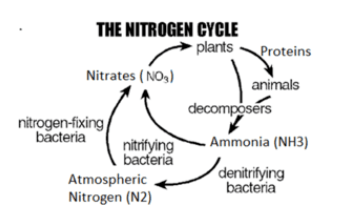
According to this diagram, plants use nitrogen to make _________________________
bacteria
animals
proteins
decomposers
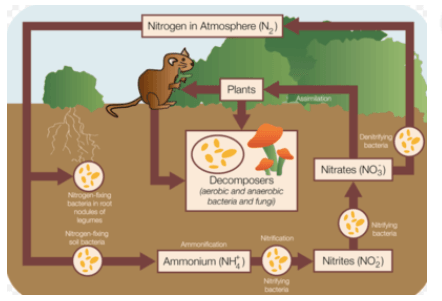
A correct path that nitrogen could take would be
air -> animals -> plants -> bacteria
animals -> air -> bacteria -> plants
bacteria -> air -> plants -> animals
air -> bacteria -> plants -> animals
respiration
combustion

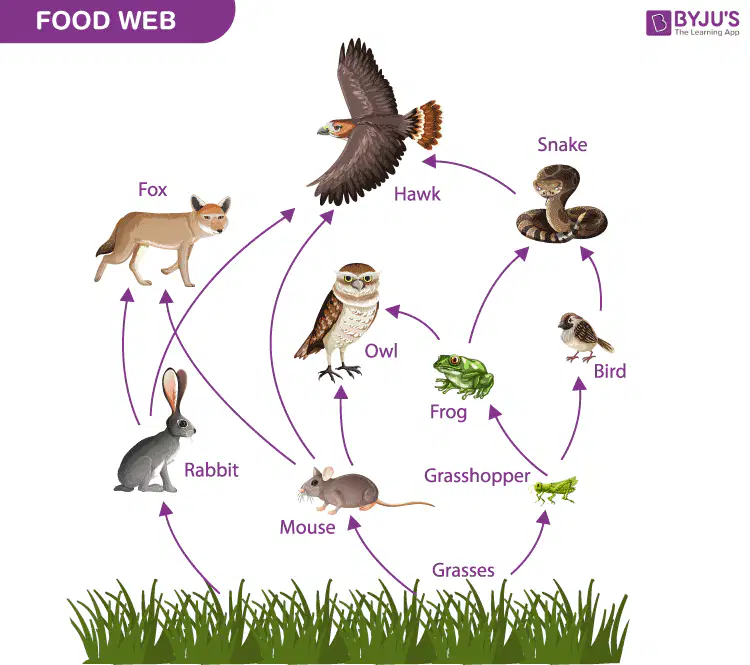
Which of the following could NOT be an example of prey?
Where does all energy in food web originate from?
Earth's Core
Water
Plants
The Sun
If a frog is the prey, what would be its predator?
A bacteria gains energy from breaking down dead/decaying organic matter. The bacteria is a __________.
Decomposer
Primary Consumer
Secondary Consumer
Tertiary Consumer

In this food web, the bird would be a _________ and a _________.
Producer
Primary Consumer
Secondary Consumer
Tertiary Consumer

Which of these is a possible Food Chain for this Ecosystem?
grass → fly → frog
frog → fly → grass
grass ← fly ← frog
fly → frog → snake

A food pyramid represent the relative amount of energy in trophic levels. Which of the following correctly shows a food pyramid?
A
B
C
D

What would happen to the blue whale population if the krill population went extinct?
the blue whale population eats other things in the food web
the blue whale population would increase
The blue whale population would remain the same.
the blue whale population would also decrease


Based on the simple food chain above, which of the following is most likely to happen if the number of hawks decreases?
The snake population will decrease
The mouse population will decrease
The mouse population will increase
The plant population will decrease

Which of the following is the best example of mutualism?
a dog steals a bone from another dog
a tiger hunts and eats a deer
a bird eats ticks from a zebra's skin
a bee stings a jogger
Monkeys helping to clean bugs off of each other's back is a form of
competition
cooperation
parasitism
commensalism


Cattle egrets feed in fields among cattle. The egret gets easy access to flying insects stirred up by the cattle, and the cattle don't care if they are there or not. This relationship is an example of
mutualism
commensalism
competition
parasitism
The behaviors and physical characteristics of species that allow them to live successfully in their environment are called
habitats
limiting factors
biotic factors
adaptations

When this isopod enters the fish through its gills, it consumes the fish's tongue replacing it. What is this an example of?
commensalism
mutualism
parasitism
predator-prey
Which of the following is a way that competition can occur.
Two male turkeys show off their enormous tail feathers to impress female turkeys.
A mosquito bites a human and drinks their blood.
Barnacles live on whales so that they can have access to food.
A lion chases away a group of hyenas so that it can eat the gazelle they just killed.
Which of the following describes an example of cooperation?
A group of elephants works together to raise an baby elephant.
Two male wolves fight each other for the right to lead the pack and mate with the females.
A leopard hunts and kills a zebra.
A bee drinks the nectar from a flower. At the same time, it carries the flower's pollen to other flowers.
These are the forms of symbiosis.
parasitism
mutualism
commensalism
cooperation
What is one of the main reasons a biome is different from another?
Sunlight
Altitude
Biodiversity
Precipitation
Which biome has the most biodiversity(variety of life)?
Desert
Temperate Deciduous Forest
Savanna
Tropical Rainforest

Desert
Taiga

Biome with plants and grasses, but no trees. Grazing animals are found here.
grassland
desert
taiga
tundra
Deciduous means
"to fall off"
"to add"
"to stay attached"
"to be active"

What is permafrost?
ground that remains frozen for at least two years in a row
A type of soil found in cold climates
a type of rock found in cold climates
a permanent layer of frost covering plants in the arctic circle
What is climate?
the blanket of air that wraps around the planet
water changing from a gas to a liquid
the condition of the atmosphere at a particular time and place
the pattern of weather conditions that occur over a long period

