
Font size
 Worksheets
Chapter 3: Dynamics of Linear Motio (C1 & C2)
Total questions: 42
Worksheet time: 1hrs 24mins
The momentum of an object depends upon the object's ___________&_____________.
size and shape
mass and speed
mass and veloctiy
mass and energy
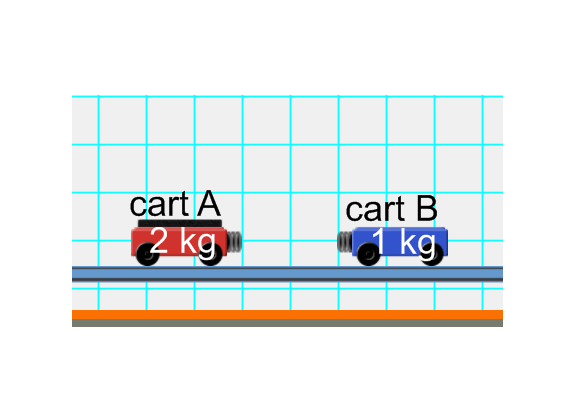
When a cannon fires a cannon ball, it recoils backwards. This occurs because of...
Energy in the system is conserved
Energy in the system is increased
Momentum in the system is conserved
Energy in the system is not conserved
In an elastic collision...
only momentum is conserved
only energy is conserved
both momentum and energy are conserved
neither momentum nor energy are conserved
Suppose a ping-pong ball and a bowling ball are rolling toward you. Both have the same momentum, and you exert the same force to stop each. How do the time intervals to stop them compare?
Less time for the ping-pong ball
Times are equal
More time for the ping-pong ball
During a collision. an object experiences an impulse. How can this impulse be calculated?
Multiplying force by time
Multiplying mass by velocity
Dividing velocity by time
Multiplying mass by acceleration
During a collision. an object experiences an impulse. The impulse causes and is equal to the _____ of the object
energy change
kinetic energy change
force
momentum
momentum change
A sailboat of mass m is moving with a momentum p. How would you represent its kinetic energy in terms of these two quantities?
K =2mp2
K = 21mp2
K = mp
K = 2mp
Check ALL that apply.
Impulse is:
The force that creates an acceleration.
The change in momentum.
the change in velocity that can be caused by a constant force over some discrete amount of time.
A vector
A scalar
The area under the curve on a Force versus time ( F vs t) graph represents
Impulse
Momentum
Work
Kinetic energy
A freight car moves along a friction less level railroad track at constant speed. The car is open on top. A large load of coal is suddenly dumped into the car. What happens to the velocity of the car?
It increases
It remains the same
It decreases
Cannot be determined from the information given
Impulse is defined as the product of force and time during which the forces act, J = F.t.
Impulse is produced by a FORCE called :
Applied force
Normal force
Gravitational force
Impulsive force
Force is a vector.
True
False
Forces acting on an object are represented by ____________
arrows only
a box or a dot only
a free body diagram
A force body diagram
What symbol do we use to represent a "body" in a free-body diagram?
small dot
small figure
an outline of a human body
small triangle
How is a force represented in a Free Body Diagram?
A straight line with an arrowhead
A curved line with an arrowhead
An arc with an arrowhead
Multiple lines with arrowheads
The force exerted by ropes and chains is called
tension
normal
elastic
mechanical

The Coffee cup in the picture is resting on a table. What force(s) are missing from the free body diagram?
No forces are missing
The normal force from the table pushing the cup up.
The normal force form the table pushing the cup down.
The friction force from the table pushing the cup left and right.

The Car in the picture is moving to the right at a constant velocity. Any friction present would be pushing the car to the ...
Up
Right
Down
Left

A man pushes a box across the floor at a constant velocity. There is a force on the box pulling it toward the center of the earth. This is called the
force of gravity
normal force
friction force
applied force


Which equation would accurately describe the forces on this cup of coffee?
Fn − Fg = 0
Fn×Fg = 0
Fn−10Fg
Fn−Fg = −10

A chandelier is hanging from the ceiling. If the force of gravity on the chandelier is 120 N, the force of tension must be ...
0 N
12 N
60 N
120 N
When determining the NET force on an object you should (TWO correct answers)
subtract forces in opposite directions
add forces in the same direction
divide by velocity
multiply by acceleration
Which of the following is the same as INERTIA? (pick two)
object at rest
object moving at a constant velocity
momentum
force
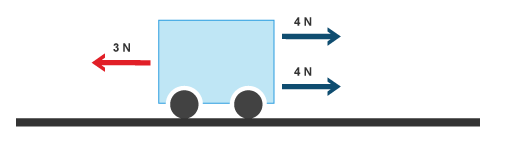
Ted is trying to move a fridge through his house, he gets stuck on a carpet and even though he is pushing the fridge, it is not moving. What force is acting against him?
applied
static friction
kinetic friction
normal

Which of the following statements is true about the image above?
The accelerations of the blocks will vary according to their mass
The net force acting on each block is the same
The blocks will experience the same acceleration
The 3m box will eat the 2m and the m boxes

Which of the following is not true about the system?
T3 is equal to the scalar sum of the magnitudes of T2 and T1
T3 is equal in magnitude to Fg
The x- components of the T1 and T2 and equivalent but in opposite directions
The system is in equilibrium.

If there is no friction, then the acceleration would be equal to
mg
sin(θ)mg
g
sin(θ)g

