
NEW
Font size
 Worksheets
Econ Unit 1 Practice Test
Total questions: 36
Worksheet time: 32mins
Which of the following best captures the idea of the fundamental economic problem?
Lack of demand for limited resources.
Limited resources and unlimited wants.
Limited wants and limited resources.
Unlimited resources and unlimited wants.
Infinite resources and limited wants.
What does it mean to say that a resource is scarce?
A society does not have enough money to purchase this resource.
Nobody wants to buy this resource.
There is an unlimited amount of the resource available.
There is not enough of this resource to satisfy all the wants and needs of a society.
The resource is no longer available.
What are the four categories of resources?
Machines, technology, minerals, and energy resources
Land resources, labor, capital goods, and entrepreneurship
Information technology, physical capital, financial capital, and high skilled workers
High skilled workers, low skilled workers, knowledge workers, and service sector workers
Forest, minerals, ocean, and energy resources
A trade-off is
always in the social interest
the benefit you receive from an increase in an activity
giving up one thing to get something else
the key to reconciling self-interest and social interest
The sacrifice involved when you choose a particular course of action is called the:
Alternative
Consumer cost
Opportunity cost
Producer cost
Economic growth can be shown by:
An inward shift of the production possibility frontier
A movement downward the production possibility frontier
A movement up the production possibility frontier
An outward shift of the production possibility frontier

The table shows the production possibilities for a country. Based on the table, which of the following production combinations is a possibility?
28 pizzas and 5 pairs of shoes
3 pairs of shoes and 23 pizzas
2 pairs of shoes and 20 pizzas
4 pairs of shoes and 15 pizzas

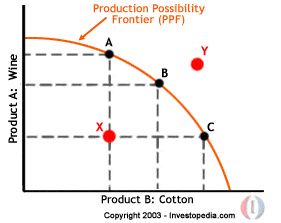

What is labor?
Hard Work
People who only do the physical work.
People who do the work to produce something.
None of the above.
Land includes...
The "gifts of nature" or natural resources not created by human effort.
the tools, equipment, and factories used in production of goods and services
people with all their efforts and abilities
individuals who start a new business or bring a product to market.
Capital refers to...
The "gifts of nature" or natural resources not created by human effort.
people with all their efforts and abilities
the tools, equipment, and factories used in production of goods and services
individuals who start a new business or bring a product to market.
Labor refers to...
people with all their efforts and abilities
individuals who start a new business or bring a product to market.
the tools, equipment, and factories used in production of goods and services.
The "gifts of nature" or natural resources not created by human effort.
Entrepreneurs are...
people with all their efforts and abilities
risk taking individuals who start a new business or bring a product to market.
The "gifts of nature" or natural resources not created by human effort.
the tools, equipment, and factories used in production of goods and services
What is a major charactertistic of a market economy is which type of ownership of property?
monopolistic
limited
private
none of the options
What is an economic system where only the government makes the economic decisions?
traditional economy
free enterprise
mixed economy
command economy
What type of economy do most countries in the world have?
Market economy
Command economy
Traditional economy
Mixed economy

The government has little to no role in the production of goods in this type of economy.
Traditional
Mixed
Command
Market
Businesses have freedom to produce whatever they think consumers will buy
Market
Command
Mixed
Traditional
In a command economy, who holds power over the economy?
The people
The government
Beyonce
The traditions of your ancesetors

