wayground logo

Free Printable Worksheets

NEW

Font size

S
M
L
XL
Worksheets

Intro to Chemistry Review

Total questions: 40

Worksheet time: 31mins

Name
Class
Date
1.

Why study chemistry?

a)

Chemistry explains things in the natural world.

b)

Many careers use chemistry.

c)

Informed citizens need a knowledge of chemistry.

d)

All the options are correct.

2.

Which one is not in the metric {SI} system?

a)
Kilometer
b)
Yard
c)
Centimeter
d)
Meter
3.

A unit of length in the metric

{SI} system is the:

a)

Liter

b)

Meter

c)

Gram

d)

Newton

4.

A unit of mass in the metric {SI} system is the:

a)

Centimeter

b)

Gram

c)

Liter

d)

Ounce

5.

The standard for temperature in the metric {SI} system is....

a)

Celsius

b)

Kelvin

c)

Fahrenheit

d)

Marvin

6.

The SI unit for volume is the __________.

a)

meter

b)

kilogram

c)

liter

d)

Newton

7.

Which of the following is a basic unit that measures TIME?

a)

meters

b)

seconds

c)

Ampere (Amp)

d)

Kelvin

8.

State of matter that takes the shape of it's container and has a definite volume.

a)

Solid state

b)

Liquid state

c)

Gas state

d)

Plasma state

9.

State of matter that can fill containers with no fixed shape and no fixed volume.

a)

Solid state

b)

Liquid state

c)

Gas state

d)

Plasma state

10.

State of matter in which materials have a definite shape and volume.

a)

Solid state

b)

Liquid state

c)

Gas state

d)

Plasma state

11.

Which is NOT a property of a solid?

a)

They do not flow.

b)

Definite volume.

c)

No definite shape.

12.
A substance that contains only one type of atom is a(n)
a)
compound
b)
element
c)
heterogeneous mixture
d)
homogeneous mixture
13.

A solid is a state of matter that has a(n)

a)

indefinite volume and indefinite shape

b)

definite volume and a definite shape

c)

definite volume and an indefinite shape

d)

indefinite volume and a definite shape

14.
Steam is an example of what state of matter?
a)
Solid
b)
Liquid
c)
Gas
d)

Plasma

15.
What is happening when my ice cream changes from a solid to a liquid?
a)
freezing
b)
melting
c)
burning
d)
evaporation
16.

Most forms of ________ can exist as solids, liquids, and gases.

a)

particles

b)

matter

c)

gases

d)

energy

17.

The process of a liquid turning into a solid is called ________.

a)

boiling

b)

condensation

c)

melting

d)

freezing

18.

State of matter that is sooo hot that electrons are stripped from the atoms.

a)

solid

b)

liquid

c)

gas

d)

plasma

19.

The state of matter where the particles are spread out as far as possible is

a)

Solid

b)

Liquid

c)

Gas

d)

Plasma

20.
The positive particles of an atom are 
a)
electrons 
b)
positrons 
c)
neutrons 
d)
protons 
21.
Particles in an atom that are neutral and have no charge are 
a)
negatrons 
b)
electrons 
c)
neutrons 
d)
protons 
22.
True or False? Neutrons have a negative charge
a)
True
b)
False
23.
What is the atomic number for an element with three protons?
a)
2
b)
1
c)
3
d)
6
24.
A particle that moves around the nucleus is a(n)...
a)
Proton
b)
Neutron
c)
Electron
d)
Quark
25.
Beryllium has how many protons?
a)
4
b)
9.0122
c)
2
d)
13.0122
26.
What does the nucleus consist of?
a)
Protons + Electrons
b)
Neutrons + Electrons
c)
Atoms
d)
Protons + Neutrons
27.
What are the 3 subatomic particles that make-up the atom?
a)
protons, neutrons, and isotopes
b)
neutrons, isotopes, and electrons
c)
positives, negatives, and electrons
d)
protons, neutrons, and electrons
28.

_____ means to spread out evenly in a liquid.

a)

melt

b)

dissolve

c)

mix

29.
Anything made of matter must _____________________.
a)
take up space and have mass
b)
have mass and be a solid
c)
be a solid and not move
d)
take up space and be a liquid
30.
What occurs during sublimation?
a)
A gas becomes a solid
b)

Heat leaves a solid

c)

Heat goes into a solid turns into gas

d)
Explosions
31.
What must occur for melting to take place?
a)
Heat goes into a liquid
b)
Heat goes into a gas
c)
Heat leaves a solid
d)
Heat goes into a solid
32.

Beryllium has how many neutrons?

a)
4
b)
9.0122
c)

5

d)
13.0122
33.
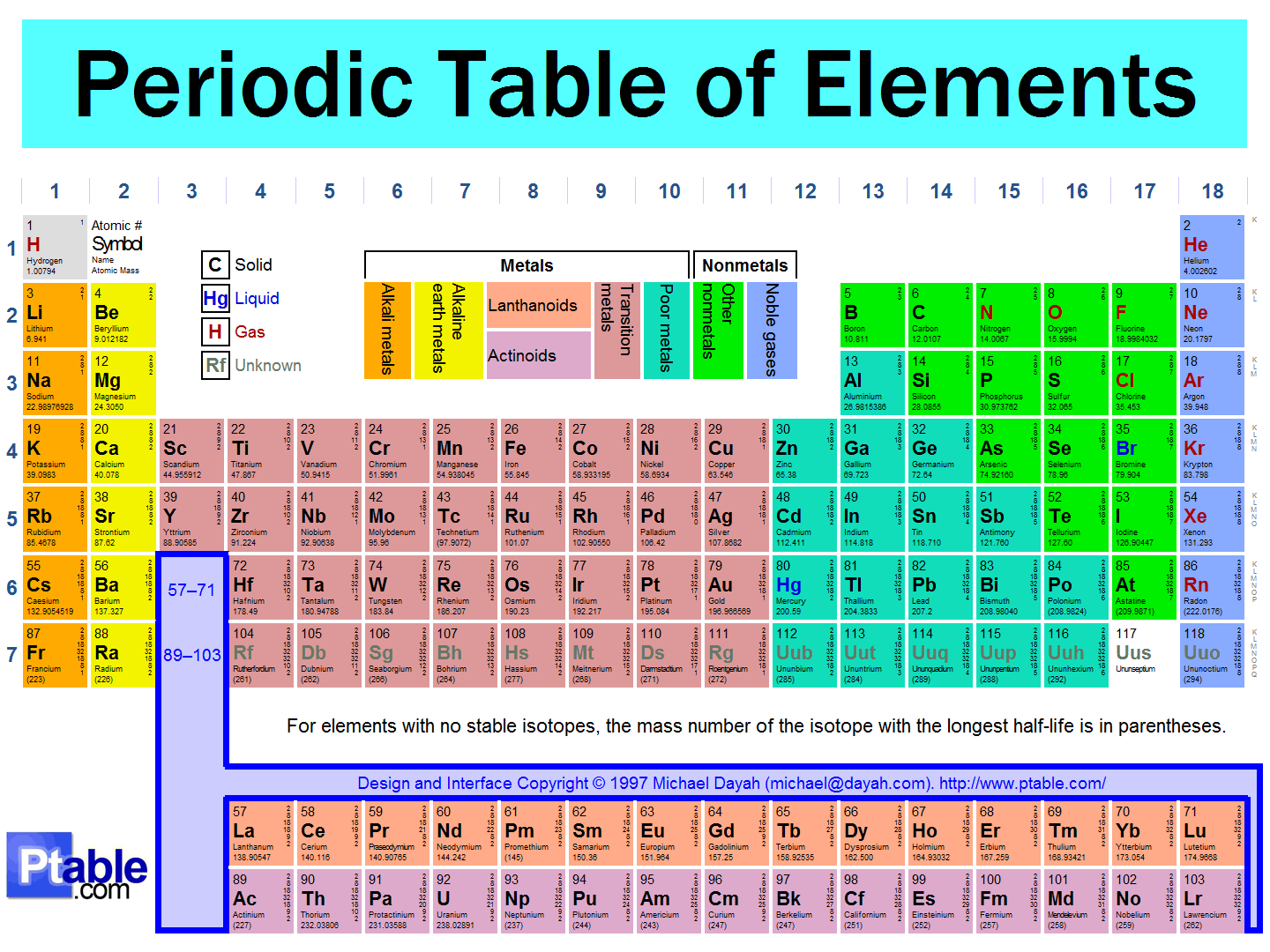
Each column in the periodic table is called a 
a)
period
b)
group
c)
cluster
d)
unit
34.
The horizontal row on the periodic table is called a
a)
group
b)
family
c)
period
d)
atomic number
35.
Elements in a ..................have similar chemical properties.  
a)
period
b)
group
c)
row
36.

Name this group: These metals are the most reactive.

a)
b)
c)
d)
37.

Name this group: These metals are the second most reactive.

a)
b)
c)
d)
38.

Name this group: These metals contain familiar metals such as gold, iron, and copper.

a)
b)
c)
d)
39.
These are found on the Periodic Table.
a)
Compounds
b)
Elements
c)
Mixtures
40.

Elements are stable

a)

because they are in nature

b)

when they sublimate

c)

When they go to counseling

d)

when they reach the Octet state