
 Worksheets
Revision Test - 3
Total questions: 75
Worksheet time: 49mins


What do plants need to survive?
sunlight, water, air, and nutrients
sunlight, winter, fall, and nutrients
swamps, bees, leaves, and nutrients
Some plants have brightly colored flowers to attract bees, birds, and butterflies.
False
True
Any living thing is called a ______
ecosystem
population
community
organism
Which of these is not a producer?
tree
grass
flower
bird
Which of these is not a consumer?
tiger
fish
squirrel
apple tree

Is this item biotic or abiotic factors?
biotic
abiotic
What kinds of ecosystems are near the equator?
tundra
taiga
rainforest
The place where an organism lives is its_____.
habitat
organism
ecosystem
population
A group of different species that live together in an environment are called a/an____.
community
population
habitat
ecosystem
All energy flow an ecosystem begins with....
plants
the sun
the moon
algae
Click on ALL the resources living things need to survive.
water
space
food
humans
What is a producer?
organism that cannot make their own food so they eat other organisms
organism that makes their own food
organism that break down dead organisms
What is a decomposer?
an organism that breaks down dead organisms for energy
an organism that makes its own food
an organism that eats other organisms
True or False:
Organisms are living things
true
false
What is a producer?
organism that cannot make their own food so they eat other organisms
organism that makes their own food
organism that break down dead organisms
What is a decomposer?
an organism that breaks down dead organisms for energy
an organism that makes its own food
an organism that eats other organisms
Does a food chain start with the sun?
yes
no
What is a consumer?
an organism that breaks down dead organisms
an organism that makes its own energy and food
an organism that eats other organisms for energy
What is a food web?
a model that contains many food chains
a model that contains one food chain
a model that shows where the sun gets its energy
a model that shows how decomposers break down organisms
True or False:
A food web shows how energy flows through an ecosystem
true
false
What is the source of all energy?
water
food
decomposers
sun
What do organisms need to survive?
to have their needs met
a comfortable home
animals to eat
humans
If there is a change in the environment, the organism will either die or have to leave
true or false
true
false
What do the arrows in a food web show?
who is the most powerful
the next organism that uses the energy
the prey
the sun
Why do scientists study how animals get their food?
to know what their favorite meal is
so that they understand how energy flows in an ecosystem
to understand why consumers are stronger than decomposers
In a food chain, what comes after a producer?
the sun
a decomposer
a consumer
What is the last thing in a food chain?
a consumer
the sun
a decomposer
a producer
Which animal is a vertebrate?
crab
spider
snail
lizard
An animals that has scales and fins is what type of animal?
mammal
fish
reptile
amphibian
A vertebrate is an animal...
with a backbone
without a backbone
Mammals are vertebrates.
True
false
Insects, worms, and spiders are vertebrates.
True
False
How are birds and reptiles alike?
They both have scales.
They both have beaks.
They can both lay eggs.
They both have feathers.
This type of animal is a vertebrate with scaly skin.
Fish
Bird
Mammal
Reptile
Which of the following is the correct life cycle for incomplete metamorphosis?
Egg → Larva → Adult
Egg → Larva → Pupa → Adult
Egg → Nymph → Adult
Egg → Pupa → Adult
Unlike other animals, insects change in a protective covering during their life cycle. What do we call this change if the insect's life cycle has four distinct stages?
Complete makeover
Incomplete Makeover
Complete Metamorphosis
Incomplete Metamorphosis
A grasshopper is an insect that goes through three distinct stages during its life cycle. The life cycle of a grasshopper is an example of which one of the following?
Quick metamorphosis
Slow metamorphosis
Complete metamorphosis
Incomplete metamorphosis

Look at the diagram.
Which fossil is the youngest?
A
B
C
D
Look at the diagram.
Which fossil is the oldest?
A
B
C
D

What is sediment?
A scientist who studies about fossils.
The harden part of an animal that died long time ago.
Different kinds of soil, rock, sand and clay that was built on fossils.

Why do scientists learn about fossils?
To learn about the environment and climate change in the future.
To learn about the environment and climate change in the present.
To learn about the environment and climate change in the past.

What provides scientific evidence of past life?
history books
timelines
stories
fossils

The picture below is a fossil of a tooth that may be from a sea creature known as the megalodon.
The megalodon is probably related to the
penguin
seal
shark

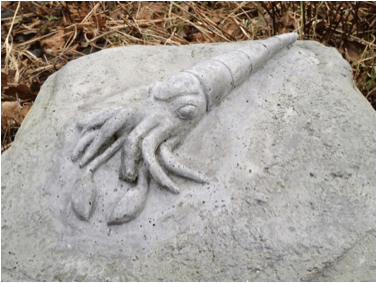
this type of fossil is a mold filled with sediment that creates a solid 3D copy of an organism
mold
petrified
cast
trace


What is the breakdown of the Earth’s crust into sediment called?
erosion
deposition
weathering
whooshing

What is it called when weathered rock is carried away?
weathering
erosion
deposition
breaking
What is the process called when a glacier deposits rocks in oceans and lakes?
deposition
chemical weathering
physical weathering
erosion
Which of the following is NOT an example of erosion?
wind blowing sand
rain falling onto the beach
sand castles becoming smaller
ocean waves moving sand back and forth
What is water getting into rocks and freezing breaking apart the rock and example of?
weathering
erosion

Sandstone is an example of _____.
Sedimentary rock
Igneous rock
Metamorphic rock

Granite is an example of ____.
Sedimentary rock
Igneous rock
Metamorphic rock

Slate is an example of ____.
Sedimentary rock
Igneous rock
Metamorphic rock

This rock was another type of rock that was heated and compressed over time. What type of rock is this?
Sedimentary
Igneous
Metamorphic

This rock started as molten magma but transformed after a volcano erupted. What type of rock is this?
Sedimentary
Igneous
Metamorphic

This rock was formed by smaller pieces of rock that settled at the bottom of a lake millions of years ago. What type of rock is this?
Sedimentary
Igneous
Metamorphic
What do we call the material that comes from rocks that have been broken down into smaller pieces?
Texture
Weathering
Sediment
Erosion

Any rock can turn into any other kind of rock.
True
False
A force is a_______ or a ________that causes movement.
push, taste
push, pull
pull, run
pull, lift


Coal and Petrol are fuels. What do they have stored in them?
energy
light
force
work
Kinetic Energy is due to the
Position of the object
Motion of the object
Mass of the object
I don't know
When a roller coaster is at its highest point, it has a lot of
Potential Energy
Kinetic Energy
Power
Force
A child jumping on the bed is the example of
Potential Energy
Kinetic Energy
A Naughty kid
Neither
A sleeping child is an example of
Potential Energy
Kinetic Energy
A peaceful kid
Neither

