
 Worksheets
Earth Science Vocabulary Quiz 2
Total questions: 50
Worksheet time: 49mins
What is the focus of an earthquake?
The place where energy is released during an earthquake.
The point above where energy is released in an earthquake.
A scale of an earthquakes magnitude.
The city were the earthquake happens.
What is an epicenter?
There the earthquake starts
where a volcano forms
Where the earthquake starts above ground.
A scale of an earthquake's magnitude.
The movement of the ground caused by a sudden release of energy in Earth's crust is called.
focus
earthquake
magnitude
seismograph
What is the amount of energy released by an earthquake called?
Seismic Wave
Seismograph
Power
Magnitude
Which statement best describes a fault?
A valley formed when 2 plates collide.
A break in earth crust (plates) caused by tension forces.
Vibrations produced when rock breaks
Sections of earths crust and upper part of the mantle.
Which statement best describes the word plates in Earth Science?
Sections of earth's crust.
The blue and white dishes in the cabinet.
The mountains created from divergent boundaries.
Valley formed when 2 plates collide.
Constructive process in earth science is best described as
The tearing down of earth's surface.
The building up of earth's surface and its features.
The washing of the river through osmosis.
Reverse osmosis.
A destructive process is described as
Reverse osmosis
The process of tearing down earth's features and destruction of earth's surface.
The process of building up earth's features through telepathic memory.
The process of building up earth's surface and its features.
Oceanic Crust
The outer layer of the earth's crust that is more dense and is on the bottom of the ocean.
The inner layer of the Earth's crust that is more dense and hot molten magma forms a solid core.
The outer layer of the Earth's crust that more dense.
The outer layer of the Earth's crust that is less dense and continents are formed on this type of crust.
Continental Crust
The outer layer of the earth's crust that is more dense and is on the bottom of the ocean.
The inner layer of the Earth's crust that is more dense and hot molten magma forms a solid core.
The outer layer of the Earth's crust that more dense.
The outer layer of the Earth's crust that is less dense and continents are formed on this type of crust.
Plates that are moving apart from each other
divergent boundary
convergent boundary
subduction zone
continental drift
The plates on the ocean floor are moving apart from each other
Seafloor spreading
ocean floor divergence
continental drift
Seafloor convergence
Boundary between two plates where the plates are sliding past each other
Divergent-
Convergent-
Transform-
Formed where two sections of Earth’s crust are colliding
Divergent-
Convergent-
Transform-
A mountain that forms as molten rock flows through a crack onto Earth's surface.
earthquake
mechanical weathering
chemical weathering
volcano

a mountain or hill made of hot rocks and gases moving to the surface of Earth from deep inside the Earth.
volcano
earthquake
mountain
landslide

Constructive forces are...
processes that build up surface features on the earth.
processes that wear down surface features on the earth.

crust
the inside layer of the Earth
the outside layer of the Earth
The thickest layer
Is hottest layer of the earth.

geologist
scientist who studies the Earth and its history
scientist who studies bugs

lava
hard rock that stays below the Earth's surface
magma that rises to the surface of the Earth
Liquid that has not were to go from the inner core of the earth.
Molten crust found only in the inner core.

magma
molten rock found on the Earth's surface
molten rock found deep in the Earth
What layer of the Earth is at the very center?
Crust
Mantle
Inner Core
Outer Core
Which layer is 2,900 km thick and is molten?
Crust
Mantle
Inner Core
Outer Core
What is the outermost layer of the Earth?
Crust
Mantle
Inner Core
Outer Core
True or False:
Oceanic and Continental are the two types of Earth's Crust.
True
False
A mountain that forms as molten rock flows through a crack onto Earth's surface.
earthquake
mechanical weathering
chemical weathering
volcano
a mountain or hill made of hot rocks and gases moving to the surface of Earth from deep inside the Earth.
volcano
earthquake
mountain
landslide


A volcano that has gentle sloping sides


A volcano that is made from layers lava and ash
What is a volcano?
A mixture of hot rocks, ash, and gases that erupts a crack in Earth's surface
When the ground shakes
A huge wave caused by an earthquake
Which of these describes Convergent Boundaries?
Two plates sliding next to each other
Two plates pushing towards each other
Two plates pushing away from each other
One plate sliding over another plate
Which of these describes Divergent Boundaries?
Two plates pushing towards each other
Two plates pushing away from each other
One plate sliding on top of another plate
Two plates sliding next to each other
Which of these describes Transform Boundaries?
Two plates pushing away from each other
Two plates sliding towards each other
Two plates sliding next to each other
A plate sliding over another plate
What is a sudden and violent shaking of the ground caused by movements within the earth's crust?
Hurricane
Earthquake
Hail
Tornado
A hot column of magma that melts through the Earth's crust as the magma reaches the Earth's surface.
plate movement
hot spot
lava
magma
The size of earthquakes are measured on the Richter Scale.
True
False
___________________ is the name of a series of waves that is so powerful it can destroy a city.
Thunder Storm
earthquake
volcano
Tsunami

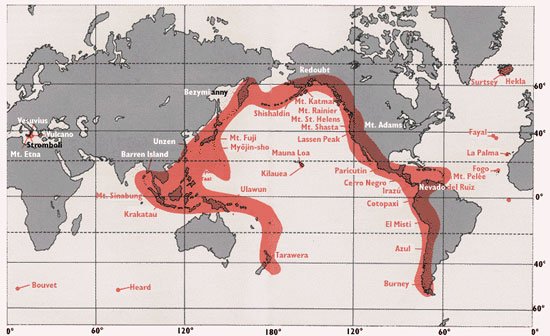
One major belt of volcanoes that surrounds the Pacific Ocean
Ring of Fire
Ring of Asia
Ring o' earthquakes
Ring a ding ding
Millions of earthquakes happen every year.
True
False
The focus is the place where an earthquake starts and energy is released.
True
False
What gets released when plates move that causes the ground to shake?
energy
light
soil

