
 Worksheets
Unit 1: Isotopes, Classifying Matter, & States of Matter
Total questions: 48
Worksheet time: 24mins
Isotopes have the same number of ...
Protons
Neutrons
Electrons
But Isotopes have a different number of...
Electrons
Protons
Neutrons

Using the picture from a periodic table, what is the Atomic Mass?
26
Fe
55.845
56
Using the picture from a periodic table, what is the Mass Number?
26
Fe
55.845
56
Using the picture from a periodic table, how many PROTONS are in Iron?
26
30
55.845
56
Using the picture from a periodic table, how many NEUTRONS are in Iron?
26
30
55.845
56
When two atoms of the same element have different masses, they are called ______, and have a different number of ______.
Neutrons; Isotopes
Atoms; Isotopes
Isotopes; Protons
Isotopes; Neutrons
The difference between a chemical and physical change is that...
A chemical change makes a new substance and a physical change doesn't
A physical change makes a new substance and a chemical change doesn't
There is no difference between a chemical and physical change
A chemical change makes something new and a physical change can only be measured microsopically
Calcium has the atomic number 20. If it has a mass number of 46, how many neutrons are present?
46
20
26
We cannot tell
Select all of the PHYSICAL changes..
Vinegar mixed with baking soda makes gas
Freezing water makes ice
Ripping a piece of paper in half
Grinding salt into a powder
Leaving hydrogen peroxide out decomposes into water and gas
Select all of the CHEMICAL changes..
Vinegar mixed with baking soda makes gas
Freezing water makes ice
Ripping a piece of paper in half
Grinding salt into a powder
Leaving hydrogen peroxide out decomposes into water and gas
What is an Ion?
Atom/molecule with a charge other than zero.
Atom/molecule with a charge other than one.
Atom/molecule with a charge other than two.
Atom/molecule with a charge other than three.
Which One Is True?
Cation: Negatively charged ion.
Anion: Negatively charged ion.
Cation: Positively charged ion.
Anion: Positively charged ion.
Cation: Positively charged ion.
Anion: Negatively charged ion.
Cation: Negatively charged ion.
Anion: Positively charged ion.
Why does every sample of a substance have the same properties?
A pure substance has a fixed composition.
An element contains only one kind of atom.
Compounds contain 2 or more elements.
The composition of a mixture is not fixed.
Based on the size of their largest particles.
Why is the composition of an element fixed?
A pure substance has a fixed composition.
An element contains only one kind of atom.
Compounds contain 2 or more elements.
The composition of a mixture is not fixed.
Based on the size of their largest particles.
What makes something a compound?
A pure substance has a fixed composition.
An element contains only one kind of atom.
Compounds contain 2 or more elements.
The composition of a mixture is not fixed.
Based on the size of their largest particles.
Why can the properties of a mixture vary?
A pure substance has a fixed composition.
An element contains only one kind of atom.
Compounds contain 2 or more elements.
The composition of a mixture is not fixed.
Based on the size of their largest particles.
How are solutions classified?
A pure substance has a fixed composition.
An element contains only one kind of atom.
Compounds contain 2 or more elements.
The composition of a mixture is not fixed.
Based on the size of their largest particles.
Choose an example of a physical property.
Viscosity
Choose a material for a specific purpose.
Filtration and distillation.
low viscosity
compsition
What are the processes that can be used to separate a mixture?
Viscosity
Choose a material for a specific purpose.
Filtration and distillation.
low viscosity
compsition
Explain why the rusting of an iron bar
decreases the strength of the bar.
When substances are changing into other substances.
A change in color, the production of a gas,
or the formation of a precipitate.
Chemical change produces new
substances, Physical change does not.
When iron rusts, the the rust is brittle.
How do chemical changes differ from
physical changes?
When substances are changing into other substances.
A change in color, the production of a gas,
or the formation of a precipitate.
Chemical change produces new
substances, Physical change does not.
When iron rusts, the the rust is brittle.
List the common types of evidence for a
chemical change.
When substances are changing into other substances.
A change in color, the production of a gas,
or the formation of a precipitate.
Chemical change produces new
substances, Physical change does not.
When iron rusts, the the rust is brittle.
When can chemical properties be observed?
When substances are changing into other substances.
A change in color, the production of a gas,
or the formation of a precipitate.
Chemical change produces new
substances, Physical change does not.
When iron rusts, the the rust is brittle.

Quartz
Element
Compound
Homogeneous Mixture
Heterogeneous Mixture

Pickle Relish
Element
Compound
Homogeneous Mixture
Heterogeneous Mixture

Salt water
Element
Compound
Homogeneous Mixture
Heterogeneous Mixture

Water
Element
Compound
Homogeneous Mixture
Heterogeneous Mixture

Aluminum
Element
Compound
Homogeneous Mixture
Heterogeneous Mixture
Tearing paper into two pieces
Chemical Change
Physical Change
Burning Leaves
Chemical Change
Physical Change

Granite
Element
Compound
Homogeneous Mixture
Heterogeneous Mixture
Melting ice cube
Chemical Change
Physical Change

Brass
Element
Compound
Homogeneous Mixture
Heterogeneous Mixture
Digesting food
Chemical Change
Physical Change
The substance burns in air
Extensive Property
Intensive Property
Chemical Property
True or False?
Heterogeneous mixture: A non-uniform mixture in which components remain separate and can be observed as individual substances or phases.
True
False
True or False?
Homogeneous mixture: A mixture of two or more substances in a single phase that is uniform throughout.
True
False

Which of the following statements about the particle theory of matter is incorrect?
All matter is made up of tiny particles.
All substances are made of the same particles.
The particles can move when they are heated.
Particles are held together by strong electrical forces.

State of matter that takes the shape of it's container and has a definite volume.
Solid state
Liquid state
Gas state
Plasma state

State of matter that can fill containers with no fixed shape or volume.
Solid state
Liquid state
Gas state
Plasma state

State of matter in which materials have a definite shape and volume.
Solid state
Liquid state
Gas state
Plasma state
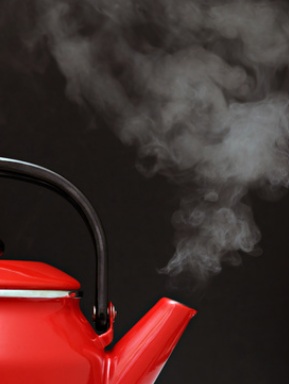
What change of state is taking place in this photograph?
Condensation
Freezing
Vaporization
Melting

The diagram shows the way the particles of a solid occupy space. Select the property of a solid that is consistent with this micro-view.
No define shape
Cannot be compressed
No definite volume

Which is NOT a property of a solid?
They do not flow.
Definite volume.
No definite shape.
They are incompressible.

Which state of matter is represented in the following diagram?
Liquid
Liquid and gas
Gas
Solid

Which of the following states is correct?
Gases cannot be compressed.
Solids are easily compressed.
Gases are easier to compress than solids.
Liquids cannot be compressed or expanded.

Which change of state occurs when particles in a solid begin to move slowly past each other?
Melting
Freezing
Condensing
Vaporizing

