Worksheets
Units 1 & 2 Test Review
Total questions: 40
Worksheet time: 24mins


Number 1
thoracic cavity
pleural cavity
cranial cavity
pelvic cavity

Letter C
pleural cavity
pericardial cavity
abdominal cavity
pelvic cavity
Which of the following cavities holds the heart AND lungs?
pleural
pericardial
thoracic
abdominal

Which of the following describes homeostasis?
keeps variables exactly at the set point
organism's ability to maintain steady(stable) internal conditions
acts to keep values outside of a desired range
operates through positive feedback
Negative feedback loops ...
are one way an organism can maintain homeostasis.
are rarely found in healthy individuals
respond by making deviations from normal even larger
cannot be counteracted with medicine
This part of the negative feedback loop causes a change in the environment, a disruption to homeostasis.
initiation event
control center
effector
receptor
A change inside of the organism caused by the initiation event is the ...
response
effector
control center
stimulus
Which part of the feedback loop is a body part that makes a change to bring the system back to homeostasis?
Effector
control center
response
receptor
The body part that senses the change inside the organism ...
receptor
control center
effector
response
Identify the initiation event.
Scenario: A person begins to exercise which causes their body temperature to increase. The temperature change is noticed and the person begins to sweat and their body temperature decreases.
temperature change is noticed
person begins to sweat
body temperature decreases
person begins to exercise
Identify the stimulus that restores homeostasis.
Scenario: A person begins to exercise which causes their body temperature to increase. The temperature change is noticed (sensed) and the person begins to sweat and their body temperature decreases.
temperature changes is noticed
a person begins to exercise
body temperature increases
body temperature decreases
Which part of the feedback loop and body is responsible for sensing the temperature change?
Scenario: A person begins to exercise which causes their body temperature to increase. The temperature change is noticed (sensed) and the person begins to sweat and their body temperature decreases.
control center - sweat glands
receptor - sweat
control center - hypothalamus (part of the brain)
receptor - brain and skin receptors
Which two systems are responsible for voluntary movement?
circulatory and excretory
digestive and circulatory
skeletal and muscular
skeletal and circulatory
Describes the front or direction toward the front of the body
Anterior
superior
posterior
Inferior
describes a position above or higher than another part of the body proper.
Anterior
Posterior
Superior
Inferior
It describes a position in a limb that is nearer to the point of attachment or the trunk of the body.
Inferior
Proximal
Superior
Anterior
Describes the back or direction toward the back of the body.
Posterior
Anterior
Superior
Inferior
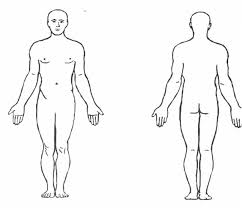
*right and left refer to "right" and "left" of the body in position.