wayground logo

Free Printable Worksheets

Font size

S
M
L
XL
Worksheets

Nuclear chemistry + coordination compounds

Total questions: 103

Worksheet time: 1hrs 7mins

Name
Class
Date
1.

Which one of the following would be most likely to undergo thermonuclear fusion?(a) 2H(b) 4He(c) 56Fe(d) 141Ba

a)

 2H

b)

 4He

c)

56Fe

d)

 141Ba

2.

Which one of the following statements about nuclear reactions is false?

a)

Particles within the nucleus are involved

b)

No new elements can be produced

c)

Rate of reaction is independent of the presence of a catalyst

d)

Rate of reaction is independent of temperature

3.

Which one of the following would be most likely to undergo thermonuclear fusion?

a)

2H

b)

4He

c)

56Fe

d)

141Ba

4.

The "magic numbers" for atoms are

a)

numbers of electrons that confer atomic stability

b)

numbers of protons and/or neutrons that confer nuclear stability

c)

atomic masses that indicate fissile isotopes.

d)

atomic masses that confer nuclear stability.

5.

A Geiger counter registered 1000 counts/second from a sample that contained a radioactive isotope of polonium. After 5.0 minutes, the counter registered 281 counts/second. What is the half-life of this isotope in seconds?

a)

87

b)

110

c)

164

d)

264

6.

How old is a bottle of wine if the tritium (3H) content (called activity) is 25% that of a new wine? The half-life of tritium is 12.5 years.

a)

1/4 years

b)

50 years

c)

25 years

d)

3.1 years

7.

The actual mass of a 37Cl atom is 36.966 amu. Calculate the mass defect (amu/atom) for a 37Cl atom.

a)

0.623 amu

b)

0.341 amu

c)

0.388 amu

d)

None of these

8.

Which isotope below has the highest nuclear binding energy per gram? No calculation is necessary.

a)

4He

b)

32S

c)

55Mn

d)

16O

9.

A positron has a mass number of _____, a charge of _____, and a mass equal to that of a(an) _____

a)

) 0, 1+, proton

b)

1, 2+, proton

c)

0, 1+, electron

d)

None of these

10.

In K4[Fe(CN)6], Fe is in the form of

a)

An atom

b)

 Neutral complex

c)

Cationic complex        

d)

Anionic complex

11.

In the complex [SbF5]2–, sp3d hybridisation is present. Geometry of the complex is

a)

Square pyramidal

b)

Square bipyramidal

c)

 Tetrahedral

d)

Square planar

12.

High spin complexes having coordination number ‘ 6 ’ are usually formed through

a)

sp3d2 hybridisation

b)

d2sp3 hybridisation

c)

sp3d hybridisation

d)

sp3 hybridisation

13.

The metal carbonyl which is paramagnetic is

a)

Ni(CO)4

b)

V(CO)6

c)

Cr(CO)6

d)

Fe(CO)5

14.

The strong field ligand is

a)

SCN

b)

I

c)

S2–

d)

NO2-

15.

The species having tetrahedral shape is

a)

[Pd(Cl)4]2–

b)

[Ni(CN)4]2–

c)

[Pd(CN)4]2–

d)

[Ni(Cl)4]2–

16.

The crystal field stabilization energy (CFSE) in [Co(SCN)6 ]3– is

a)

0

b)

4

c)

24

d)

18

17.

The orbitals of iron involved in the hybrdization in Fe(CO)5 are

a)

s, px, py, pz and

dx2 -y2

b)

s, px, py, dx2 -y2 and

dz2

c)

s, px, py, pz and

dz2

d)

s, px, pz, dxy and

dx2 -y2

18.

dsp2 hybridization represents

a)

octahedral geometry

b)

square-planar geometry

c)

 trigonal-bipyramidal geometry

d)

square-pyramidal geometry

19.

[NiCl4]2– is paramagnetic and therefore its geometry is

a)

pyramidal

b)

bi-pyramidal

c)

tetrahedral

d)

square planar

20.

Alpha particles contain ____________.

a)

two protons and two electrons

b)

two electrons and two neutrons

c)

four electrons

d)

two protons and two neutrons

21.

Radioactivity can be harmful and cause disease because it affects __________.

a)

air

b)

water

c)

cells

d)

blood

22.

Gamma rays _________.

a)

have no mass and no charge

b)

have mass but no charge

c)

have no mass but have charge

d)

have both mass and charge

23.

During nuclear fission, a nucleus _________.

a)

grows

b)

divides

c)

shrinks

d)

combines with another

24.

What is the term for an ongoing series of nuclear reactions?

a)

fission

b)

chain reaction

c)

fusion

d)

nuclear

25.

When a neutron turns into a proton in a nucleus, what sort of particle is emitted?

a)

Alpha

b)

Beta

c)

Gamma

d)

Photon

26.

What are found in the nucleus of an atom?

a)

protons and electrons

b)

electrons and neutrons

c)

protons, neutrons, and electrons

d)

protons and neutrons

27.

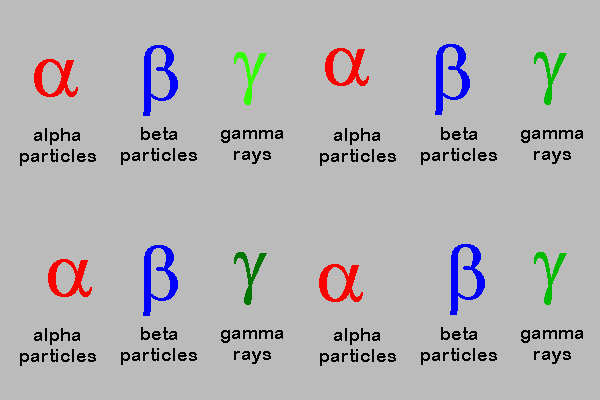
The image represents a/an _________.

a)

Alpha Particles

b)

Beta Particles

c)

Gamma Rays

d)

Photons

28.

The image represents a/an _________.

a)

Alpha Particle

b)

Beta Particle

c)

Gamma Ray

d)

Photon

29.

The image represents a/an ________.

a)

Alpha Particles

b)

Beta Particles

c)

Gamma Ray

d)

Photons

30.

An Alpha particle has a ______ charge.

a)

None

b)

+2

c)

-1

31.

Gamma Rays have ______ charge.

a)

None

b)

+2

c)

+1

32.

________ occurs when a neutron strikes a nucleus.

a)

Nuclear

Fission

b)

Nuclear

Fusion

33.

__________ occurs when two nuclei combine to form another nucleus.

a)

Nuclear Fission

b)

Nuclear Fusion

34.
The time taken for half of an amount of radioactive atoms to decay.
a)
Nuclear fusion
b)
Full-life
c)
Dead time
d)
Half-life
35.
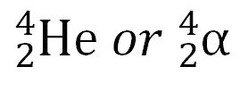
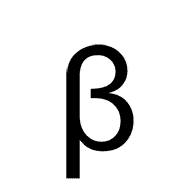
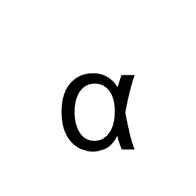
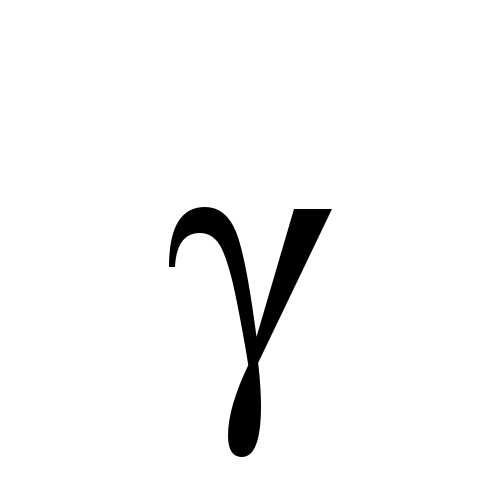
What do these symbols represent?
a)
alpha particle
b)
beta particle
c)
neutron
d)
gamma ray
36.
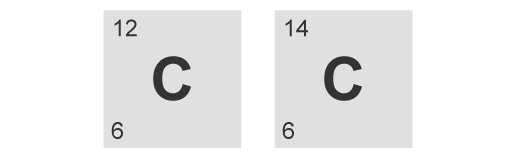
How are these isotopes different?
a)
Different atomic numbers
b)
Different number of protons
c)
Different number of neutrons
d)
Different number of electrons
37.
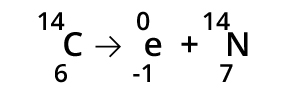
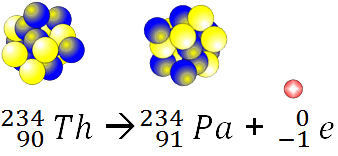
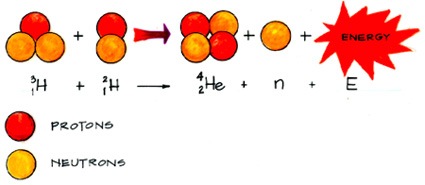
What type of nuclear equation is this?
a)
fusion
b)
fission
c)
alpha
d)
beta
38.
What happens to the atomic number during alpha decay?
a)
The atomic number decreases by 4
b)
The atomic number increases by 1
c)
The atomic number decreases by 2.
d)
The atomic number stays the same.
39.
The technetium-99 isotope has a half-life of 6.0 hours. If 100.0 mg were injected into a patient how much remains after 18 hours?
a)
33.0 mg
b)
12.5 mg
c)
.33 mg
d)
15.8 mg
40.
Balance the following equation:
146C --> 0-1e + ________
a)
145B
b)
146C
c)
147N
d)
42He
41.
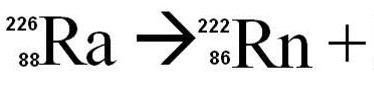
Complete the nuclear equation and determine the type of decay that is occurring in this reaction. 
a)
alpha
b)
beta
c)
gamma
d)
none
42.
Barium-122 has a half-life of 2 minutes. A fresh sample weighing 80 g was obtained. If it takes 10 minutes to set up an experiment using barium-122, how much barium-122 will be left when the experiment begins?
a)
0.25g
b)
2.5g
c)
25g
d)
80g
43.
What does it mean when an element is radioactive?
a)
atom emits radiation
b)
nucei unstable due to uneven p to n ratio
c)
nuclei changes to become stable
d)
all of the above
44.
What is the missing isotope that will balance the following nuclear equation?
94Be  +  11H →  _____  +  42He
a)
105B
b)
105Ne
c)
63Li
d)
63C
45.
If Thorium-234 undergoes a beta decay, What element will be left in its place?
a)
Actinium-234
b)
Thorium-233
c)
Protactinium-234
d)
Radium-230
46.

When the isotope 5024X releases an alpha particle we get another element Y that looks like

a)

5022Y

b)

4622Y

c)

4820Y

d)

5426Y

47.

When the isotope 5024X releases a beta particle we get another element, Y, that looks like

a)

5023Y

b)

4622Y

c)

5025Y

d)

5024Y

48.

What is meant by the statement that 3215P has a half life of 14 days

a)

It takes 7 days to go down to 50% radioactivity each time

b)

It takes 14 days to lose 50% of its current isotope

c)

After 14 days it starts to become less radioactive

d)

It takes 14 days to go up by 50% radioactivity each time
49.

In order of most to least penetrating radiation we have

a)

Alpha , Beta, Gamma

b)

Beta , Gamma , Alpha

c)

Gamma, Beta, Alpha

d)

Gamma, Alpha, Beta

50.
The half life of Thorium-234 is 24 days. What fraction of the element remains after 96 days
a)
1/2
b)
1/4
c)
1/8
d)
1/16
51.
Which type of nuclear radiation is being emitted here?
a)
Alpha
b)
beta
c)
gamma 
d)
none
52.
Has the symbol
a)
Alpha
b)
Beta
c)
Gamma
53.
Has the symbol
a)
Alpha
b)
Beta
c)
Gamma
54.
Has the symbol
a)
Alpha
b)
Beta 
c)
Gamma
55.

Which type of radioactive decay gives off energy only (no particles)?

a)

alpha

b)

beta

c)

gamma

56.

Complete the nuclear equation and determine the type of decay that is occurring in this reaction.

a)

alpha, 42He

b)

beta, 0-1e

c)

gamma

d)

none

57.
The time taken for half of an amount of radioactive atoms to decay.
a)
Nuclear fusion
b)
Full-life
c)
Dead time
d)
Half-life
58.
Gamma rays have a _____ charge
a)
0
b)
+1
c)
-1
d)
+2
59.
Alpha particles have a _____ charge.
a)
+2
b)
0
c)
+1
d)
-1
60.
The technetium-99 isotope has a half-life of 6.0 hours. If 100.0 mg were injected into a patient how much remains after 18 hours?
a)
33.0 mg
b)
12.5 mg
c)
.33 mg
d)
15.8 mg
61.

Beta particles have a _____ charge.

a)

+2

b)

0

c)

+1

d)

-1

62.

Which type of radiation can be found on the electromagnetic spectrum?

a)

alpha

b)

beta

c)

gamma

63.
What would two different isotopes of an atom have in common?
a)
Number of neutrons 
b)
Number of protons
c)
Atomic weight 
d)
Atomic mass
64.
What happens when the number of protons in an atom changes? 
a)
The number of electrons changes too 
b)
Usually nothing happens, unless the atom is radioactive 
c)
The atomic nucleus explodes
d)
It becomes a completely different atom, with different properties 
65.
What element is the ?
a)
Ag-115
b)
Cd-115
c)
Pd-115
d)
Not Listed
66.
This is an example of...
a)
Fission  reaction
b)
Fusion reaction
c)
Decomposition reaction
d)
Combustion
67.
If a sulfur atom has 16 protons, 16 electrons, and 16 neutrons, its atomic mass is:
a)
16
b)
32
c)
48
d)
64
68.

The central metal ion of K4[Fe(CN)6]

a)

Fe+

b)

Fe2+

c)

Fe3+

d)

Fe4+

69.

The coordination entity of K2[NiCl4]

a)

NiCl4

b)

K2[NiCl4

c)

[NiCl4]2-

d)

Ni2+

70.

In the complex [Co(NH3)5Cl]Cl, the coordination number is

a)

3

b)

5

c)

6

d)

4

71.

Which one is a cationic complex?

a)

K3[Fe(CN)6]

b)

Na2[Ni(EDTA)]

c)

[Co(en)2Cl2]Cl

d)

K3[Fe(CN)5NO]

72.

Pick out the odd one out.

a)

CN-

b)

Cl-

c)

SO42-

d)

C2O42-

73.

Which one is an anionic complex?

a)

K[Ag(CN)2]

b)

[Ag(NH3)2]Cl

c)

[Ni(CO)4]

d)

[Co(NH3)6]Cl3

74.

Which one is a neutral ligand?

a)

H2O

b)

NH3

c)

CO

d)

All of these

75.

Which formula is correct for this complex ion: Sodium hexacyanoferrate(III)?

a)

S4[Fe(CN)6]

b)

Na2[Fe(CN6)6]

c)

Na3[Fe(CN)6]

d)

Na4[Fe(CN)5]

76.

Co-ordination number can be defined as

a)

Ring forming ligands

b)

Number of monodentate ligands linked to central atom

c)

Ligands capable of accepting π-e- density

d)

Ligand & central metal ion kept in square bracket

77.

Complexes having bidentate ligands are known as

a)

co-ordination sphere

b)

chelates

c)

central metal atom or ion

d)

complex ion

78.
Which process produces alpha particles?
a)
Alpha decay
b)
Beta decay
c)
Gamma decay
d)
Nuclear fusion
79.
Which process produces beta particles?
a)
Alpha decay
b)
Beta decay
c)
Gamma decay
d)
Nuclear fusion
80.
Which process involves the joining of small nuclei?
a)
Beta decay
b)
Alpha decay
c)
Nuclear fission
d)
Nuclear fusion
81.
Which process involves the splitting of large nuclei?
a)
Beta decay
b)
Alpha decay
c)
Nuclear fission
d)
Nuclear fusion
82.
The nuclear process occurring at a nuclear power plant.
a)
Nuclear fusion
b)
Nuclear fission
c)
Combustion
d)
Multiplication
83.
Arrange in order of increasing ability to penetrate matter.
a)
Beta, gamma, alpha
b)
Alpha, gamma, beta
c)
Gamma, beta, alpha
d)
Alpha, beta, gamma
84.
Classify this process.
a)
Nuclear fission
b)
Nuclear fusion
c)
Alpha decay
d)
Beta decay
85.
What do these symbols represent?
a)
alpha particle
b)
beta particle
c)
neutron
d)
gamma ray
86.
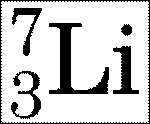
How many protons are in this atom?
a)
3
b)
4
c)
6
d)
10
87.
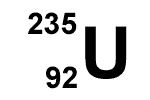
How many neutrons are in this isotope of Uranium?
a)
235
b)
92
c)
327
d)
143
88.
How are these isotopes different?
a)
Different atomic numbers
b)
Different number of protons
c)
Different number of neutrons
d)
Different number of electrons
89.
What is one problem with using nuclear fission as an energy source?
a)
finding radioactive elements that have longer half-lives
b)
finding ways of storing radioactive wastes
c)
finding compounds to cool heated water
d)
finding non-radioactive elements for reactors
90.
In a neutral atom, the number of protons always equals
a)
the number of neutrons.
b)
the number of electrons.
c)
the mass number.
d)
the average atomic mass.
91.
Why does an atom undergo beta decay?
a)
It has too many electrons.
b)
It has an atomic number greater than 83
c)
It has more neutrons than protons
d)
It has more protons than neutrons
92.
What happens to the atomic number during alpha decay?
a)
The atomic number decreases by 4
b)
The atomic number increases by 1
c)
The atomic number decreases by 2.
d)
The atomic number stays the same.
93.
The time taken for half of an amount of radioactive atoms to decay.
a)
Nuclear fusion
b)
Full-life
c)
Dead time
d)
Half-life
94.
Which type of nuclear radiation is being emitted here?
a)
Alpha
b)
beta
c)
gamma 
d)
none
95.
Has the symbol
a)
Alpha
b)
Beta
c)
Gamma
96.
Has the symbol
a)
Alpha
b)
Beta
c)
Gamma
97.

1. The donor sites of (EDTA)4- are ?

a)

O atoms only

b)

N atoms only

c)

Two N and four O atoms

d)

Three N and three O atoms

98.

The IUPAC name of the compound [Cu (NH3)4](NO3)2 is :

a)

Cuprammonium nitrate

b)

Tetraammine copper (II) dinitrate

c)

Tetraammine copper (II) nitrate

d)

Tetraammine copper (III) dinitrate

99.

EAN (Effective Atomic Number) of a metal carbonyl M(CO)x is 36. If atomic number of metal M is 26, what is the value of x ?

a)

4

b)

8

c)

5

d)

6

100.

Co-ordination compounds have great importance in biological systems. In this context, which statement is incorrect ?

a)

Carboxypeptidase A is an enzyme and contains zinc

b)

Haemoglobin is the red pigment of blood and contains iron

c)

Cyanocobalmin is B-12 and contains cobalt

d)

Chlorophylls are green pigments in plants and contain calcium

101.
Has the symbol
a)
Alpha
b)
Beta 
c)
Gamma
102.

Which type of radioactive decay gives off energy only (no particles)?

a)

alpha

b)

beta

c)

gamma

103.

In the symbol 167N what the 7 stand for?

a)

Mass number

b)

Atomic number

c)

Atomic mass

d)

Number of neutrons