wayground logo

Free Printable Worksheets

NEW

Font size

S
M
L
XL
Worksheets

25.1 Nuclear Decay Particles

Total questions: 41

Worksheet time: 20mins

Name
Class
Date
1.

What type of decay does this symbol represent?

a)

beta decay

b)

alpha decay

c)

fission

d)

fusion

2.

What type of decay does this symbol represent?

a)

beta decay

b)

alpha decay

c)

gamma decay

d)

fusion

3.

The bottom number in alpha decay tells you the _____________ of the element.

a)

identity

b)

mass

c)

mass number

d)

symbol

4.
What is emitted during Alpha Radiation?
a)
A helium nuclei.
b)
A helium atom
c)
Gamma Rays.
d)
Positrons
5.

In alpha decay when the top number decreases by 4, what are you actually losing?

a)

2 protons & 2 neutrons

b)

4 protons

c)

2 protons & 2 electrons

d)

2 electrons & 2 neutrons

6.
The type of radioactive particle that can be stopped by a sheet of paper is the ____.
a)
alpha particle
b)
beta particle
c)
gamma ray
d)
uranium
7.
Negatively charged particles emitted from a nucleus at a high speed are ____.  
a)
alpha particle
b)
gamma rays
c)
beta particles
d)
X rays
8.

Gamma rays _________.

a)

have no mass and no charge

b)

have mass but no charge

c)

have no mass but have charge

d)

have mass and charge

9.

What in the name for the original, unstable isotope before decay

a)

Parent isotope

b)

Father isotope

c)

Daughter isotope

d)

Son Isotope

10.

What is the name for the final, more stable isotope following decay

a)

Parent isotope

b)

Father isotope

c)

Daughter isotope

d)

Son Isotope

11.
In a correctly written symbol what would be located in the "A" position?
a)
number of neutrons
b)
atomic number
c)
number of electrons 
d)
mass number
12.

In a correctly written symbol what would be located in the "Z" position?

a)

number of neutrons

b)

atomic number

c)

number of electrons

d)

mass number

13.
Radioactive materials have unstable...
a)
electrons
b)
protons
c)
nuclei
d)
neutrons
14.
A helium nucleus with two protons and two neutrons is called a(n) ____.  
a)
alpha particle
b)
electroscope
c)
beta particle
d)
gamma ray
15.
The most penetrating type of radiation is the ____.  
a)
alpha particle
b)
gamma ray
c)
beta particle
d)
uranium
16.
Alpha particles.....
a)

are positively charged.

b)

consist of two protons and four neutrons.

c)

can penetrate any thickness of matter

d)

All of the above 

17.
The type of radioactive particle that can be stopped by a sheet of paper is the ____.
a)
alpha particle
b)
beta particle
c)
gamma ray
d)
uranium
18.
Negatively charged particles emitted from a nucleus at a high speed are ____.  
a)
alpha particle
b)
gamma rays
c)
beta particles
d)
X rays
19.

List the three types of nuclear radiation in increasing order of penetrating power.  

a)
  alpha, beta, gamma 
b)
X ray, beta, gamma
c)

gamma, beta, alpha

d)
X ray, gamma, beta 
20.

What nuclear decay reaction gives of extremely high energy waves?

a)

alpha

b)

beta

c)

gamma

21.

Gamma rays _________.

a)

have no mass and no charge

b)

have mass but no charge

c)

have no mass but have charge

d)

have mass and charge

22.
The process of nuclear change in an atom of radioactive material is called... 
a)
nuclear decay
b)
nuclear mass
c)
isotopes
d)
radon
23.
Radioactive materials have unstable...
a)
electrons
b)
protons
c)
nuclei
d)
neutrons
24.
A helium nucleus with two protons and two neutrons is called a(n) ____.  
a)
alpha particle
b)
electroscope
c)
beta particle
d)
gamma ray
25.
The most penetrating type of radiation is the ____.  
a)
alpha particle
b)
gamma ray
c)
beta particle
d)
uranium
26.
Alpha particles.....
a)
a) are positively charged.
b)
b) consist of two protons and four neutrons.
c)
c) can penetrate any thickness of matter
d)
d) All of the above 
27.
The process of nuclear change in an atom of radioactive material is called... 
a)
nuclear decay
b)
nuclear mass
c)
isotopes
d)
radon
28.
During beta decay, a nucleus .... 
a)
gives up two protons and two neutrons.
b)
  maintains the same number of protons and neutrons.
c)
  loses a proton and gains a neutron.
d)
gains a proton and loses a neutron. 
29.
When a nucleus undergoes nuclear decay by gamma rays, the atomic number of the element....
a)
remains the same
b)
  decreases by one.
c)
increases by one.
d)
increases by two.
30.
Radioactive materials have unstable...
a)
electrons
b)
protons
c)
nuclei
d)
neutrons
31.
The type of radioactive particle that can be stopped by a sheet of paper is the ____.
a)
alpha particle
b)
beta particle
c)
gamma ray
d)
uranium
32.
The most penetrating type of radiation is the ____.  
a)
alpha particle
b)
gamma ray
c)
beta particle
d)
uranium
33.
A helium nucleus with two protons and two neutrons is called a(n) ____.  
a)
alpha particle
b)
electroscope
c)
beta particle
d)
gamma ray
34.
Negatively charged particles emitted from a nucleus at a high speed are ____.  
a)
alpha particle
b)
gamma rays
c)
beta particles
d)
X rays
35.
The three types of nuclear radiation in increasing order of penetrating power are ____.  
a)
  alpha, beta, gamma 
b)
X ray, beta, gamma
c)
alpha, gamma, beta 
d)
X ray, gamma, beta 
36.

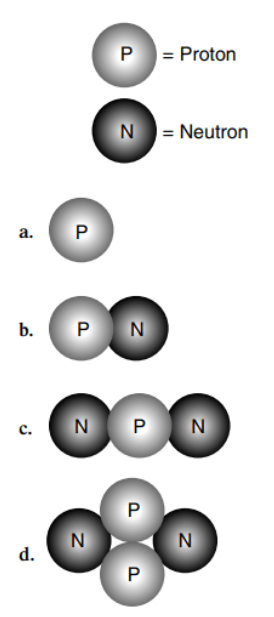
Which of these is an alpha particle?

a)

A

b)

B

c)

C

d)

D

37.

The mass number of a nucleus is equal to ______.

a)

the number of protons plus the number of neutrons

b)

the number of electrons

c)

the number of protons

d)

the number of neutrons

38.

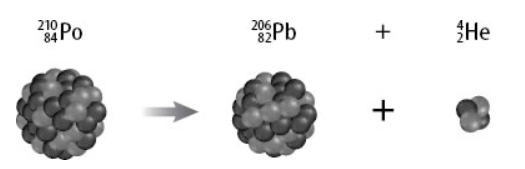
What type of nuclear decay is represented in this illustration?

a)

beta decay

b)

gamma radiation

c)

alpha decay

d)

nuclear fusion

39.

Which happens in a nucleus during gamma decay?

a)

The number of protons increases.

b)

The number of neutrons increases.

c)

The number of protons remains the same.

d)

The total number of neutrons plus neutrons decreases.

40.

When a neutron turns into a proton in a nucleus, what sort of particle is emitted?

a)

alpha

b)

beta

c)

gamma

d)

photon

41.

Gamma rays _________.

a)

have no mass and no charge

b)

have mass but no charge

c)

have no mass but have charge

d)

have mass and charge