
 Worksheets
Chemical Bonds
Total questions: 38
Worksheet time: 28mins
Which of the following describes covalent bonds?
Bonds form because of opposite charges
electrons are shared to fill outer electron shells
Electrons are transferred between atoms
Covalent bonds are magical

For representative elements (Groups 1A - 8A), the number of valence electrons is equal to
the group number
the period number
the atomic number
the group number minus 10
For metals (groups 1-3), its easier to _____ electrons to have a full outer shell.
gain
lose
share
For nonmetals (grousp 5-7), its easier to _____ electrons to have a full outer shell.
gain
lose
share

The octet rules states that most elements want to have _____ valence electrons.
2
4
6
8
Why do elements bond?
To be friends
To create a new element
To become stable
To get bigger
Which of the following describes covalent bonds?
Bonds form because of opposite charges
electrons are shared to fill outer electron shells
Electrons are transferred between atoms
Covalent bonds are magical

How many valence electrons does Oxygen (O) have?
6
8
15
16
For nonmetals (grousp 5-7), its easier to _____ electrons to have a full outer shell.
gain
lose
share
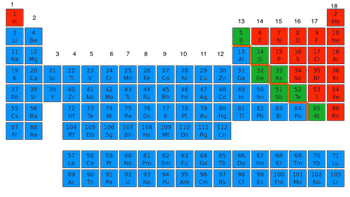

The general electron dot structure :X: could represent
B
Si
Li
F

An atom of Neon complies with the Octet Rule because it has ___ electrons in its outer shell.
10
8
2
7

What type of diagram is this?
Lewis Dot Structure Diagram
Bohr Model
Alkali Diagram
Chemical Diagram


Which of the following is true about Ionic Bonds? (select ALL TRUE options)
High melting point
Low melting point
Can dissolve in water
Cannot dissolve in water
Can conduct electricity
Which of the following is true about Covalent (non-polar) bonds? (select ALL true options)
High melting point
Low melting point
Can dissolve in water
Cannot dissolve in water
Can conduct electricity
THE ANSWER IS A
A
B
C
D
How many dogs does Ms. Mac have?
3
5
4
6
What does the subscript following the element in a chemical formula indicate?
The compound is balanced
The charge
The amount of atoms of the previous element
The amount of atoms of the next element
What is a subscript?
A number that indicates how many atoms of a given element within a chemical formula
Sub who?
The charge on a cation
The charge on an anion
What is the smallest particle in an ionic compound?
Positive
Nucleus
Ions
two or more non metals
What technique is used to balance chemical formulas?
PEMDAS
ending non metal with -ide
pythagorean theorem
criss cross
How are ionic compounds named?
name of non metal and non metal
name of metal and non metal
name of metal (roman numerals if it is a transition) and non metal suffix -ide
name anion, then cation with suffix -ide

